Navigating the New Social Split: Why Threads and Bluesky Matter in 2026
You open your phone, stare at your latest draft, and sigh. Twitter feels like a ghost town one day and a battlefield the next. Threads feels like a massive corporate cocktail party where everyone is trying just a little too hard. Bluesky feels like an indie basement show where you don't quite know the unwritten rules yet. You are exhausted. Trying to figure out how to post on Threads and Bluesky without completely losing your mind is the defining creator struggle of 2025.
Jump to a section:
- Navigating the New Social Split: Why Threads and Bluesky Matter in 2026
- Quick Answer: How to Post on Threads and Bluesky
- Why Building an Audience Across Fragmented Platforms Is So Hard
- Strategy 1: Align Your Content Vibe with the Platform's DNA
- Strategy 2: The 'Smart Cross-Post' Framework
- Strategy 3: Optimize for the 'Reply Graph' First
- Strategy 4: Master Custom Feeds and Quote Posts
- Strategy 5: Format Links and Visuals for Maximum Reach
- Why Most Brands Still Get Bad Results (Common Mistakes)
- Real Examples: Before & After Platform Adaptation
- The Secret to Multi-Platform Growth? Algorithmic Consistency
- Your 2025 Posting Checklist for Threads & Bluesky
- Frequently Asked Questions
- Final Thoughts: Secure Your First-Mover Advantage
Most creators just copy and paste the exact same text across all three apps.
That is exactly why their reach is dying.
Ignoring these new platforms means leaving serious money, audience share, and brand equity on the table. But treating them like glorified dumping grounds for your old tweets is even worse. I see creators burning out daily because they fight the specific culture of each app instead of aligning with its inherent mechanics. If you want to stop wasting time, you might need to rethink your approach entirely, much like figuring out how to save 15+ hours every week on social media by building actual systems.
Ready to save 15+ hours every week?
Join other creators who've automated their social media with SocialCal.
Get started freeLook, you don't need to double your workload. You just need to understand the behavioral loop driving each platform. Let's break down the mechanics of what actually works right now.
Quick Answer: How to Post on Threads and Bluesky
What is how to post on Threads and Bluesky? How to post on Threads and Bluesky effectively requires drafting one core message, then adjusting its tone and format for two entirely different systems. Format Threads posts for broad appeal and visual engagement to trigger Meta's algorithmic feed. Format Bluesky posts as raw, frequent, text-heavy updates optimized for chronological timelines and community-built custom feeds.
Why Building an Audience Across Fragmented Platforms Is So Hard
Let's talk about behavioral reasoning. Why does the copy-paste method fail so spectacularly? Because you are ignoring the user habit loop.
Think about why someone opens Threads. They are usually tapping over from Instagram. They are in a visual, entertainment-first mindset. Meta's algorithm is built on an engagement graph, meaning it measures early engagement velocity. If your post gets a few quick replies and holds attention, Meta pushes it to the "For You" feeds of thousands of strangers who don't follow you.
Bluesky is fundamentally different. Users open Bluesky to see what their specific, curated community is talking about right now. It is primarily chronological. There is no omnipotent algorithm deciding what goes viral based on dwell time. It relies heavily on community signaling.
If you drop a highly polished, formatted B2B marketing hook onto Bluesky, you look like a corporate suit handing out business cards at a skate park. They will ignore you. If you drop a raw, unformatted, niche technical thought onto Threads without an engaging hook or image, Meta's algorithm sees low initial dwell time and buries it immediately.
People struggle because they write for the message, not the medium.
Strategy 1: Align Your Content Vibe with the Platform's DNA
Tone dictates algorithmic reach. It is that simple.
You can have the most valuable insight in your industry, but if you package it wrong, nobody sees it. The algorithm is not judging your intelligence. It is judging how users physically interact with your text on the screen.
Threads: The 'Casual Authority' Approach
Meta's graph rewards "Casual Authority." This means you need to sound like an expert who happens to be chatting at a coffee shop, not a professor giving a lecture.
The algorithm heavily favors engaging, visually appealing conversation. Broad-appeal topics perform incredibly well here because the system is designed to cross-pollinate audiences. You want to use strong opening hooks, clean line breaks, and ideally, an attached image or carousel. Meta wants users to linger on the post.
Actionable step: Take your rigid industry insight and rewrite the first line as a personal observation. Instead of "B2B sales strategies for Q3," write "I just reviewed 50 sales calls from last month, and almost everyone is making this one pricing mistake."
Bluesky: Mastering Chronological Authenticity
Bluesky is community-driven. Authenticity is the primary currency here.
Because the main feed is chronological, high-frequency, slightly unpolished text posts perform vastly better. You don't need to stress over the perfect hook. You just need to share your active thoughts, works in progress, and raw reactions to industry news. The community values transparency over polish.
To gain initial traction, you need to be included in "Starter Packs"—user-curated lists of accounts to follow for specific niches. You get into these packs by replying genuinely to established voices in your niche, not by broadcasting polished thought leadership.
Strategy 2: The 'Smart Cross-Post' Framework
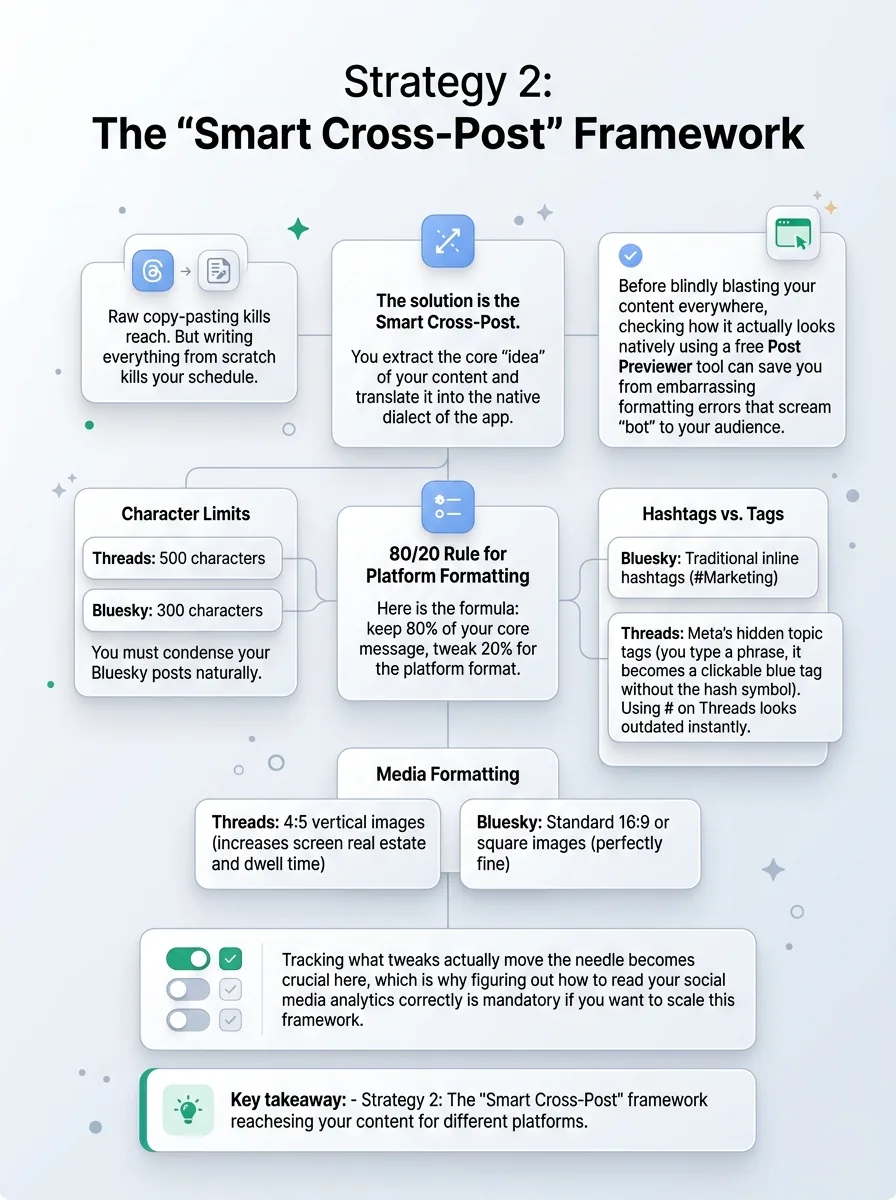
Raw copy-pasting kills reach. But writing everything from scratch kills your schedule.
The solution is the Smart Cross-Post. You extract the core "idea" of your content and translate it into the native dialect of the app. Before blindly blasting your content everywhere, checking how it actually looks natively using a free Post Previewer tool can save you from embarrassing formatting errors that scream "bot" to your audience.
The 80/20 Rule for Platform Formatting
Here is the formula: keep 80% of your core message, tweak 20% for the platform format.
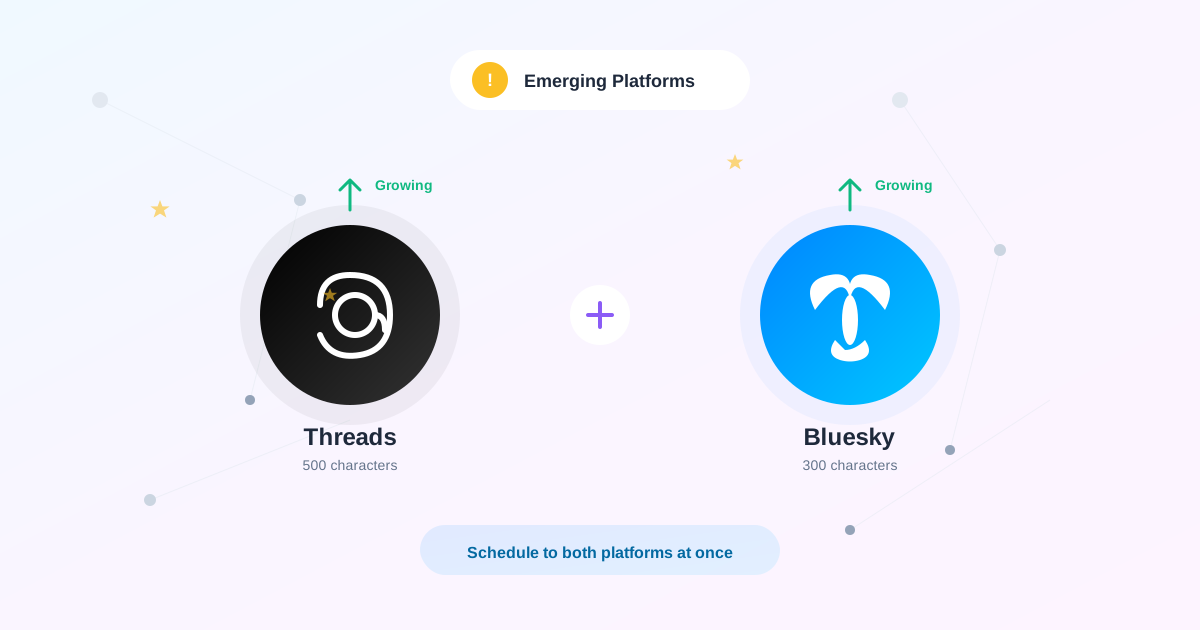
Character Limits: Threads gives you 500 characters. Bluesky gives you 300. You must condense your Bluesky posts naturally.
Hashtags vs. Tags: Bluesky uses traditional inline hashtags (#Marketing). Threads uses Meta's hidden topic tags (you type a phrase, and it becomes a clickable blue tag without the hash symbol). Using # on Threads looks outdated instantly.
Media Formatting: Threads loves 4:5 vertical images because it takes up more screen real estate, increasing dwell time. Bluesky handles standard 16:9 or square images perfectly fine.
Tracking what tweaks actually move the needle becomes crucial here, which is why figuring out how to read your social media analytics correctly is mandatory if you want to scale this framework.
Strategy 3: Optimize for the 'Reply Graph' First
Both platforms currently weigh replies significantly heavier than likes or reposts.
This is basic community signaling. A like takes a millisecond. A repost takes two seconds. A reply requires cognitive effort, typing, and a willingness to engage in dialogue. Algorithms and chronological communities both view replies as the highest form of content validation.
If you end your posts with definitive, closed statements, you kill the conversation. "And that is why SEO is dead." Period. End of thought. Nobody has anything to add to that except "I agree" or "You are wrong."
Instead, end with perspective-shifting questions. "I'm seeing AI search engines throttle organic traffic by 20% this month. What are you seeing in your client analytics right now?" This invites experts to share their data, building a massive reply graph under your post.
This focus on deep conversation rather than pure output volume is highly similar to the mechanics behind the secret to Instagram growth without posting daily. Engagement depth always beats publishing frequency.
Strategy 4: Master Custom Feeds and Quote Posts
Visibility on these platforms requires technical strategy.
Bluesky operates on a system of custom feeds (often called Skyfeeds). Users can subscribe to feeds built by other users based on regex code, keywords, or specific account lists. There are feeds for "Tech News," "Designers," "Writers," and thousands of niche topics. To optimize for Bluesky, you need to naturally include the exact keywords those custom feeds scrape for. If a feed pulls posts containing the words "SaaS marketing," make sure those exact words are in your post, not just vague industry terms.
Threads operates differently. It relies heavily on the central algorithmic "For You" page. The fastest way to get pulled onto that page is by quote-posting trending industry news or viral posts from larger accounts. When you quote-post a highly active thread and add a genuinely insightful comment, Meta's algorithm piggybacks your post onto the reach of the original.
Strategy 5: Format Links and Visuals for Maximum Reach
Let's talk about the 2025 reality of link penalties.
Algorithms throttle outbound links. Period. Why? Because an outbound link takes the user off the app, which means the platform can no longer serve them ads. The mechanistic result is that your post's reach gets artificially capped the moment you include a "http" in the main body.
You have to bypass this.
Actionable step: Post your insight natively with a strong image or graphic. Do not include the link. In the first reply to your own post, drop the link and say "Link to the full breakdown here." Alternatively, you can quote-post your own link-less post an hour later, adding the link then. This secures your initial algorithmic distribution before you introduce the off-platform exit.
Why Most Brands Still Get Bad Results (Common Mistakes)
I audit creator accounts every week. The patterns of failure are incredibly consistent. Here is why most people still get terrible reach on text platforms.
Mistake 1: Treating Them Exactly Like 'Old Twitter'
Bringing outdated 2018 tactics to 2025 platforms is a death sentence. The "broetry" format (single sentences spaced out over 20 lines) is actively mocked on Bluesky and suppressed on Threads. Hyper-combative, negative engagement bait might have worked on Twitter, but both Threads and Bluesky have built-in community moderation and algorithmic penalties for toxicity. If you constantly pick fights, your account gets shadow-limited.
Mistake 2: Ghost-Posting Without Community Engagement
This is the most common sin. You schedule a post, it goes live, and you don't open the app for three days. You are a ghost.
Algorithms penalize "drop and run" behavior. The system needs to see that you are an active node in the network. You must spend 10 minutes replying to other people's content before you post, and 10 minutes replying to comments after you post. This warms up your account's social graph and signals to the algorithm that you are a real user contributing to the ecosystem.
A lot of people blame their scheduling tools for low reach, but usually, it's just this ghosting behavior. It's a common misconception we see when creators ask does scheduling Instagram posts reduce reach—the tool isn't the problem, the lack of human presence around the posting time is.
Real Examples: Before & After Platform Adaptation
Let's look at exactly how this works in practice.
Case Study: Adapting a SaaS Product Update
The Generic B2B Post (Fails everywhere):
"We are excited to announce Version 2.0 of our analytics software. We have added new custom reporting features and faster load times. Click the link below to read the release notes and upgrade today! #SaaS #Update"
The Threads Version (Casual Authority):
"Building analytics software is exhausting 😅 For the last 6 months, our team has been completely rebuilding our reporting engine from scratch. Today, V2 is finally live. The biggest lesson? Users don't want more data. They want faster answers. Here are 3 things we changed about our UI to make that happen: [Thread continues with visual carousel]"
The Bluesky Version (Chronological Authenticity):
"Finally shipped V2 of the analytics dashboard today. The backend migration was a nightmare, but we managed to cut query load times by almost 40%. Huge shoutout to the dev team for surviving this sprint. Drop a reply if you want a test invite, I'll send some codes over in DMs."
Notice the difference? The core message (we launched a software update) is identical. The packaging is completely native to the culture of the specific app.
The Secret to Multi-Platform Growth? Algorithmic Consistency
Here is what nobody tells you about social media growth.
Algorithms need predictable data to build your audience graph. If you post three times one week, disappear for a month, and then post ten times in two days, the algorithm doesn't know who to show your content to. It loses the signal.
The real issue isn't knowing how to post on Threads and Bluesky. It's doing it consistently without burning out. You have a business to run, videos to edit, and a life to live. Manually logging into four different apps every morning to carefully format text posts is completely unsustainable.
This is where smart systems come in. You need a centralized dashboard to write your core idea once, tweak the formats per platform, and automate the distribution. Tools like SocialCal provide a dedicated Threads Scheduler and Bluesky Scheduler that let you manage this entire workflow from one screen. You compose the post, let the system handle the native API formatting, and maintain the daily consistency the algorithms demand.
Choosing the right hub for this workflow is a big decision, so if you are still manually juggling browser tabs, it is probably time to look at a Buffer vs. Hootsuite vs. Later vs. SocialCal comparison to see how modern creators are actually operating.
Your 2025 Posting Checklist for Threads & Bluesky
Screenshot this. Follow it every time you sit down to write.
Define the Core Idea: What is the single takeaway you want the reader to have?
Format for Threads (The Hook): Rewrite the opening to be conversational, visually engaging, and highly relatable. Use hidden topic tags.
Format for Bluesky (The Raw Thought): Strip away the marketing polish. Speak directly to your niche peers. Use inline hashtags if necessary.
Schedule Native Variations: Load the distinct versions into your scheduling tool to maintain consistency.
Warm the Graph: Spend 10 minutes leaving genuine replies on other people's posts right before your content goes live.
Ready to save 15+ hours every week?
Join other creators who've automated their social media with SocialCal.
Get started freeFrequently Asked Questions
Can you auto-post to Threads and Bluesky?
Yes. Both platforms now have open APIs that allow for third-party scheduling. You can use professional social media management tools to schedule and auto-post content, images, and threads to both platforms without manual intervention.
Do hashtags work the same way on both apps?
No. Bluesky uses traditional inline hashtags (e.g., #SEO) that power chronological search and custom feeds. Threads uses a unique topic tag system where you type a phrase, tap a button, and it becomes a clickable blue link without the hash symbol.
Which platform has better organic reach in 2025?
It depends on your audience. Threads has a massive, mainstream algorithm that can make a post go viral to millions of strangers. Bluesky has a smaller, highly engaged, chronological user base that offers better reach for deep niche, tech, and creative communities.
Should I post the exact same time on both platforms?
Not necessarily. Threads peaks during standard entertainment scrolling hours (evenings and weekends). Bluesky tends to have high engagement during workday hours as users check in on industry news and community updates.
Final Thoughts: Secure Your First-Mover Advantage
The creator landscape is fracturing, but that fragmentation is an opportunity. Most of your competitors are too lazy to adapt. They will keep copying and pasting their way into irrelevance.
Growth isn't about finding the perfect hack. It's about adapting to the environment and maintaining consistency. Stop fighting the native culture of these platforms and start building a system that works for you. By using SocialCal to handle the heavy lifting of scheduling and multi-platform formatting, you can finally focus on what actually matters—writing great content that connects with real people.