
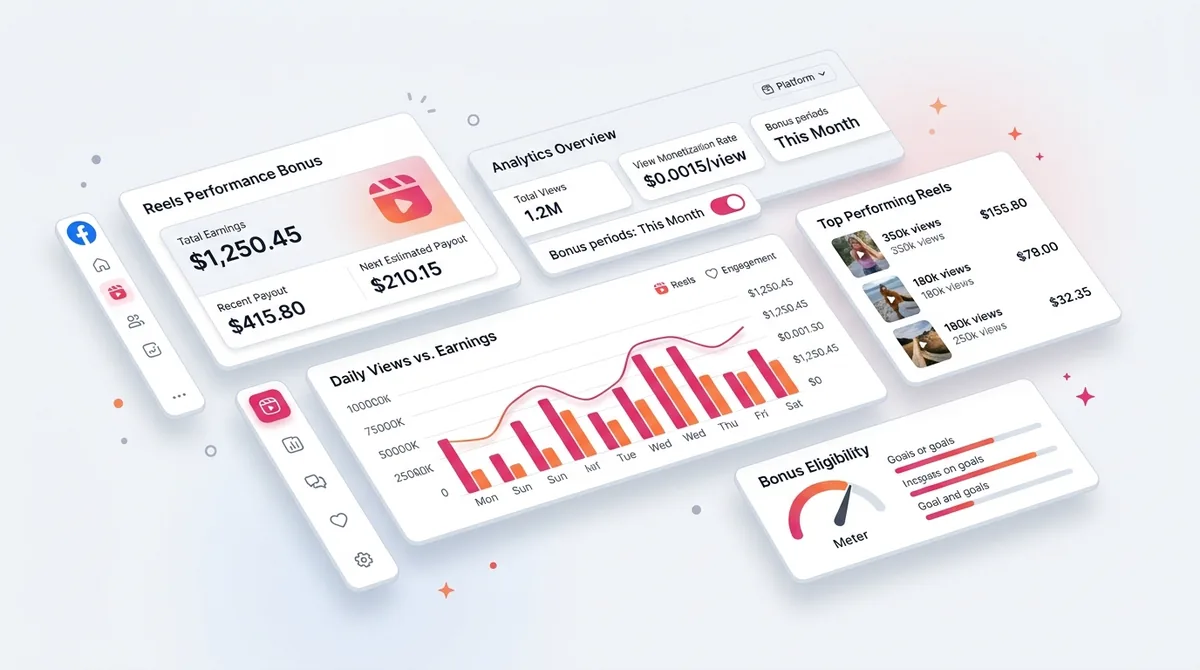
Facebook’s Reels payouts are chaos if you’re trying to Google your way through it. You search “how much does Facebook pay for views”, find a bunch of screenshots from 2021, and walk away thinking you’re about to make $35K a month from short clips.
Jump to a section:
- How much does Facebook pay for 1,000 Reels views?
- Why Facebook Reels payouts confuse even active creators
- A short history of Facebook Reels monetization
- How much does Facebook pay for views under the Performance Bonus?
- How to qualify for the Performance Bonus Program
- Beyond per-view payments — where Reels income actually scales
- Mistakes that block your Reels earnings
- Facebook Reels vs Instagram Reels vs YouTube Shorts vs TikTok
- Cross-posting Reels to maximize total per-video earnings
- Quick framework: Estimate your Reels monthly income
- Frequently asked questions about Facebook Reels payouts
- The principle: per-view payouts are the floor, not the ceiling
You’re not. That program is dead.
Here’s the real 2026 picture: Facebook’s Reels monetization has changed three times in three years — Reels Play Bonus in 2021, the Performance Bonus Program in 2023, and an expanded version in 2025. Each pays differently. Most articles still explain a program that no longer exists, which is why creators are constantly confused and miscalculating their earnings.
How much does Facebook pay for 1,000 Reels views?
If you just want the quick math: Facebook currently pays Reels creators through the Performance Bonus Program at roughly $0.01–0.05 per 1,000 views (about $10–50 per 1 million views). Rates are invitation-only, region-dependent, and heavily based on engagement quality. Top performers sometimes see higher effective rates. The original Reels Play Bonus (~$0.01 per view) was retired in 2023.
So if you’re trying to figure out how much does Facebook pay for views, that’s the honest ballpark. Not the fantasy numbers from 2021 screenshots.
Why Facebook Reels payouts confuse even active creators
The biggest reason this topic is a mess: you’re reading advice from three different eras of Facebook at once.
You’ve got:
- Old Reels Play Bonus screenshots from 2021–2022 with wild numbers per view
- Mid-2023 posts talking about the “new Performance Bonus” with half the details missing
- 2025+ updates hidden inside Meta FAQ pages that no one reads
Meanwhile, you’re just trying to answer a simple question: “If I get 1M views, how much money is that?”
Here’s what actually makes this hard:
- The program is invite-only — two creators with identical views can earn totally different amounts because only one of them is in the Performance Bonus Program.
- Not all views are monetized — Facebook filters out low-quality, spammy, or ineligible views before paying you.
- Engagement quality matters — the algorithm cares more about watch time, replays, shares, and comments than raw reach.
- Programs have changed names — creators still say “Reels Play Bonus” when they’re actually in the Performance Bonus Program.
Most creators get tripped up by one of these and then think “Facebook doesn’t pay creators anymore.”
Not true. The money is there. It’s just structured very differently than TikTok’s old Creator Fund or the old flat-rate Reels bonuses.
Ready to save 15+ hours every week?
Join other creators who've automated their social media with SocialCal.
Get started freeA short history of Facebook Reels monetization
If you want to understand how much does Facebook pay for views now, you need to understand what changed. Because all the confusion comes from people mixing up these eras.
Reels Play Bonus (2021–2023, retired)
This is the one everyone still screenshots. It launched in 2021 as an aggressive push to get creators publishing Reels on Facebook.
How it worked:
- Flat-ish per-view payout (roughly up to $0.01 per view in early tests, then tapered)
- Monthly earnings cap, sometimes up to $35K in certain markets
- Pretty blunt metrics — more views = more money, period
This led to the obvious behavior: clickbait, repost spam, and “anything for views” content. You could repost a trending TikTok, slap it on Facebook, and make real money.
Most of the viral “I made $10K in one month from Facebook Reels” stories you see on YouTube? That was this era. Those numbers do not reflect the current system.
Performance Bonus Program (2023–present)
In 2023, Meta killed off the Reels Play Bonus for most creators and rolled out the Performance Bonus Program instead.
The key shift: views alone don’t really pay you anymore. Engaged views do.
Performance Bonus looks at things like:
- Average watch time (are people staying past 3 seconds?)
- Replays (did they watch again?)
- Shares and saves (did they send it to a friend?)
- Comment rate (are people talking about it?)
It’s also not a “sign up whenever you want” thing. It’s invitation-only. Meta picks creators based on their activity and performance, then sends an invite in your dashboard/notifications.
As of 2026, it’s active in the US, UK, Canada, India, and around 30+ other markets. Meta updates the list quietly, usually inside their help docs like this: https://www.facebook.com/business/help.
That’s why your friend in one country might be earning on the same content that earns you $0 — their account is in the program and region; yours isn’t (yet).
Why Meta pivoted from flat rate to performance
This wasn’t random. Meta had a problem: flat-rate bonuses paid the same for a 3-second clickbait clip as a genuinely good 45-second tutorial.
So creators acted like rational humans. They pumped out whatever could hit big view counts:
- Low-effort memes with shocking thumbnails
- Reposted TikToks with watermarks
- Reels that tricked people into watching 3 seconds then bailed
The algorithm hated this because users hated this. People would open the app, hit three garbage Reels, and bounce.
So Meta shifted from “we’ll pay you for every view” to “we’ll pay you better if people actually like watching you.”
The Performance Bonus is basically Meta saying: if your content keeps people on the app — watching longer, commenting, sharing — we’ll share a slice of the pie with you. If you’re just farming empty views, not so much.
How much does Facebook pay for views under the Performance Bonus?
Let’s translate the theory into numbers, because that’s what you actually care about.
Realistic 2026 ranges for creators already in the Performance Bonus Program:
- $0.01–0.05 per 1,000 views on average
- That’s about $10–50 per 1,000,000 views
So if you have a month with 5M monetized Reels views, you might see something like:
- Low end: 5M / 1,000 = 5,000 × $0.01 = $50
- Mid range: 5M / 1,000 = 5,000 × $0.03 = $150
- High-engagement content: 5M / 1,000 = 5,000 × $0.05 = $250
That’s why I keep saying this: treating per-view payouts as your primary income stream is a trap. They’re fine as bonus money. They’re not a stable business model.
The creators actually winning with Reels are using that reach to sell other things: subscriptions, coaching, courses, brands deals, or driving traffic to long-form content where ad revenue is stronger.
How to qualify for the Performance Bonus Program
You can’t control the exact rate Facebook pays per 1,000 views. But you can control whether you’re even in the program and whether your content qualifies.
Required: Professional Mode + Page or Profile
This is the first gate and a lot of creators still miss it.
You need either:
- A Facebook Page, or
- A personal profile switched to Professional Mode
If you’re posting Reels from a regular personal profile with no Professional Mode, you’re basically practicing on hard mode with no payout switch turned on.
Professional Mode turns your profile into a creator-style surface: insights, monetization options, and access to things like Stars and bonuses. Meta has a guide on it here: https://www.facebook.com/creators/tools/professional-mode.
Required: Region eligibility
Next gate: where you live.
Performance Bonus is live in 30+ countries, but it’s not global. Meta updates the list roughly quarterly, quietly expanding to new markets.
The catch:
- Being in an eligible country doesn’t guarantee enrollment
- Being outside that list means you’re simply not in the program yet, no matter your views
So if you’re getting great views and still earning $0, this might be why. Check your monetization section inside the Facebook app or Creator Studio instead of guessing based on friends’ screenshots.
Required: Original content + Community Guidelines history
Meta is very clear about this even if creators pretend they aren’t: recycled content with visible watermarks will not be monetized.
That means:
- Reposting TikToks with the TikTok logo still on them? Blocked from bonuses.
- Reuploading IG Reels with the Instagram logo visible? Blocked.
- Compilations of other people’s clips? Also usually blocked unless you’re transforming them heavily.
On top of that, if you’ve had recent Community Guidelines violations (copyright strikes, harmful content, etc.), Meta can block you from monetization for 30–90 days or more.
If you want to reuse your content from TikTok or IG, export a clean copy from your editing app, or re-download the original without watermark using tools like a high-quality Facebook Downloader so you’re always working from a master file.
How invitations work
You can’t apply directly for the Performance Bonus Program. Meta taps you on the shoulder.
They usually look for creators who:
- Post Reels consistently (think 3+ times per week over a few months)
- Have a baseline following (5K+ is common, but engaged smaller accounts sometimes get in)
- Show solid engagement — not just views, but strong watch time and comments
Invites show up:
- Inside your monetization tab
- As notifications in Creator Studio or the Professional Dashboard
So if you’re serious about Reels income, make it a habit to check your monetization tab weekly. Lots of creators miss their invite because they never look there.
Beyond per-view payments — where Reels income actually scales
Here’s the hard truth: most creators who rely only on per-view payouts burn out. They start doing the math and realize 10M views might equal a couple hundred dollars.
The real money is in the stack — using Reels as a front door for multiple income streams.
For most creators I’ve seen, 60–80% of income doesn’t come from the Performance Bonus itself. It comes from:
- Brand collaborations sourced from your Reels stats and DMs
- Subscriptions (monthly paid followers for exclusive content)
- Stars during LIVE or on eligible content
- In-stream ads on long-form videos and Lives
- Off-platform deals (sponsorships, affiliate deals, coaching, your own products)
Example: I’ve watched creators with 100K followers and modest Reels performance make more from one $1,500 monthly brand deal than from six months of bonus payouts. The Reels weren’t the product — they were the proof that they had reach and influence.
Think of the Performance Bonus as your “tip jar from Meta.” Nice to have. But you build the actual business on top of the audience those Reels give you.
Mistakes that block your Reels earnings
This is where most creators quietly kill their own income potential and then blame the algorithm.
Cross-posting with watermarks visible
Meta has made this super clear: if they see another platform’s watermark (TikTok, Instagram, etc.), that Reel is almost guaranteed not to be eligible for bonuses.
Creators still ignore this. They export from TikTok, post straight to Facebook, then complain they’re not getting paid.
The fix: always edit a “clean” master version without platform logos. If you ever lose your original, grab the non-watermarked file using something like a simple Facebook Reel Downloader or similar for other platforms, then reupload that as your base.
Posting only short Reels (under 15 seconds)
Everyone loves 7-second loops because they get wild view counts. But under the Performance Bonus, that’s usually not how you maximize income.
The system weights watch time heavily. A 7-second clip, even watched 3 times, often loses to a 30–45 second clip that someone watches once all the way through.
I’m not saying never post short Reels. Just understand: if your entire catalog is 6–10 seconds long, your earnings per 1,000 views will probably sit at the very low end of that $0.01–0.05 range.
Ignoring Stars and Subscriptions
There are creators doing $500–2,000/month from Stars and Subscriptions with fewer than 100K followers, while others with bigger audiences make $40 a month from Reels bonuses.
Why? Because Stars and Subscriptions pay based on relationship, not just reach.
If you’re going LIVE, responding to comments, and building a real community, Stars can out-earn your Performance Bonus quickly. Same with Subscriptions if you offer behind-the-scenes content, Q&As, or exclusive tutorials.
Treating Performance Bonus as your primary income
This is the mindset kill shot.
At $10–50 per 1M views, you would need tens of millions of views monthly just to pay basic bills. That’s a lot of pressure on both you and the algorithm.
Creators who treat per-view payouts as “extra” money stay sane. They still care about views, but they don’t panic when a month underperforms — because their real money comes from clients, offers, or recurring income layered on top of those views.
Facebook Reels vs Instagram Reels vs YouTube Shorts vs TikTok
If you care about how much does Facebook pay for views, you should also care about what your short-form views are worth everywhere, not just on one app.
| Platform | Program | Approx payout per 1M views | Notes |
|---|---|---|---|
| Facebook Reels | Performance Bonus Program | $10–50 | Invite-only, region + engagement dependent |
| Instagram Reels | Reels Play Bonus (discontinued) | $0 (now) | 2023 program discontinued; current focus is on brand partnerships via creator tools |
| YouTube Shorts | Ad revenue share | ~$50–200 | Depends on geo, niche CPMs, and watch time |
| TikTok | Creator Fund / Creativity Program | $20–40 (Fund), $1–5K+ (Creativity Program) | Huge variation by region and watch time; Creativity Program favors longer videos |
The takeaway: Facebook’s per-view payouts are on the lower side, but Facebook’s distribution and older audience with higher spending power can be very lucrative for brand deals and product sales hooked by those views.
Cross-posting Reels to maximize total per-video earnings
Instead of obsessing over one platform’s rate, think like this: “How do I get paid four times for the same video?”
Say you post the same 30-second tutorial across:
- Facebook Reels (Performance Bonus + Stars + brand deals)
- Instagram Reels (reach + brand collabs)
- YouTube Shorts (ad revenue share + channel growth)
- TikTok (Creativity Program / Fund + creator marketplace deals)
That’s one idea, four income tracks.
The bottleneck is usually consistency, not creativity. Creators have the footage, but they get exhausted manually posting to four apps every day, tweaking captions and formats, and they fall off after a week.
This is where scheduling actually matters for your earnings. Algorithms reward consistent posting patterns because it trains your audience to show up and gives the system predictable content to test. The problem usually isn’t that you don’t know what to post — it’s that you can’t keep doing it every single day while also editing, selling, and living your life.
That’s why I like using multi-platform schedulers: you upload one Reel, adjust the caption for each platform, then queue it across everything in one shot. Tools like SocialCal’s Multi-Platform Publishing plus its Facebook Page Scheduler basically remove the “ugh, I forgot to post” factor from your income.
Quick framework: Estimate your Reels monthly income
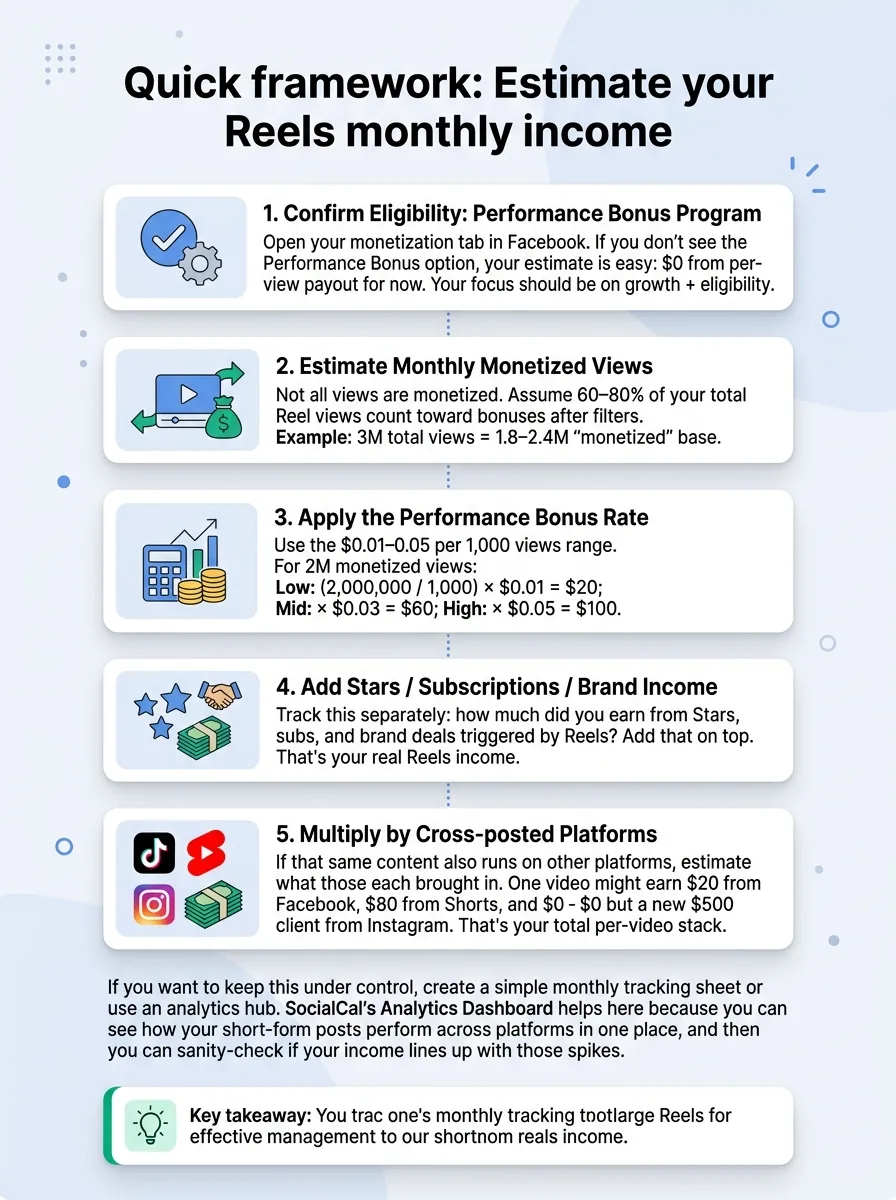
Let’s turn all this into something you can actually screenshot and run with.
- Confirm if you’re in the Performance Bonus Program.
Open your monetization tab in Facebook. If you don’t see the Performance Bonus option, your estimate is easy: $0 from per-view payouts for now. Your focus should be on growth + eligibility. - Estimate your monthly monetized views.
Not all views are monetized. A simple rule of thumb: assume 60–80% of your total Reel views count toward bonuses after filters. So if you did 3M total views last month, use 1.8–2.4M as your “monetized” base. - Apply the Performance Bonus rate.
Use the $0.01–0.05 per 1,000 views range. For 2M monetized views:
- Low: (2,000,000 / 1,000) × $0.01 = $20
- Mid: × $0.03 = $60
- High: × $0.05 = $100 - Add Stars / Subscriptions / brand income.
Track this separately: how much did you earn from Stars, subs, and brand deals triggered by Reels? Add that on top. That’s your real Reels income. - Multiply by cross-posted platforms.
If that same content also runs on TikTok, YouTube Shorts, and Instagram, estimate what those each brought in. One video might earn $20 from Facebook, $80 from Shorts, and $0 but a new $500 client from Instagram. That’s your total per-video stack.
If you want to keep this under control, create a simple monthly tracking sheet or use an analytics hub. SocialCal’s Analytics Dashboard helps here because you can see how your short-form posts perform across platforms in one place, and then you can sanity-check if your income lines up with those spikes.
Ready to save 15+ hours every week?
Join other creators who've automated their social media with SocialCal.
Get started freeFrequently asked questions about Facebook Reels payouts
Why isn’t my Facebook Reel monetized?
Usually one of four reasons:
- Your account isn’t in the Performance Bonus Program
- You’re not in an eligible country for the program
- The Reel violates guidelines (music, copyright, or policy issues)
- It’s detected as recycled content with another platform’s watermark
Check your monetization tab — that’s your source of truth, not random screenshots online.
When will I get my Performance Bonus payout?
Meta typically calculates earnings at the end of your bonus period (often monthly), then issues payouts within the following month once you’ve hit the minimum payout threshold and have your payment details set up.
You can see expected payout dates and pending earnings in your Payouts section inside Facebook’s monetization dashboard.
Can I monetize Reels reposted from Instagram?
Yes, but only if they qualify as original in Meta’s eyes. That means no visible Instagram watermark, and ideally you’re uploading the source file directly to Facebook rather than using the “Share to Facebook” repost button.
Clean, watermark-free uploads tend to get better distribution and are less likely to get flagged as reused content.
Does Facebook still pay Reels Play Bonus?
No. The old Reels Play Bonus program that paid a flat per-view rate with huge monthly caps has been retired for most creators since 2023.
The current program paying for Reels views is the Performance Bonus Program, which uses engagement quality and other signals instead of a simple “per view” math.
How do I get invited to the Performance Bonus Program?
You can’t apply manually. Meta invites creators who:
- Use a Page or Professional Mode profile
- Post Reels consistently over time
- Have healthy, non-botted engagement and no serious policy violations
Your best shot is to publish high-retention, original Reels 3–5 times per week, keep your account clean, and check your monetization tab regularly so you don’t miss an invite.
The principle: per-view payouts are the floor, not the ceiling
If you remember one thing from all this, let it be this: Facebook Reels per-view payouts are real, but they’re the floor of your earning potential, not the ceiling.
The creators who survive long term aren’t chasing the perfect CPM. They’re building systems: consistent Reels output, smart cross-posting, and clear offers behind the content. If scheduling and multi-platform posting are the parts you keep dropping, tools like a simple content calendar or SocialCal’s Content Calendar can quietly make the difference between “I post when I feel like it” and “my content works for me every day.”
Growth isn’t about perfect videos. It’s about showing up often enough that one of your good ones hits — and having something ready to sell when it does.