

The TikTok Burnout: Why Finding Your Posting Rhythm Is So Difficult
You have probably heard the advice from self-proclaimed growth gurus. They tell you to post three times a day or the algorithm will completely forget you exist. It sounds logical on paper, but in practice, it is just exhausting.
Jump to a section:
- The TikTok Burnout: Why Finding Your Posting Rhythm Is So Difficult
- Quick Answer: How Often Should You Post on TikTok?
- The Content Velocity Trap: Why Posting 'Just to Post' Fails
- Strategy 1: Establishing Your Creative Baseline
- Strategy 2: Using Low-Lift Content for Daily Presence
- Strategy 3: The 48-Hour Maturity Window and Batching
- Why Most Brands Still Get Bad Results: 5 Common Mistakes
- Real-World Examples: Posting Frequency in Action
- The Consistency Bridge: Moving From 'When' to 'How'
- A 4-Step Framework for Your New TikTok Schedule
- Common TikTok Posting Questions (FAQ)
- Conclusion: Consistency Outperforms Intensity
You spend half your week filming, editing, and desperately trying to feed the beast. Then you watch your views absolutely tank because you rushed those last five videos just to hit an arbitrary quota. Sound familiar? So, how often should you post on tiktok without burning out or sacrificing the quality that actually gets people to stick around?
Ready to save 15+ hours every week?
Join other creators who've automated their social media with SocialCal.
Get started freeHere is the paradox of the TikTok algorithm. It demands volume to gather data, but it aggressively punishes low-quality filler content. If you just throw garbage at the wall, your account gets flagged as unengaging. Let's fix your posting rhythm and build a sustainable strategy that protects your mental health.
Quick Answer: How Often Should You Post on TikTok?
For optimal growth, you should post on TikTok 1 to 3 times per day. However, the safe minimum for most brands and creators is 3 to 5 times per week. The key is maintaining a cadence your team can sustain for months. The algorithm rewards consistent data signals over sporadic high-volume bursts.
The Content Velocity Trap: Why Posting 'Just to Post' Fails
Most creators misunderstand how TikTok evaluates their account. They think the platform simply wants more videos. What the algorithm actually wants is positive viewer habit loops.
TikTok relies on an Algorithm Learning Cycle. Every time you publish, the AI tests your video with a small seed audience and measures the early engagement velocity. If your first 100 viewers swipe away within three seconds because the hook is boring or the lighting is terrible, the algorithm assumes the video is bad. It stops distributing it.
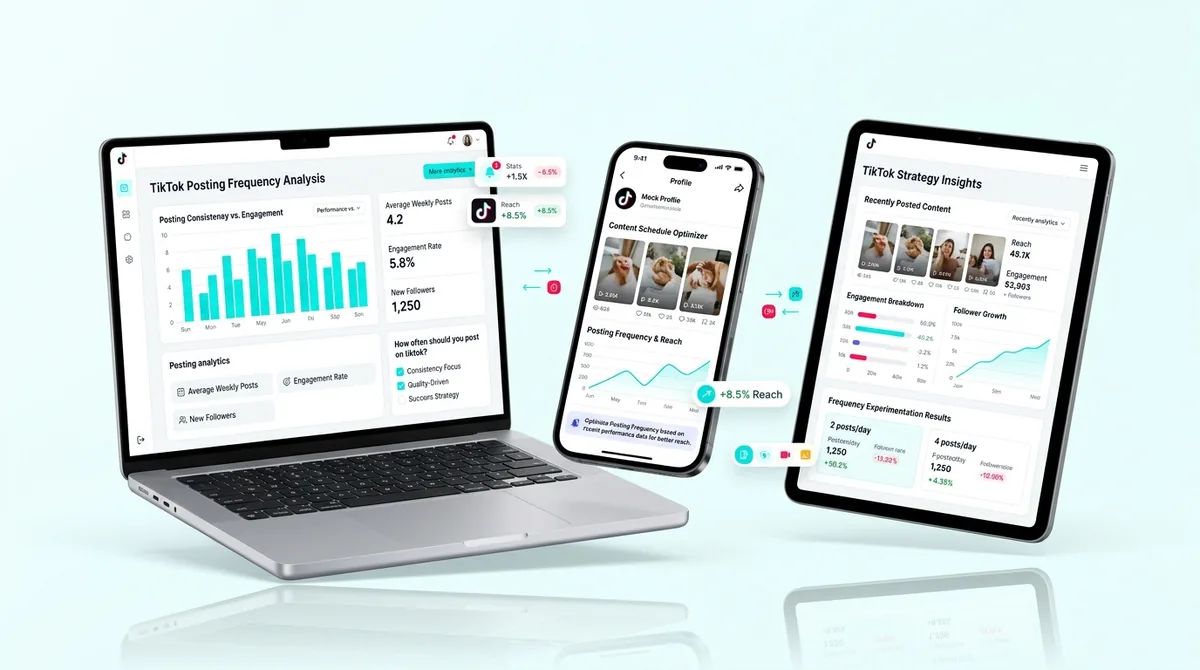
If you post three bad videos a day just to hit a quota, you are actively damaging your future reach. You train your audience to scroll past you. When they see your face, their muscle memory triggers a swipe because they expect low-effort content. You confuse the AI and ruin your engagement rate. Quality builds the audience, and volume just speeds up the delivery.
Strategy 1: Establishing Your Creative Baseline
Before you commit to a daily posting schedule, you have to find your personal Quality-Volume Equilibrium. Mechanistically, TikTok evaluates videos individually, but your account's overall authority is built through high average watch times across your entire profile.
You need a baseline. Audit your production time for a single, high-quality video from scripting to editing. Multiply that by your available weekly hours. That is your true posting capacity. Not even close to what the gurus tell you, right?
Defining Your Weekly 'A-Side' and 'B-Side' Content
The music industry figured this out decades ago. You do not need a masterpiece every single time you hit record. Divide your efforts.
'A-Side' content is your high-production work. These are the deeply researched educational videos, the highly edited sketches, or the heavily scripted stories. You do these maybe one or two times a week.
Your 'B-Side' content fills the daily gaps. These are low-lift trend reactions, quick talking-head thoughts while walking to your car, or behind-the-scenes clips. They keep your face on the For You Page without causing creative burnout.
Strategy 2: Using Low-Lift Content for Daily Presence
Perfect is the enemy of the TikTok algorithm. Highly polished corporate videos often flop because they trigger immediate ad-blindness in viewers. Raw, native-looking content usually outperforms high-budget productions because it fits the organic aesthetic of the platform.
You can maintain your posting frequency just by using native app features. Stitches and Duets allow you to piggyback off viral conversations in your niche. You supply the commentary, but the original creator supplied the hook.
Using Video Replies to Build Community Habits
What nobody tells you is that your comment section is an infinite content generator. When someone asks a good question on your A-Side video, do not just type a reply.
Tap the comment and reply with a video. This creates an incredible feedback loop. It rewards your active followers by making them feel seen, encourages others to comment in hopes of getting their own video, and entirely bypasses the script-writing phase for you. You just hit record and talk.
Strategy 3: The 48-Hour Maturity Window and Batching
TikTok is not Instagram. An Instagram post usually dies in the feed after 24 hours. A TikTok video operates on a delayed maturity window. It can sit at 200 views for three entire days, and then suddenly hit the right cluster of users and shoot to 500,000 views on a Thursday afternoon.
Mechanistically, this delayed viral push means you do not need to post every three hours to stay relevant. The algorithm takes time to find your target audience's active pockets. According to research from Sprout Social, maintaining a reliable schedule builds more audience trust than sporadic mass posting.
The Batch-and-Bridge Workflow
Real life gets in the way of content creation. You will get sick, take a vacation, or just have a terrible Tuesday. You protect your consistency by batching.
Here is a simple workflow. Spend two hours on a Sunday afternoon filming 7 to 10 short talking-head videos. Change your shirt three times so they look like different days. Now you have a bridge of content that guarantees you never miss a posting day during the week, no matter what happens.
Why Most Brands Still Get Bad Results: 5 Common Mistakes
Even with a solid frequency, I see creators sabotage their own accounts through basic behavioral mistakes. Avoid these errors.
Deleting Underperforming Videos
Stop deleting your videos! When a post tanks and gets 80 views, your ego hurts and you want it off your page. But deleting videos literally deletes the data graph the algorithm was building. It resets the AI's learning phase for your account, making your next post perform even worse.
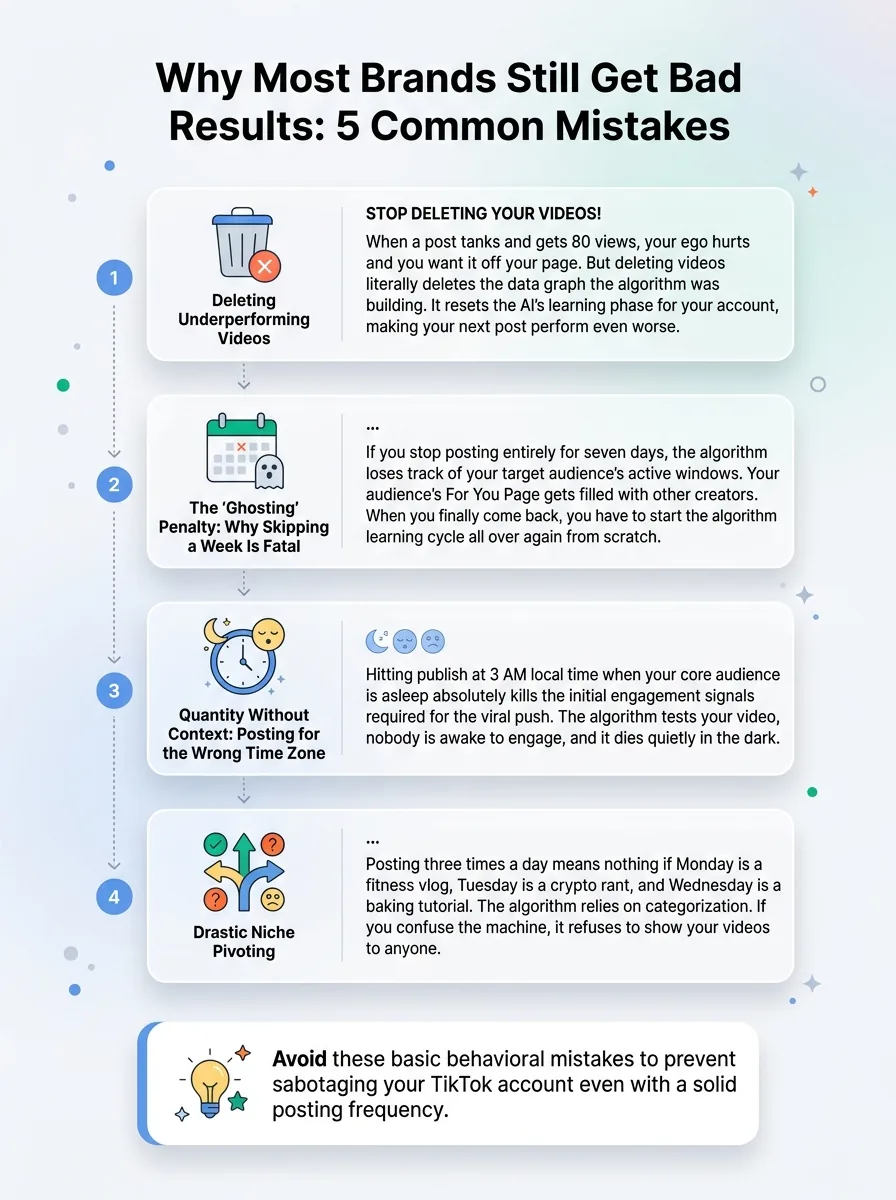
The 'Ghosting' Penalty: Why Skipping a Week Is Fatal
If you stop posting entirely for seven days, the algorithm loses track of your target audience's active windows. Your audience's For You Page gets filled with other creators. When you finally come back, you have to start the algorithm learning cycle all over again from scratch.
Quantity Without Context: Posting for the Wrong Time Zone
Hitting publish at 3 AM local time when your core audience is asleep absolutely kills the initial engagement signals required for the viral push. The algorithm tests your video, nobody is awake to engage, and it dies quietly in the dark.
Drastic Niche Pivoting
Posting three times a day means nothing if Monday is a fitness vlog, Tuesday is a crypto rant, and Wednesday is a baking tutorial. The algorithm relies on categorization. If you confuse the machine, it refuses to show your videos to anyone.
Real-World Examples: Posting Frequency in Action
Let's look at how this plays out in the wild.
I worked with a B2B SaaS brand that was absolutely exhausting their marketing team by demanding seven posts a week. The videos were dry, rushed product updates. We cut their frequency down to three high-value educational tutorials per week. Lead conversions increased by 400% in a month because the quality finally held the viewer's attention long enough to build trust.
Case Study: The Pivot from Daily Vlogging to Strategic Education
Consider a solo creator who built an audience through daily vlogging. They hit a wall of extreme burnout after six months. They decided to cut their posting frequency in half. Instead of daily updates, they posted three times a week, but doubled down on specific SEO-driven hooks targeting search queries. Their daily views actually went up because their older videos started ranking in TikTok search results.
The Consistency Bridge: Moving From 'When' to 'How'
We can debate how often should you post on tiktok until we are blue in the face. But the perfect frequency is entirely irrelevant if you cannot actually execute it. The problem is rarely a lack of ideas.
The real friction is the manual act of pulling out your phone, writing a caption, adding hashtags, and hitting publish at the exact right moment every single day. If you want to dive deeper into the mechanics of this friction, understanding manual posting versus scheduling reveals why most creators eventually drop off.
You need a behavioral solution to bridge the gap between your strategy and your execution. Consistency trains the algorithm, but scheduling protects your sanity. By using the TikTok Scheduler in SocialCal, you upload your batched videos directly from your desktop and set them to auto-publish. You get all the algorithmic benefits of a daily presence without the constant, nagging anxiety of remembering to post.
A 4-Step Framework for Your New TikTok Schedule
Do not try to overhaul your entire life today. Follow these steps to build a routine that actually sticks.
Step 1: The Content Audit and Capacity Check
Time yourself making one standard video this week. Be honest about the minutes spent writing, filming, and editing. Divide your total available weekly creative hours by that number. That is your maximum weekly post count.
Step 2: Automating Your Posting Pipeline
Remove the decision fatigue of hitting publish. Take your batched videos, load them into your calendar, and schedule them out for the week. Before you lock them in, run your drafts through a post previewer just to verify that your text hooks aren't being hidden behind TikTok's heart and comment buttons on the right side of the screen.
Step 3: Schedule Your Engagement Blocks
Posting is only half the job. Block out 15 minutes immediately after your video goes live to reply to comments. This boosts early engagement velocity.
Step 4: The 30-Day Evaluation
Do not change your frequency for a full month. Let the algorithm map your data points. Then, review your analytics to see if your average watch time is trending up or down.
Common TikTok Posting Questions (FAQ)
Is it possible to post too much on TikTok?
Yes. If your quality drops because you are rushing, your watch time plummets. Posting 10 bad videos a day will actively hurt your account's algorithmic standing.
Does deleting videos hurt your account?
Absolutely. It removes data the algorithm uses to understand your audience. If a video flops, just set it to 'Private' instead of deleting it.
How long should I wait between posts?
Give your videos at least one to two hours to breathe. If you post three videos in five minutes, they will cannibalize each other's early reach.
Ready to save 15+ hours every week?
Join other creators who've automated their social media with SocialCal.
Get started freeConclusion: Consistency Outperforms Intensity
TikTok is a marathon, not a sprint. Success rarely comes from one viral hit; it comes from showing up reliably for your audience week after week. Find a posting frequency that challenges you but doesn't break you. Use a tool like SocialCal to automate the delivery so you can focus entirely on creating the kind of quality content that actually converts viewers into community members.


