The Real Reason Your Reels Aren’t Reaching New Eyes
You stare at the screen. The Reel you just spent three hours scripting, shooting, and editing just hit 200 views and stopped dead. Your follower count looks like a flatline on a heart monitor. You are posting consistently, you are doing everything the supposed experts tell you to do, but your reach refuses to budge.
Jump to a section:
- The Real Reason Your Reels Aren’t Reaching New Eyes
- What is Instagram Growth with Trial Reels?
- The Psychology of Stagnation: Why Traditional Posting Limits Your Reach
- Strategy 1: Using Trial Reels to Pressure-Test High-Impact Hooks
- Strategy 2: Niche Expansion Without Alienating Your Core Community
- Strategy 3: Behavioral Data Mining: When to 'Graduate' a Trial Reel
- Strategy 4: Rapid Prototyping Visual Aesthetics and Trends
- Strategy 5: Optimizing for the 'Exploration Phase' of the Instagram Algorithm
- Why Most Creators Fail with Trial Reels: 5 Common Pitfalls
- Real-World Examples: Trial Reel Success Stories
- The Secret to Growth: Why Consistency Matters More Than Perfection
- The 5-Step Instagram Trial Reels Checklist
- Frequently Asked Questions about Instagram Trial Reels
- Conclusion: Turning Experiments into Followers
Does this remind you something?
Most creators eventually hit this exact wall. You build a modest audience, figure out what they like, and then you get completely trapped by them. You become terrified of experimenting because posting something "off-brand" might annoy your core followers or ruin your carefully curated grid. This fear creates a massive growth bottleneck.
Ready to save 15+ hours every week?
Join other creators who've automated their social media with SocialCal.
Get started freeThe old "post and pray" method is dead. If you want to break out of a plateau, you have to test new concepts. But testing on your main feed risks algorithmic penalties if your current followers don't engage. You need a sandbox. You need a way to fail quietly and succeed loudly.
What is Instagram Growth with Trial Reels?
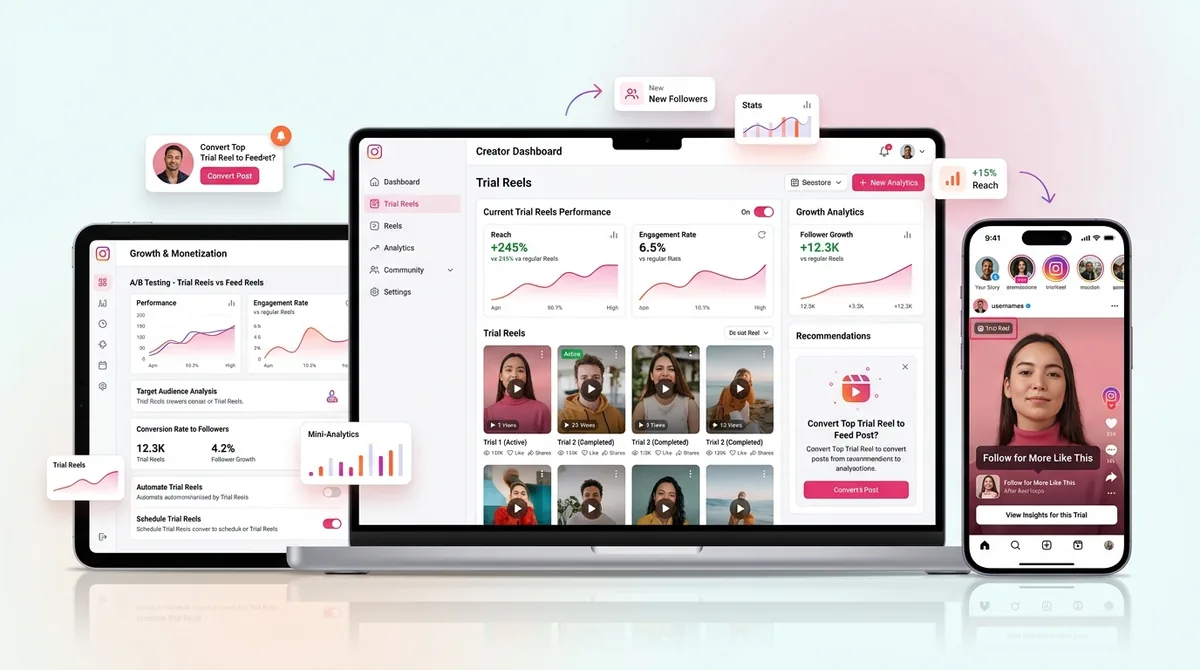
Instagram growth with Trial Reels is the strategy of publishing short-form video content exclusively to non-followers for a set period to test performance. This built-in feature allows creators to measure a video's hook retention and shareability with a cold audience before deciding to graduate it to their main profile grid.
The Psychology of Stagnation: Why Traditional Posting Limits Your Reach
To fix your growth, you first have to understand the behavioral loop keeping you stuck. I call it the Safe Content Loop.
When you publish a standard Reel, the Instagram algorithm performs a "follower sentiment check." It takes your new video and shows it to a small percentage of your most active followers. If they watch it, like it, and share it, the algorithm assumes the content is good and pushes it out to the Explore page and the broader Reels feed.
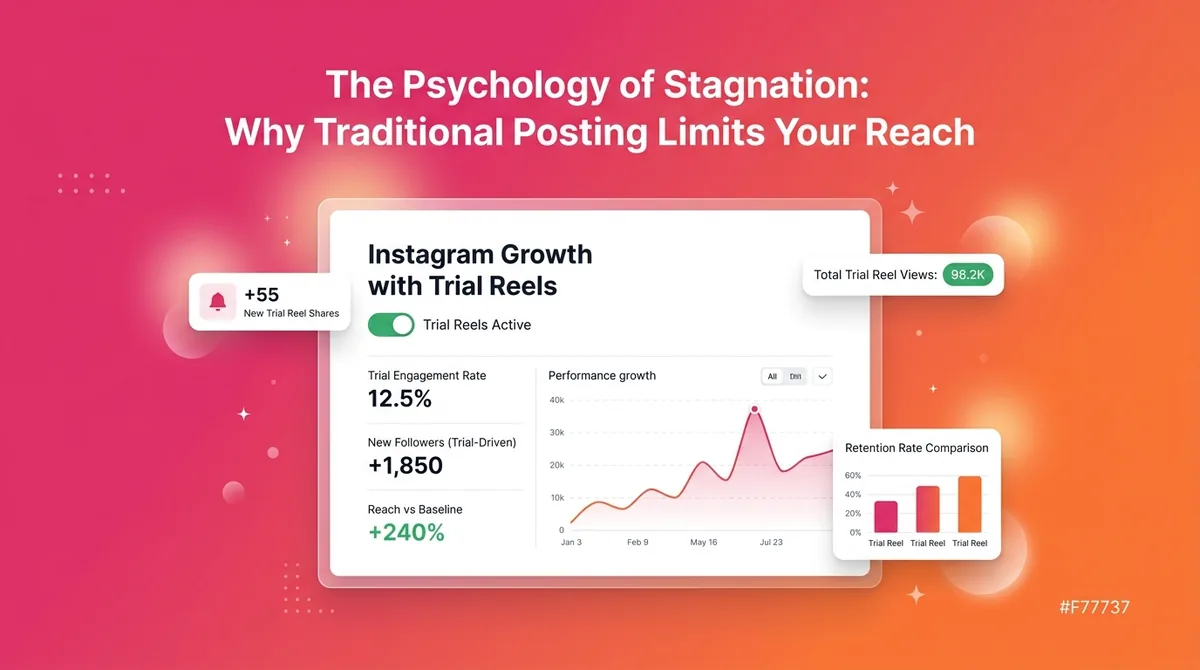
But here is the catch. If you try to pivot your niche, or test a completely new format, your current followers will likely scroll right past it. They didn't sign up for that new topic. The algorithm sees this initial swipe-away, assumes your video is terrible, and kills the reach immediately. You experience an algorithmic "cooling off" period. Your post dies in the crib, not because the content was objectively bad, but because it was shown to the wrong seed audience.
This forces you to keep making the exact same content for the exact same people. You never reach new clusters of users. You slowly burn out.
Strategy 1: Using Trial Reels to Pressure-Test High-Impact Hooks
Trial Reels completely change the math of experimentation. Because they are hidden from your followers, they allow you to isolate variables like a scientist. And the most important variable you will ever test is your hook.
Mechanistically, the algorithm measures early engagement velocity. The first three seconds of your video determine ninety percent of its total reach potential. If a Trial Reel has a massive drop-off rate in those opening seconds with strangers, you know the hook is the problem, not the underlying value of the video.
If you are stuck staring at a blank screen trying to figure out what to say, running your ideas through a viral hook tester gives you immediate, objective feedback before you ever pick up a camera. Then, you shoot three variations.
Measuring the 'Scroll-Stop' Ratio in Non-Follower Feeds
Let's look at how this works in practice. Imagine you are a fitness coach. You have a great three-minute explanation of why most people fail at calorie deficits. Instead of just posting it and hoping for the best, you shoot three different five-second intros.
Intro A: "Here is how to calculate your daily caloric intake." Intro B: "Stop eating chicken and rice until you watch this." Intro C: "The real reason you aren't losing belly fat."
You post all three as Trial Reels. You wait 24 hours and check your retention graphs. Intro A loses 80% of viewers immediately. Intro B holds 40%. Intro C holds 65%. You now have definitive, data-backed proof of what stops the scroll for a cold audience. You take Intro C, attach it to your main video, and publish it to your grid with confidence.
Strategy 2: Niche Expansion Without Alienating Your Core Community
Most creators think they have to start a second account if they want to talk about something outside their hyper-specific niche. That is a massive waste of energy.
Trial Reels act as a psychological buffer for your audience. They let you step outside your rigid brand persona without causing unfollows. If you are a real estate agent who normally posts property tours, but you want to start talking about personal finance, doing that abruptly on your main feed will confuse your buyers.
Testing new topics with strangers lets you build a bridge between your current niche and your future niche.
Testing Adjacent Interests via the 'Non-Follower First' Logic
Take a B2B SaaS company that sells productivity software. Their grid is full of software tutorials and feature updates. Very dry. Very safe.
They want to reach a broader audience of entrepreneurs, so they create a Trial Reel about "Minimalist Office Interior Design for Deep Work." This has nothing to do with their software, but it appeals to the exact same demographic. By running it as a Trial, they avoid annoying their hardcore software users. If the Reel tanks, nobody sees it. If it blows up, they capture thousands of new eyeballs and organically funnel them toward the software.
Strategy 3: Behavioral Data Mining: When to 'Graduate' a Trial Reel
Not every experiment is meant to live forever. The entire point of this strategy is to find the outliers and amplify them. So how do you actually know when a Trial Reel is a winner?
You don't look at views. Views are a vanity metric heavily influenced by the time of day and initial algorithm clustering. You look at the "shares per view" ratio.
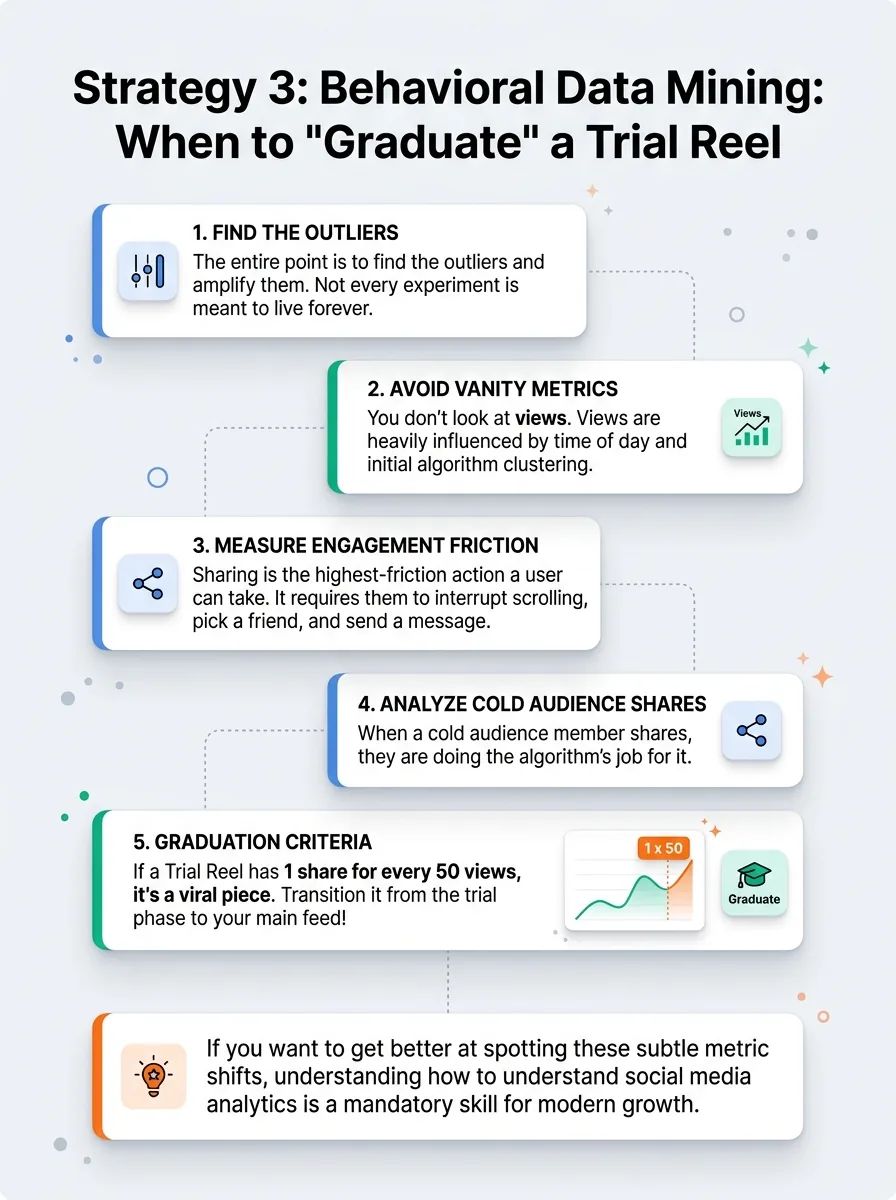
Sharing is the highest-friction action a user can take. It requires them to interrupt their scrolling, pick a friend, and send a message. When a cold audience member shares your content, they are doing the algorithm's job for it. If your Trial Reel is generating one share for every fifty views, you have a viral piece of content on your hands. That is the exact moment you transition it from the trial phase to your main feed. If you want to get better at spotting these subtle metric shifts, understanding how to understand social media analytics is a mandatory skill for modern growth.
Strategy 4: Rapid Prototyping Visual Aesthetics and Trends
Perfectionism is the enemy of reach. You probably have a folder full of half-finished Reel ideas that you never posted because the lighting wasn't quite right, or the editing style felt a little too chaotic for your brand.
Trial Reels drastically lower the barrier to entry. They give you psychological permission to post "ugly" content just to see if the underlying framework resonates.
The 24-Hour Trend Cycle: Speed Over Perfection
Trends move so fast now that by the time you polish a video, the audio is already dead. Trial Reels allow you to participate in the 24-hour trend cycle instantly.
Consider a minimalist skincare brand. Their aesthetic is clean, slow, and quiet. Suddenly, a high-energy, chaotic trending audio takes over the platform. The social media manager knows the audio could get massive reach, but it feels entirely off-brand. They throw together a quick, low-production video using the audio and post it as a Trial Reel. It hits a million views in two days. They get the brand awareness without permanently altering their pristine profile grid.
Strategy 5: Optimizing for the 'Exploration Phase' of the Instagram Algorithm
This is where the technical advantage really shines. As head of Instagram Adam Mosseri detailed in his breakdown of how Instagram ranks content, the platform relies heavily on predictive models to determine what a user might want to see next.
When you use Trial Reels, you bypass your existing followers and force the algorithm into its Exploration Phase immediately. The AI has to look at the raw metadata of your video to figure out who to show it to. It looks at your on-screen text, your spoken words, your caption, and your visual framing.
You are essentially training the algorithm on who your ideal new follower is, rather than letting it default to your current followers.
Leveraging Categorization Signals for Better Discovery
To succeed here, you have to be wildly intentional with your signals. If you are testing a Trial Reel, your caption shouldn't be a vague emoji. It needs to be dense with niche-specific keywords.
If you are a chef targeting meal-prep beginners, your caption needs to literally say the words "cheap meal prep for beginners," "high protein low budget," and "easy cooking hacks." The algorithm reads this text to form its initial test clusters. Clear signals mean your Trial Reel gets shown to the right non-followers immediately, giving you accurate data.
Why Most Creators Fail with Trial Reels: 5 Common Pitfalls
The feature is powerful, but it isn't magic. A lot of creators try this for a week, get terrible results, and go back to their old habits. Here is what they are doing wrong.
Mistake #1: Treating Trials Like Throwaway Content
Low quality is still low quality. A Trial Reel should be an experiment in a new topic or a new format, not an excuse to post something lazy. If you mumble into a blurry camera with bad lighting, the video will fail. It won't fail because the topic was bad; it will fail because the execution was unwatchable. You will walk away thinking your audience doesn't like the topic, when in reality, they just didn't like the awful video.
Mistake #2: Ignoring the 48-Hour Feedback Window
Data has an expiration date. If you post a Trial Reel and don't check the retention graph for a week, you've missed the window of opportunity. The entire point of the strategy is rapid iteration. If a hook works on Tuesday, you should be filming three more variations of that exact hook by Thursday.
Mistake #3: Testing Too Many Variables at Once
If you change your filming location, your editing style, your topic, and your hook all in one Trial Reel, and it goes viral, you have no idea why it worked. Was it the new lighting? The new topic? You can't replicate the success because you don't know the recipe. Change one thing at a time.
Mistake #4: Forgetting to Actually Graduate the Winners
Some creators get so addicted to the low-pressure sandbox that they never actually push the winning content to their main feed. A Trial Reel that performs exceptionally well with strangers is guaranteed gold for your existing audience. Don't leave engagement on the table.
Mistake #5: Confusing the Algorithm with Wild Swings
While Trial Reels are great for niche expansion, testing completely unrelated topics back-to-back will confuse the categorization AI. If you post about crypto on Monday, baking on Tuesday, and fitness on Wednesday, the algorithm will struggle to build a coherent profile of your account.
Real-World Examples: Trial Reel Success Stories
Theory is great, but let's look at what this actually looks like in the wild.
Example A: A Notion template creator was stuck at 12,000 followers for six months. Her videos were beautiful, screen-recorded tutorials. She used Trial Reels to test a completely different format: direct-to-camera speaking videos discussing workplace burnout. The first two failed. The third one hit 400,000 views in the trial phase. She pushed it to her main feed, gained 8,000 followers in a week, and completely pivoted her content strategy based on that one successful test.
Example B: A local coffee shop used Trial Reels to test "behind the scenes" employee humor. Their main feed was strictly professional photos of latte art. The employee humor Trial Reels performed so well with non-followers in their city that they realized they were suppressing their own personality. They eventually merged the humor into their main feed, doubling their average local engagement.
The Secret to Growth: Why Consistency Matters More Than Perfection
The algorithm heavily rewards the frequency of your experiments. If you test one hook a month, it will take you years to find what works. If you test three hooks a week, you will find your winning format in a month. It is a sheer numbers game.
But the real bottleneck isn't finding ideas. It is the manual, grinding labor of logging into the app, uploading the video, writing the caption, and hitting publish every single day. Manual posting is the fastest route to creator burnout.
To run a high-volume testing strategy, you need a reliable system to handle the logistics. Using a dedicated Instagram Scheduler allows you to batch-upload all your trial variations on Sunday, auto-post your hashtags in the first comment, and visually map out your week. You separate the creative work of filming from the administrative work of publishing. And if you are still clinging to the old myth that third-party tools hurt your reach, the actual data on whether scheduling posts reduces reach proves otherwise. The platforms want consistency above all else.
The 5-Step Instagram Trial Reels Checklist
Ready to start testing? Follow this exact sequence for your next batch of content.
Identify the Variable: Decide exactly what you are testing (a specific hook, a new visual aesthetic, or an adjacent topic).
Batch Three Variations: Shoot three distinct versions of the opening three seconds. Keep the core body of the video the same.
Optimize Categorization: Write a keyword-dense caption to tell the algorithm exactly who should see the test.
Monitor the 48-Hour Mark: Check the "shares per view" and the 3-second retention graph for each variation.
Graduate the Winner: Take the variation with the highest retention, remove the trial status, and push it to your main profile grid.
Ready to save 15+ hours every week?
Join other creators who've automated their social media with SocialCal.
Get started freeFrequently Asked Questions about Instagram Trial Reels
Do Trial Reels show on my profile grid?
No. While in the trial phase, these Reels do not appear on your main profile grid and are hidden from your current followers' standard feeds.
How long do Trial Reels last?
They remain in the trial phase until you manually choose to publish them to your broader audience, or until you archive them. The data, however, is most actionable within the first 48 to 72 hours.
Can followers see my Trial Reels at all?
If a non-follower shares the Trial Reel directly with one of your followers via DM, they can view it. Otherwise, it is suppressed from their native feed experience.
Do Trial Reels affect my account's overall engagement rate?
Trial Reels do not negatively impact your main account standing if they flop. That is the entire purpose of the feature. They protect your core engagement metrics while you test risky content.
Conclusion: Turning Experiments into Followers
Growth is never about guessing what the algorithm wants. It is about running controlled experiments and letting the audience tell you exactly what they are willing to watch. Trial Reels remove the fear of failure from the equation, letting you prototype your way to a viral hit. The only thing left for you to do is build the habit of testing, let SocialCal handle the daily publishing friction, and trust the data over your own assumptions.