Why Your Threads Strategy Needs a Clean Slate (And Why Most Fall Short)
Let's be brutally honest. You probably started your Threads account by importing your Instagram bio, blasting out a quick introductory post, and waiting for the magic to happen.
Jump to a section:
- Why Your Threads Strategy Needs a Clean Slate (And Why Most Fall Short)
- What is a Threads Growth Strategy?
- The Friction Point: Why Building on Threads Feels Different (and Harder)
- Strategy 1: The 'Conversation-First' Content Funnel
- Strategy 2: Mastering the 'Unfolding' Thread Format
- Strategy 3: Leveraging Instagram Synergy Without Being Redundant
- Strategy 4: The 'Active Sentiment' Feedback Loop
- Strategy 5: Niche Authority Through Micro-Community Interactions
- Why Most People Still Get Bad Results (Mistakes to Avoid)
- Real-World Success: Threads Growth in Action
- The Consistency Bridge: Solving the Burnout Problem
- The Threads Growth Checklist (Actionable Framework)
- Threads Strategy FAQ: Your Questions Answered
- Conclusion: Building a Sustainable Threads Presence
And then nothing happened.
Just you, a couple of confused bots, and the echo of your own keyboard. You have an audience elsewhere. Maybe it's 5k followers on Twitter or 50k on Instagram. But when you open Threads and drop your best content, it feels like a total ghost town. Sound familiar?
Most creators hit this exact wall. They try to copy their Twitter threads or LinkedIn posts directly over to a new app, expecting a 1:1 translation of engagement. But building a viable threads growth strategy requires a complete teardown of what you think you know about text-based social media.
Here is the thing. Threads isn't operating on a traditional "Interest Graph" where keywords dictate discovery. It operates on a "Social Vibe Graph." Meta built this platform as an antidote to the hostile, news-heavy environment of its competitors. If you show up acting like a broadcaster instead of a conversationalist, the algorithm will quietly bury you.
Ready to save 15+ hours every week?
Join other creators who've automated their social media with SocialCal.
Get started freeWe are going to map out exactly how to build your authority from zero. No engagement bait. No spamming. Just a step-by-step blueprint based on how the platform actually routes attention.
What is a Threads Growth Strategy?
A threads growth strategy is a systematic framework focused on community-centric engagement, high-velocity conversational posting, and algorithmic signaling. Unlike traditional platforms, it prioritizes unfolding conversations and sentiment-based reach over hashtags to build organic authority, maximize dwell time, and drive meaningful audience conversions.
The Friction Point: Why Building on Threads Feels Different (and Harder)
To win on any platform, you have to understand what its engineers are trying to optimize for. Meta wants Threads to be the friendly corner of the internet. They are actively measuring the "Vibe Check" of your content.
When you post a raw link, Meta's algorithm sees an exit sign. It knows you are trying to pull users away from their app. Consequently, posts containing only outbound links without any conversational context are heavily throttled. They want active participation, not passive doom-scrolling.
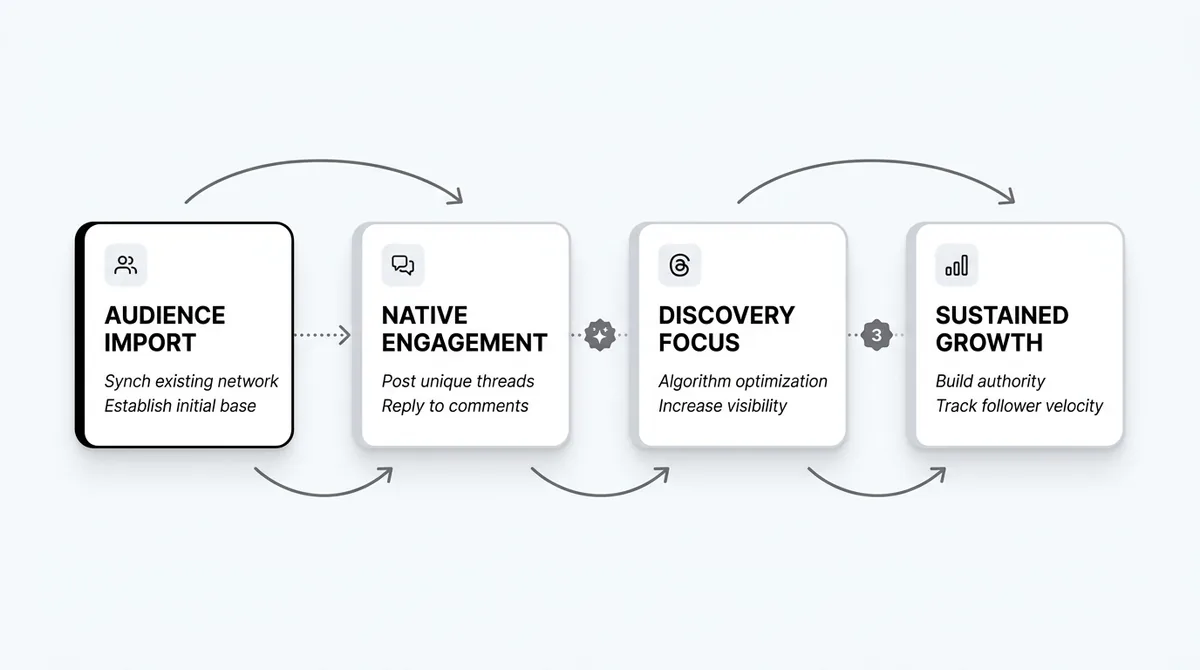
Historically, platforms like Twitter relied on robust keyword search functionality to surface content to new users. Threads initially lacked this, which fundamentally changed discovery. Instead of searching for topics, users discover content through a "Suggested For You" feed driven entirely by relational data. The algorithm watches who you interact with, how long you linger on a post, and whether the sentiment of the replies is positive or negative.
If you don't trigger those specific behavioral loops, your content simply won't circulate. Period.
Strategy 1: The 'Conversation-First' Content Funnel
Most creators treat their timeline as a megaphone. You need to treat yours as a dinner party.
The Meta algorithm heavily prioritizes threads with high reply-to-like ratios. Why? Because a like takes a fraction of a second and requires zero cognitive effort. A reply requires a user to stop their scroll, formulate a thought, type it out, and hit send. That represents massive dwell time, which is the exact metric Meta's engineers use to measure content quality.
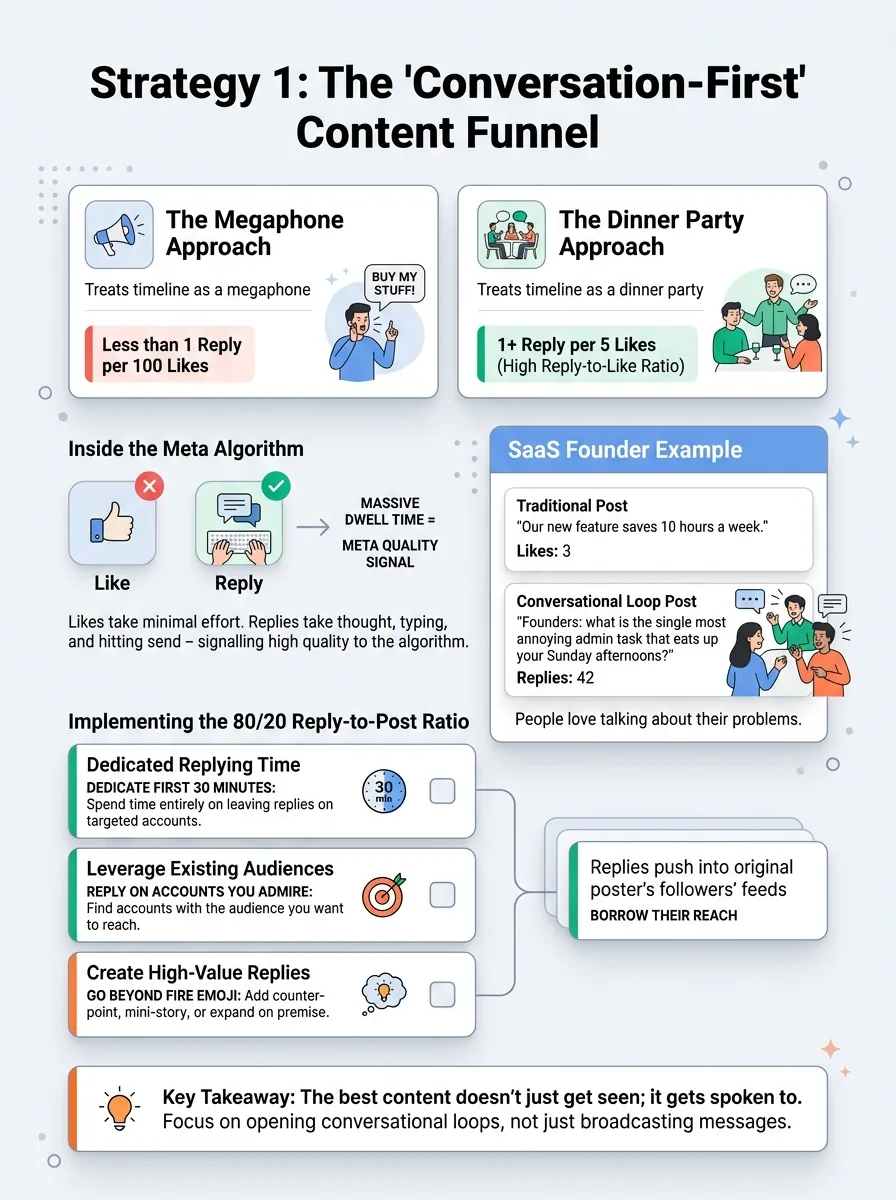
Imagine a SaaS founder trying to grow their account. If they post, "Our new feature saves 10 hours a week," they might get three likes. If instead they post, "Founders: what is the single most annoying admin task that eats up your Sunday afternoons?" they open a conversational loop.
People love talking about their problems.
Implementing the 80/20 Reply-to-Post Ratio
Your ratio of replies to original posts should be heavily skewed when you're starting out. Try dedicating the first 30 minutes of your morning entirely to leaving high-value replies on accounts that already have the audience you want.
Don't just leave a fire emoji. Add a counter-point, share a mini-story, or expand on their premise. Because Threads pushes replies into the main feed of the original poster's followers, you are effectively borrowing their reach to build your own.
Strategy 2: Mastering the 'Unfolding' Thread Format
There is a specific behavioral psychology to vertical scrolling. When a user sees a massive wall of text, their brain immediately registers it as work. They swipe past. But when you break that same text into a series of digestible, connected posts—an "unfolding" thread—you trick the brain into micro-commitments.
Each swipe down is a tiny investment. By the time they hit the third post, they are committed to finishing the thought.
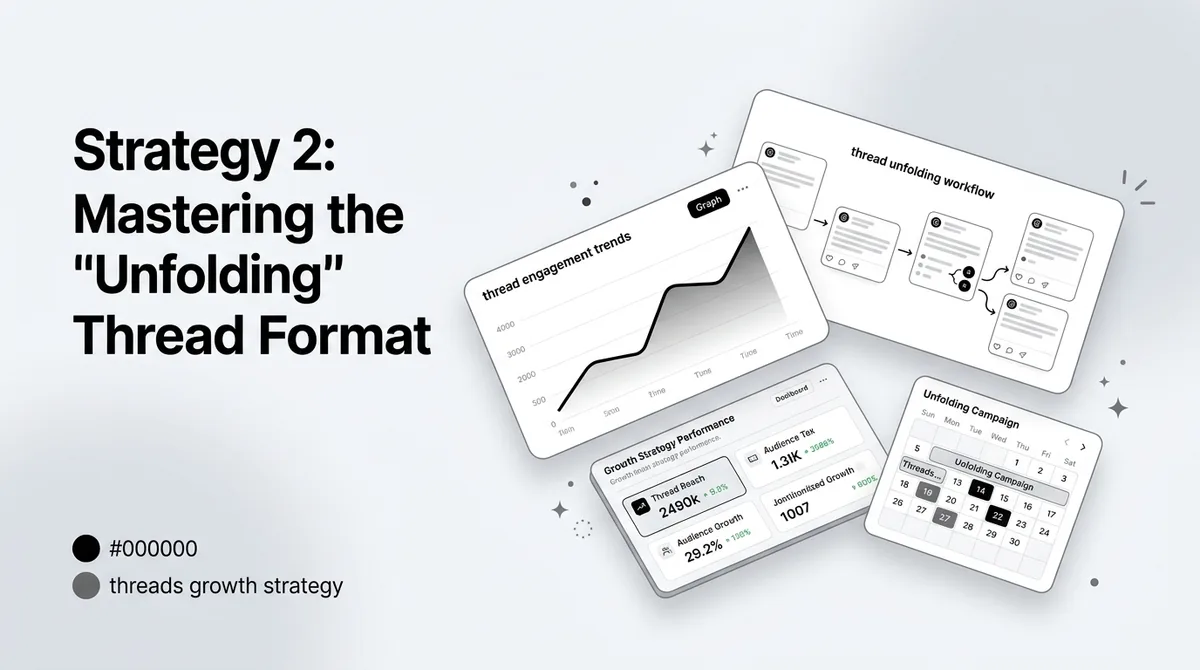
This increases their total time spent on your content. The algorithm measures this "dwell time velocity" in the first hour of posting to determine if your thread should be pushed to the wider network. If you want to analyze what's currently keeping users reading, use a Threads downloader to save viral posts in your niche and break down their formatting structure offline.
Visual-Text Hybridization for Better Dwell Time
Text alone gets boring. The most effective accounts mix short text hooks with native-feeling carousels. Instead of writing five paragraphs about a new marketing tactic, write a two-sentence hook and attach a three-slide carousel that visually breaks down the steps.
The combination of reading text and swiping horizontally through a carousel forces the user to interact with your post in multiple directions. That behavioral complexity signals high engagement to the algorithm.
Strategy 3: Leveraging Instagram Synergy Without Being Redundant
Because Meta tied Threads directly to your Instagram account, the two platforms share a massive amount of backend data. But this creates a trap.
Creators get lazy and simply hit the "share to Threads" button when posting an Instagram Reel. This is a massive mistake. Your Instagram audience follows you on Threads for a different flavor of content. If they wanted your polished photos, they would stay on Instagram.
What actually works is "cross-teasing." Treat your Instagram growth strategy as the top of your funnel, and Threads as the bottom.
Turning Your Instagram Stories Into Threads Conversations
Instead of posting the same content, use one platform to fuel the other. Post a controversial poll on your Instagram Story. When the results come in, take a screenshot of the data and post it on Threads with a deeper, written analysis of why you think the audience voted that way.
Then, go back to your Instagram Story, share a sticker link to the Threads post, and tell your audience, "The debate going down in the replies right now is wild. Come weigh in." You are migrating active, engaged users from a visual format into a text-based discussion.
Strategy 4: The 'Active Sentiment' Feedback Loop
Here is what nobody tells you about modern social algorithms. They don't just count engagement anymore. They read it.
Meta uses advanced AI to analyze the sentiment of the replies you generate. They outline this explicitly in their official ranking guidelines across their family of apps. If your post triggers angry, toxic, or highly combative replies, the algorithm will often cap your reach to prevent the platform from turning into a toxic wasteland.
If your posts trigger constructive debate, humor, or mutual agreement, the algorithm rewards you with algorithmic momentum.
You want to trigger "safe engagement." Use light humor. Share industry hot takes that are opinionated but not deeply offensive. For example, debating whether cold email is dead will get marketers fired up, but it won't violate community guidelines or trigger a toxicity filter.
Strategy 5: Niche Authority Through Micro-Community Interactions
Your goal isn't to reach everyone. It's to become unavoidable to a very specific subset of people.
The algorithm maps users based on interaction clusters. If you consistently interact with five prominent designers, Meta's backend categorizes you as part of the "design community" cluster. It will then start suggesting your account to other people who follow those designers.
Identify 10 "anchor accounts" in your specific niche. Turn on notifications for their posts. Be the first person to leave a thoughtful, value-add reply when they publish. You aren't just engaging with them; you are auditioning for their audience.
Why Most People Still Get Bad Results (Mistakes to Avoid)
Even with a solid plan, creators sabotage their own growth by ignoring the platform's unwritten rules. If your account feels stuck, you are likely committing one of these algorithmic sins.
Mistake: Treating Threads Like a Link Dump
We touched on this earlier, but it deserves its own spotlight. If you are using Threads exclusively to drop links to your newest blog post or YouTube video, you are killing your account trust score. According to recent industry data, posts containing outbound links without native conversational text see a massive drop in visibility.
If you must share a link, write a complete, standalone post that provides 90% of the value natively. Put the link in a reply to your own post, or weave it naturally into the bottom of a longer thread. Make the link optional, not mandatory.
Mistake: The 'Broadcast' Mentality
Talking at an audience instead of with them leads to high unfollow rates. Threads users have zero tolerance for corporate speak. If your posts sound like a press release, people will tune out immediately.
Drop the professional veneer. Write like you're texting a colleague who understands your industry.
Mistake: Ignoring Post-Level Sentiment Signals
Engagement baiting—asking people to "comment X to get my free guide"—works on Instagram because the algorithm is tuned for direct message automation. On Threads, explicit engagement baiting is often flagged by the algorithm as low-quality content.
You can offer resources, but do it organically. Say, "I put together a template for this. If you want it, let me know below and I'll send it over." It feels human, which is what the platform is optimized for.
Real-World Success: Threads Growth in Action
Theory is great, but application is what actually pays the bills. Let's look at how this plays out in practice.
Case Study A: The Solo SaaS Founder's 30-Day Pivot
Marcus was building a time-tracking app. For two months, he posted daily updates about his code pushes and feature releases. His engagement hovered near zero.
He pivoted to a radical "build in public" transparency strategy. Instead of announcing features, he started posting screenshots of his Stripe dashboard—the good and the bad. He asked the community for advice on pricing models. He shared the exact email scripts he used to land his first 10 customers.
By shifting from "look what I built" to "help me figure this out," he hit 5,000 highly engaged followers in 30 days. People didn't just follow him; they became emotionally invested in his startup's survival.
Case Study B: The B2B Brand That Humanized Their Voice
A mid-sized logistics company was struggling to get any traction. Their marketing team was posting links to whitepapers about supply chain optimization.
They handed the account over to a junior social manager who started posting day-in-the-life observations about the chaos of freight shipping, using industry-specific humor and memes. They asked warehouse managers about their biggest pet peeves. The account exploded. They moved away from whitepapers toward authentic industry discourse, and their inbound lead quality actually improved because they built genuine affinity.
The Consistency Bridge: Solving the Burnout Problem
Algorithm behavioral mechanisms are compounding. Posting an amazing thread once a week won't trigger the algorithm to label you as a high-value creator. Posting good, conversational content daily trains the algorithm to expect reliable activity from your account.
When you post at a consistent cadence, you establish a behavioral baseline. The system learns when your audience is most likely to engage with you, boosting your initial distribution velocity.
But here is the reality check: manual daily posting leads to creator burnout. You cannot sit at your desk all day waiting for the perfect moment to publish.
The real issue isn't finding the perfect post format. It's being able to maintain your presence consistently while you are busy running your actual business. This is why having a dedicated Threads scheduler is non-negotiable for serious creators. You can sit down on a Sunday, map out your conversation starters, schedule your unfolding threads, and spend the rest of the week simply jumping into the app to reply to comments natively.
You build the architecture ahead of time, so you only have to show up for the conversation.
The Threads Growth Checklist (Actionable Framework)
Stop overcomplicating it. If you want to reboot your presence today, screenshot this framework and follow it strictly for the next 14 days.
Spend 15 minutes every morning replying to larger accounts in your niche with thoughtful, additive comments.
Publish one text-only "conversation starter" daily. Ask a specific, relatable question about your industry.
Publish one "unfolding" thread per week. Break a complex topic into 4-5 connected, highly visual posts.
Limit outbound links to a maximum of one per week, and always bury the link in a reply, never in the main post body.
Cross-pollinate with your Instagram audience by teasing Threads debates on your Instagram Stories.
Audit your tone. Read your post out loud. If it sounds like a LinkedIn corporate update, delete it and rewrite it casually.
Ready to save 15+ hours every week?
Join other creators who've automated their social media with SocialCal.
Get started freeThreads Strategy FAQ: Your Questions Answered
How do you get followers on Threads from scratch?
When you have zero followers, posting original content is practically useless. Focus entirely on leaving high-value replies to established accounts in your niche. Your replies will be seen by their audience, which triggers "Suggested For You" visibility and drives targeted profile visits.
Does the Threads algorithm favor certain types of content?
Yes. The platform prioritizes native text-based conversations, multi-post threads, and attached media (photos/video) over posts containing external links. Content that generates high dwell time and positive reply sentiment is pushed the hardest.
How often should I post on Threads for maximum growth?
Volume matters less than conversational velocity. Posting 1-2 original thoughts per day, combined with 5-10 thoughtful replies to other users, is the sweet spot for signaling active participation to the algorithm without burning yourself out.
Should I use hashtags on Threads?
Threads allows one active tag per post. Use it strategically to categorize your content, but don't rely on it for massive reach. Community engagement and dwell time are far more heavily weighted than tag categorization.
Conclusion: Building a Sustainable Threads Presence
Growth on this platform isn't about perfectly polished graphics or hacking the algorithm with spam tactics. It is about becoming a reliable, interesting voice in a specific room. Authority on Threads is earned through contribution, not just publication.
Don't burn out trying to manually manage every single post. Build your strategy, use SocialCal to schedule your foundational content, and spend your actual screen time doing what matters: talking to your audience.