The Facebook Reach Slump: Why Your Best Content is Being Ghosted
You spend two hours crafting the perfect Facebook post. The graphic is clean. The copy hits just right. You hit publish, wait a day, and check your insights. Twelve likes and a reach that accounts for roughly 2% of your follower base.
Jump to a section:
- The Facebook Reach Slump: Why Your Best Content is Being Ghosted
- Quick Answer: Why has my Facebook page reach dropped?
- The Behavioral Reality: Why Organic Reach Is Harder Than Ever
- Core Strategy: Prioritizing High-Velocity Engagement
- The Reach-Killer Checklist: 4 Habits to Break
- The Consistency Bridge: Why Perfection is the Enemy of Reach
- Facebook Reach FAQ
- Conclusion: Reclaiming Your Feed Presence
Sound familiar?
When your Facebook page reach dropped recently, your first instinct was probably to curse the algorithm. Most creators do. But the truth is a bit more complicated, and a lot more actionable. The algorithm isn't a mysterious shadow figure trying to ruin your business. It is just a machine learning model optimizing for one specific thing: keeping people on the platform.
Look, the way users interact with the feed has fundamentally changed over the last two years. If your numbers are tanking, you don't need a new account. You need to understand the new behavioral signals Facebook actually cares about.
Quick Answer: Why has my Facebook page reach dropped?
Facebook page reach has dropped primarily due to the platform's shift toward "Meaningful Social Interactions" (MSI). Facebook now prioritizes content that sparks active conversations over passive scrolling. If your reach is down, it's likely because your content isn't triggering deep engagement signals like long-form comments, shares, or repeat visits.
The Behavioral Reality: Why Organic Reach Is Harder Than Ever
Here is what nobody tells you about the modern news feed. Reach is no longer a given right just because someone hit the "follow" button on your page.
We are operating in the peak Attention Economy. Meta's entire business model relies on ad revenue, which means their AI aggressively filters out anything that causes a user to scroll past or close the app. According to official Meta documentation, the system actively demotes "bait" and prioritizes posts that build community.
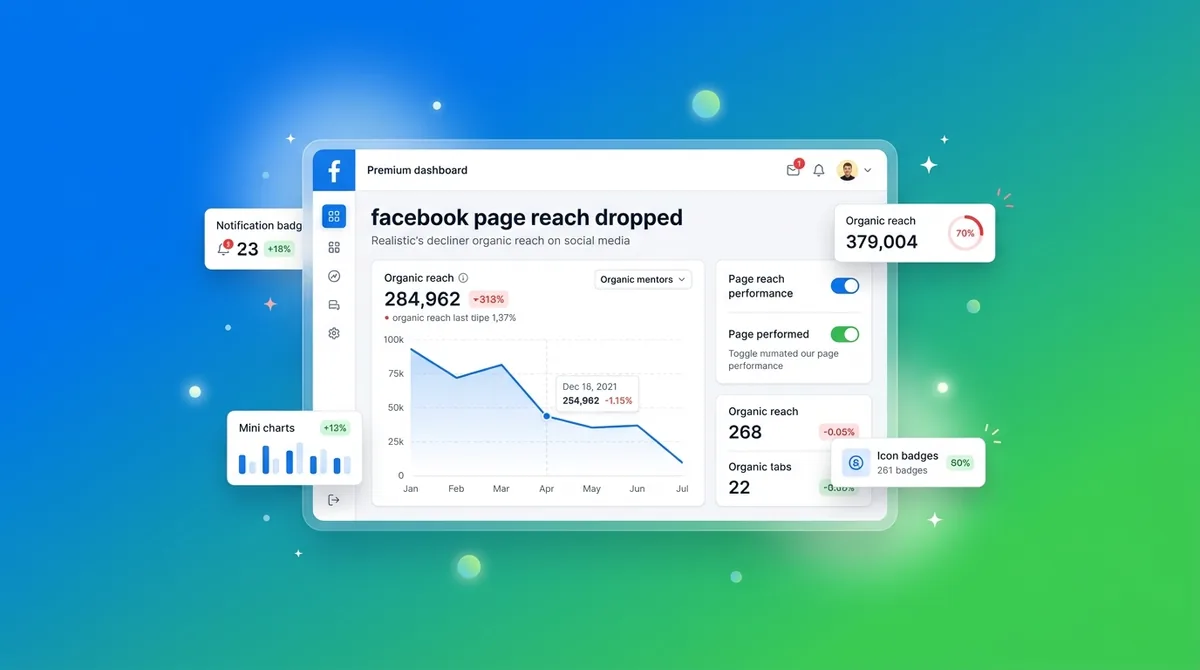
Passive vs. Active Signals in the Feed
There are two types of engagement, and most creators are optimizing for the wrong one.
"Thin" engagement consists of passive signals. A quick like. A generic clapping emoji. A three-second video view. Five years ago, this was enough to push your post into the viral ecosystem. Today, the algorithm barely registers it.
What actually works is "thick" engagement. Multi-sentence comments where users reply to each other. People sharing your post to their own feeds with added commentary. Saving the post to reference later. These active signals tell the machine learning model that your content isn't just taking up space—it's actively holding human attention.
The Content Saturation Paradox
The sheer volume of content uploaded every minute creates a ruthless survival-of-the-fittest environment. Your organic reach is suffocating under a mountain of competing media.
Because feed real estate is so limited, the decay rate of a standard Facebook update has shrunk. The half-life of a post used to be a full day. Now, if a post doesn't generate thick engagement within the first hour, the algorithm quietly buries it. Early engagement velocity dictates your ultimate reach.
Core Strategy: Prioritizing High-Velocity Engagement
Reach is earned through immediate post-publication activity. It is a direct reflection of how your audience behaves in those critical first 30 minutes.
Mastering 'Meaningful Social Interactions' (MSI)
Facebook prioritizes conversation threads because typing out a reply requires a user to stop scrolling entirely. It breaks the passive habit loop.
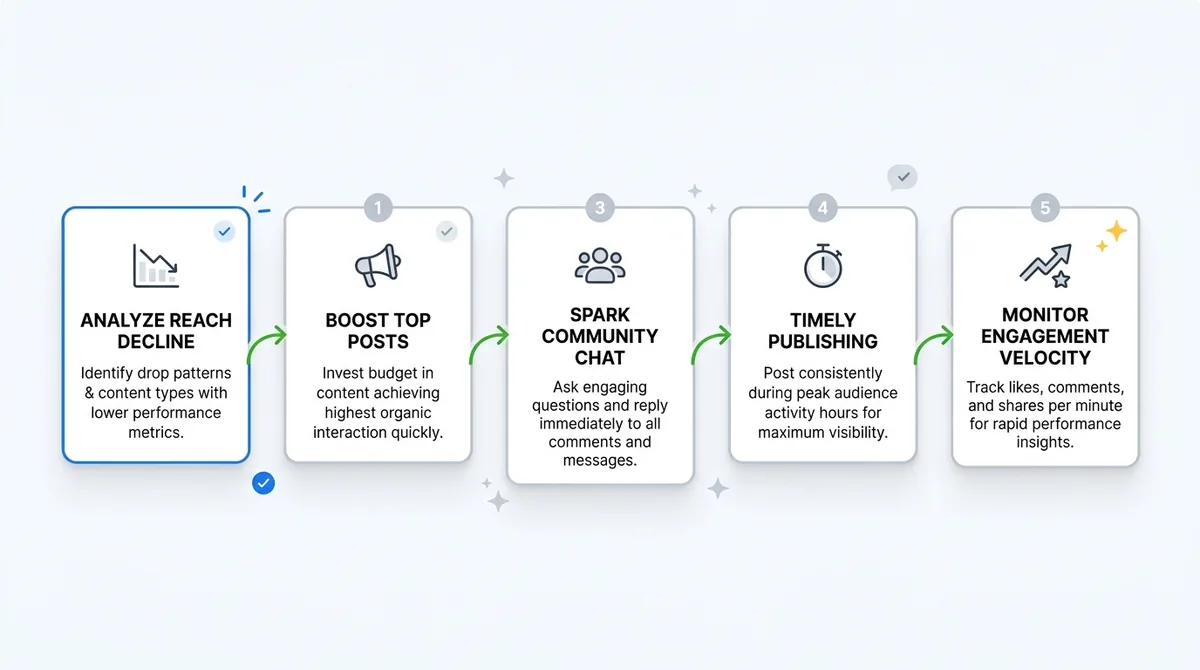
Most creators ask generic questions like "Do you agree?" to try and game this. In practice, this rarely matters. The AI can recognize low-effort engagement bait. Instead, you need to embed an engagement trigger in your first two sentences. Frame a slightly controversial opinion or ask a highly specific "how would you handle this" scenario. You want people arguing, agreeing heavily, or sharing long personal anecdotes in the comments.
The 'Native Content' Advantage
The fastest way to kill your distribution is sending people to another website. Facebook rewards users for keeping traffic locked inside its own ecosystem.
If you have a great YouTube video, do not just drop the YouTube link on your page. The algorithm will suppress it because you are threatening their retention metrics. Instead, upload the raw video file natively. Better yet, if you want to study exactly what works natively, use a free Facebook downloader to save viral competitor videos to your desktop. Study their first three seconds frame by frame to see how they hook viewers without relying on external platforms.
The Reach-Killer Checklist: 4 Habits to Break
If your Facebook page reach dropped off a cliff recently, audit your last ten posts against these common missteps.
1. Over-Optimizing for External Clicks
We just touched on this, but the "Link Penalty" is very real. If every post you make includes a link to your blog, Shopify store, or newsletter, you are signaling to Facebook that your page is a leaky bucket.
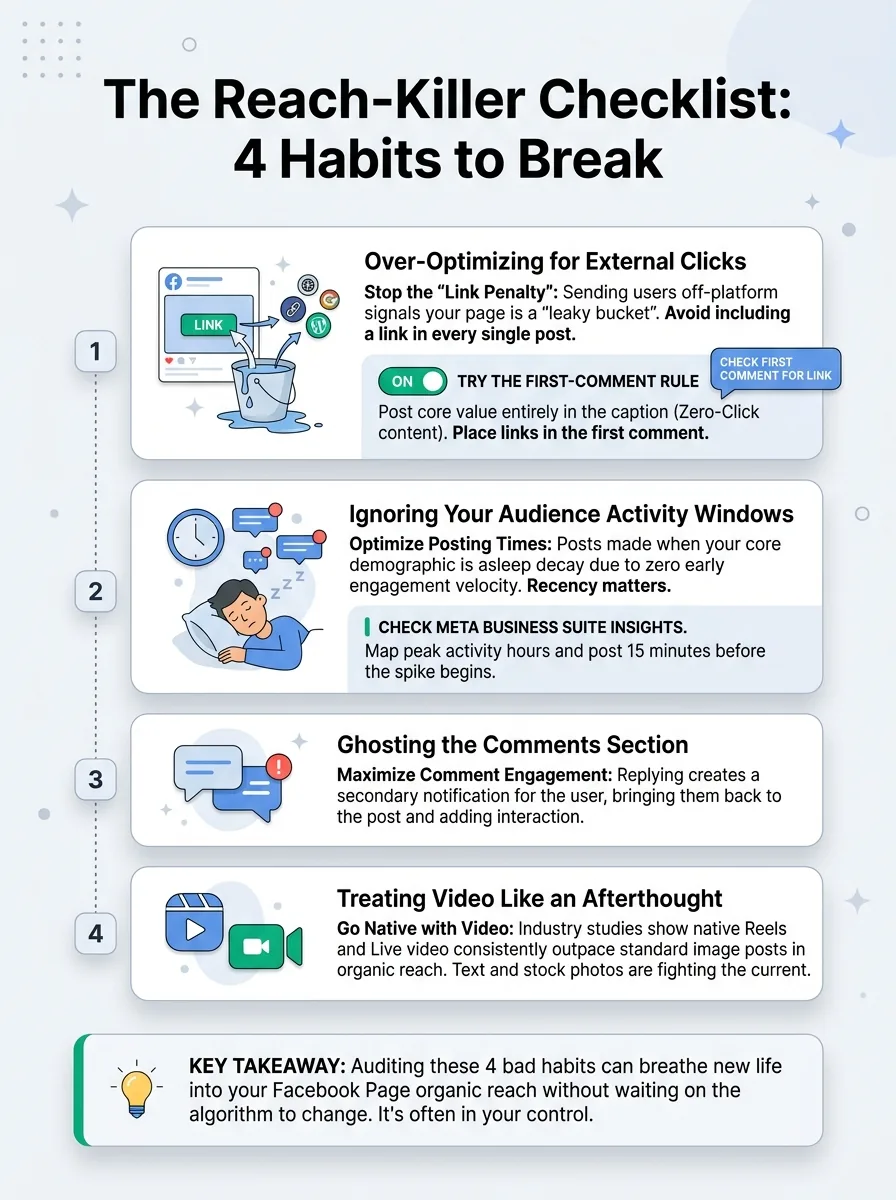
Try the first-comment rule. Post the core value entirely in the caption (Zero-Click content), and tell readers to check the first comment for the link.
2. Ignoring Your Audience Activity Windows
The recency signal matters. If you post a brilliant update at 2 AM when your core demographic is asleep, the early engagement velocity will be zero. By the time they wake up, your post has already decayed.
Check your Meta Business Suite insights to map the exact peak activity hours for your unique followers. Post 15 minutes before that spike begins.
3. Ghosting the Comments Section
If someone takes the time to write a thick comment and you ignore it, you waste a massive opportunity. Replying to comments creates a secondary notification for that user, bringing them back to the post and adding another interaction to the total tally.
4. Treating Video Like an Afterthought
Recent studies from industry research firms like Socialinsider show that native Reels and Live video consistently outpace standard image posts in organic reach. If you are only posting text and stock photos, you are fighting the current.
The Consistency Bridge: Why Perfection is the Enemy of Reach
Here is a trap I see creators fall into all the time. You spend a week researching the algorithm, you craft one "perfect" native video, you post it, and it does decently. Then you burn out and don't post again for nine days.
The algorithm needs a predictable stream of data to map your audience graph. Sporadic posting prevents the AI from learning who to actually show your content to. The real issue isn't usually a "bad post"—it's the lack of a consistent behavioral feedback loop.
That is where automation becomes your best friend. The goal is to build consistency without living inside the app. By mapping out your high-engagement posts in a visual Facebook Scheduler, you ensure you never miss those peak audience activity windows. SocialCal acts as the bridge between your content strategy and the algorithm's demand for relentless consistency. You write the posts when you feel creative, but the system publishes them exactly when the algorithm is hungriest.
Facebook Reach FAQ
Why is my Facebook reach so low in 2024?
Reach is low because feed space is hyper-competitive and Meta prioritizes "Meaningful Social Interactions." If your posts don't generate immediate, long-form comments and shares, the algorithm suppresses them in favor of content that keeps users actively engaged.
How can I see who is following my page?
Go to your Page, click on Settings, navigate to the "People and Other Pages" tab, and you can view a list of users who currently like or follow your page. You can also use Meta Business Suite for a broader demographic breakdown.
Does editing a post kill its reach?
Yes, editing a post shortly after publishing often temporarily stalls its distribution while the algorithm re-evaluates the new text for policy violations. It's better to double-check your copy before hitting publish or use a scheduling tool to catch errors in advance.
Is there a 'shadowban' on Facebook pages?
While creators heavily use the term shadowban, a sudden drop in reach is almost always a quality or engagement issue, not a secret ban. Unless you have actively violated Community Standards (which you can check in Page Quality settings), your content simply isn't passing the algorithm's engagement thresholds.
Conclusion: Reclaiming Your Feed Presence
Getting your distribution back requires a fundamental shift in how you view the platform. Stop broadcasting at your audience and start designing content that forces a conversation. You cannot control the machine learning model, but you have total control over the behavioral signals you feed it.
Growth isn't about perfectly gaming the system once. It is about consistently showing up with high-value, native content that respects the platform's rules. Take your top ideas, queue them up in SocialCal so you hit those critical active windows, and let the consistency do the heavy lifting.