Why Your TikTok Growth Has Hit a Plateau (And How a Series Fixes It)
You post a video. It pops off. Half a million views overnight.
Jump to a section:
- Why Your TikTok Growth Has Hit a Plateau (And How a Series Fixes It)
- The Psychological Friction: Why Random Posting Kills Your Reach
- Strategy 1: Identify Your 'High-Intent' Content Pillars
- Strategy 2: Master the 'Open Loop' Narrative Structure
- Strategy 3: Optimize for the 'TikTok SEO' Feedback Loop
- Strategy 4: Implement Visual and Verbal Branding Cues
- Strategy 5: Use 'Comment-to-Video' Growth Engines
- Why Most TikTok Series Fail: 5 Common Pitfalls
- Real-World Examples of High-Growth TikTok Series
- The Consistency Bridge: Why Execution Beats Strategy
- The 7-Step TikTok Series Checklist for Rapid Growth
- Frequently Asked Questions About TikTok Series
- Conclusion: Start Building Your Brand Authority Today
You wake up feeling like you finally cracked the algorithm. You rush to check your profile, expecting to see a flood of new fans. But the reality is entirely different. You gained exactly 14 new followers. The video dies two days later, and your next upload barely breaks 200 views.
Sound familiar?
This is the one-hit-wonder trap. Most creators think TikTok growth is about engineering the perfect viral moment. They chase trends, use trending audio, and pray the algorithm blesses them again. But viral views without retention are useless vanity metrics.
Growth isn't about luck. It is about building repeatable systems that train both the algorithm and your audience to expect highly specific value from your account.
Ready to save 15+ hours every week?
Join other creators who've automated their social media with SocialCal.
Get started freeWhat is a tiktok series strategy for growth?
A tiktok series strategy for growth is a structured content plan where you produce a sequence of related videos solving one specific problem. Grouping content creates binge-worthy loops, signaling high authority to the algorithm and dramatically increasing profile visits and follower conversion rates.
The Psychological Friction: Why Random Posting Kills Your Reach
You need to understand how the platform actually routes traffic. The For You Page (FYP) functions brilliantly as a discovery engine. It puts your content in front of strangers based on their micro-behaviors. But it is a terrible retention engine.
If there is no thematic continuity between your videos, you create massive cognitive friction for the viewer.
Imagine a user sees your funny skit about corporate meetings. They laugh, click to your profile, and see a grid consisting of a gym vlog, a cryptocurrency hot take, and a video of your dog. Their brain burns calories trying to categorize what you actually do. Because they can't figure it out in three seconds, they bounce.
This triggers the Algorithm Training Cycle. When users visit your profile and leave without watching more or following, the algorithm records a negative signal. It assumes your content was clickbait or low quality. If you want the algorithm to push your content, you have to prove you can keep people on the app for extended sessions.
Strategy 1: Identify Your 'High-Intent' Content Pillars
Choosing one narrow topic works infinitely better than being a generalist. The TikTok algorithm relies on entity recognition. It scans your text, speech, and captions to map your account to a specific cluster of users.
When you talk about a dozen different things, the algorithm's confidence score in your account drops. It doesn't know who your ideal viewer is, so it stops testing your content.
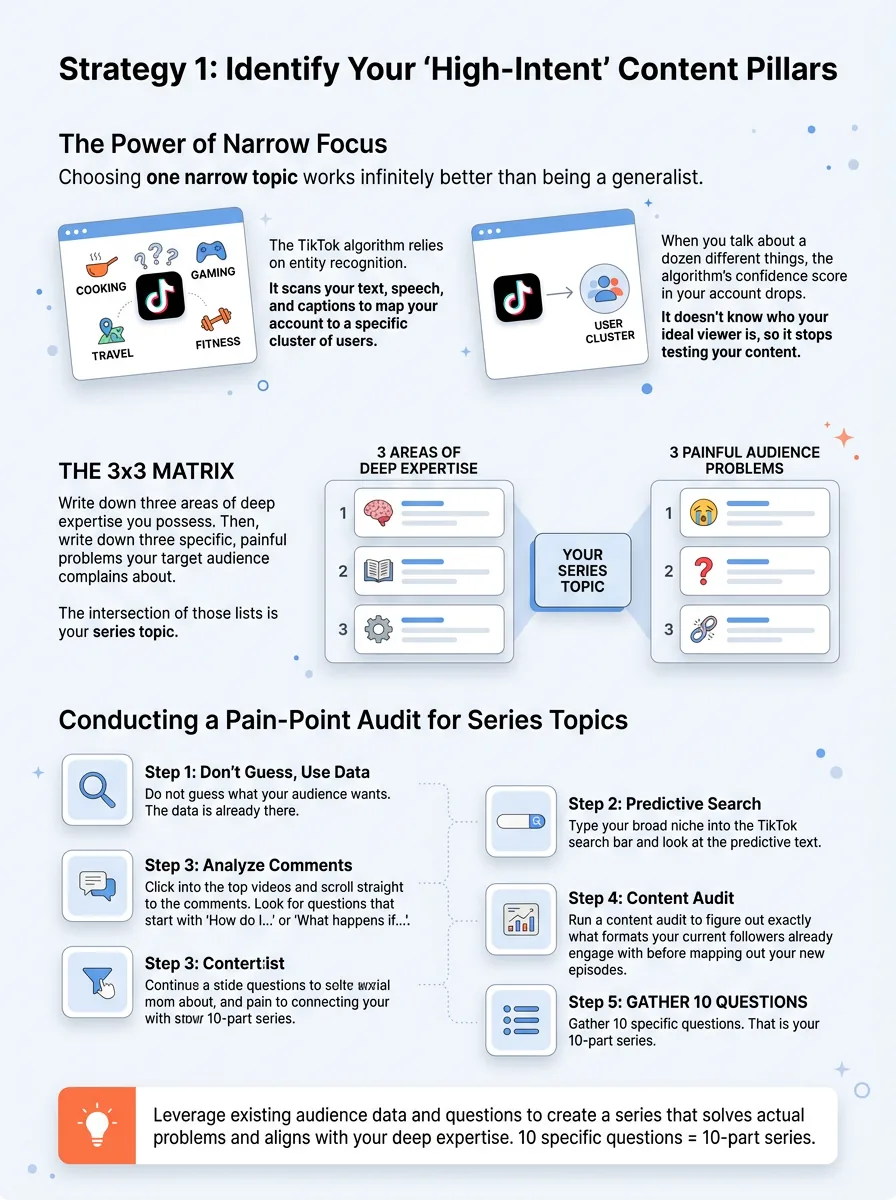
To fix this, use the 3x3 Matrix. Write down three areas of deep expertise you possess. Then, write down three specific, painful problems your target audience complains about. The intersection of those lists is your series topic.
Conducting a Pain-Point Audit for Series Topics
Do not guess what your audience wants. The data is already there.
Type your broad niche into the TikTok search bar and look at the predictive text. Then, click into the top videos and scroll straight to the comments. Look for questions that start with "How do I..." or "What happens if...". You can run a content audit to figure out exactly what formats your current followers already engage with before mapping out your new episodes.
Gather 10 specific questions. That is your 10-part series.
Strategy 2: Master the 'Open Loop' Narrative Structure
Psychology dictates how we consume media. The Zeigarnik Effect, a well-documented psychological principle, states that humans are wired to remember uncompleted tasks and crave closure. Psychology Today notes that our brains essentially hold onto open loops until they are resolved.
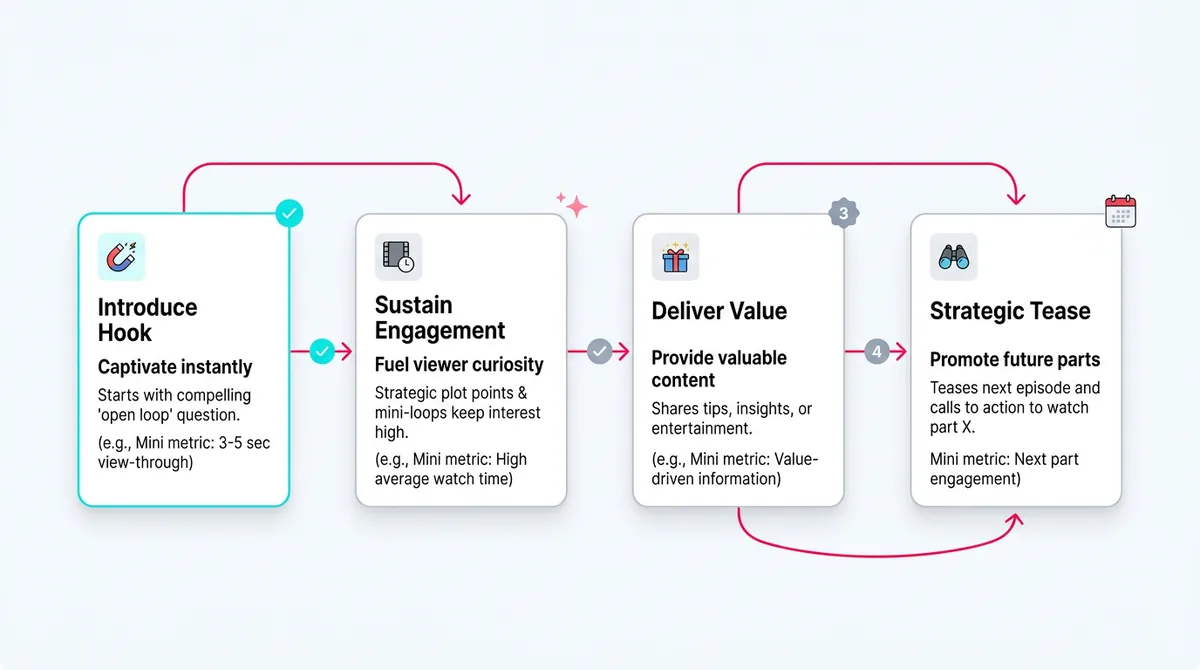
A TikTok series artificially creates an open loop that spans multiple videos.
You solve a micro-problem in the current video, but end with a cliffhanger that introduces the next logical problem. Viewers who want the complete solution are forced to follow you to get the ending.
Writing Sequential Hooks to Increase 'Profile Visits'
Your hooks need to do heavy lifting. Instead of just stating the topic, tie it to the broader narrative.
Start Episode 3 by saying, "In Part 1 and 2 we fixed your lighting and camera settings, but Part 3 is where most creators ruin their audio." This achieves two things. First, it tells the viewer this is part of a larger curriculum. Second, it creates FOMO. Anyone who missed the first two parts will immediately click your profile icon to catch up.
That profile click is a massive positive signal to the algorithm.
Strategy 3: Optimize for the 'TikTok SEO' Feedback Loop
TikTok is rapidly shifting from an entertainment feed to a utility platform. TikTok has publicly confirmed its focus on search-intent features, meaning users are treating the app like Google.
A series allows you to dominate a specific keyword cluster.
When every video in your series includes the same core keywords in the speech, the on-screen text, and the caption, you tell the search engine exactly where to rank you. If someone searches "how to grow tomatoes indoors," and you have a 5-part series heavily optimized for those exact words, your entire profile gets served up as the ultimate authority.
Structuring Your Series Playlists for Maximum Watch Time
Do not rely on users manually finding the next video. Use the Playlist feature.
Group your series content into a dedicated playlist and name it using your primary keyword. When a user watches a video from a playlist, TikTok automatically auto-plays the next video in that sequence when the first one ends. This skyrockets your average watch time metrics across your entire account.
Strategy 4: Implement Visual and Verbal Branding Cues
Familiarity breeds trust. The human brain looks for patterns to reduce cognitive load.
If every episode of your series looks completely different, the viewer won't realize they are watching a cohesive program. You need visual and verbal anchors. Record every episode in the exact same chair, with the exact same lighting, wearing the same style of shirt.
Develop a signature intro phrase. "Welcome back to Day 4 of fixing your resume." When a user scrolls rapidly through the FYP, that visual familiarity stops their thumb. They recognize you before their conscious brain even processes what you are saying.
Strategy 5: Use 'Comment-to-Video' Growth Engines
The algorithm actively rewards accounts that use native features to build community. The "Reply with Video" feature is arguably the strongest retention tool on the platform.
Post Episode 1. Wait for the comments to roll in. Find the most insightful, upvoted question, and use that specific comment as the visual hook for Episode 2. This proves to your audience that you are actually listening.
If you want to study how top creators execute this format, use a TikTok downloader to grab their best Q&A videos, strip the watermark, and break down their pacing frame by frame in your editing software. Seeing exactly how many seconds they spend on the question before delivering the answer will completely change how you edit.
Why Most TikTok Series Fail: 5 Common Pitfalls
Even with a good topic, execution is where most creators stumble. Avoid these early mistakes that signal poor quality to the algorithm.
The 'Over-Production' Trap That Kills Momentum
You do not need cinema-grade lighting or five hours of editing for a TikTok video. When you over-produce Episode 1, you set an unsustainable standard. You realize Episode 2 will take another five hours, so you procrastinate. The series dies before it starts. Speed and clarity are far more important than production value.
Lack of Thematic Continuity Across Episodes
Don't change the vibe halfway through. If your series started as a hyper-tactical, screen-recording tutorial, do not make Episode 4 a talking-head vlog from your car. Changing formats resets the algorithm's understanding of your content and alienates the audience who subscribed for the original format.
Ignoring the 'Episode 1' Performance Barrier
Here is what nobody tells you about starting a series.
Episode 1 usually does well. Episode 2 and 3 will almost always see a massive drop in views. Most creators panic here and abandon the project. Don't. The algorithm hasn't connected the videos yet. Once you hit Episode 4 or 5, the binge-loop kicks in. A new viewer finds Episode 5, watches all previous parts, and suddenly the views on Episode 2 skyrocket retroactively.
Real-World Examples of High-Growth TikTok Series
Look at the "30-Day Transformation" format. A fitness creator documents 30 days of fixing their posture. Day 1 gets decent traction. By Day 14, the audience is emotionally invested. By Day 30, the account has grown by 50,000 followers because people wanted to see the final result. The narrative arc drove the growth.
Another strong format is "The Daily Industry Secret." A marketing agency owner shares one thing PR firms don't want you to know, every day for a week. The format is identical every time: same desk, same hook structure, fast pacing. The repetition builds massive authority.
The Consistency Bridge: Why Execution Beats Strategy
The real reason most series strategies fail isn't the underlying idea. It is the friction of daily posting.
The algorithm heavily rewards accounts that publish at consistent intervals because it can predict viewer behavior. If you post at 9 AM every day, the system learns to allocate traffic to you at 9 AM. But life gets in the way. You get busy, you forget to post, or you simply don't have the energy to open the app and write a caption on a Tuesday afternoon.
That friction breaks the habit loop you are trying to build with your audience.
Removing the manual work is how you actually execute a series. By using a TikTok scheduler directly from your desktop, you can batch-edit all 10 episodes on a Sunday and line them up for the next two weeks. You remove the emotion from posting. Your content hits the algorithm exactly when it needs to, keeping your series hot in the feed while you focus on brainstorming the next idea.
The 7-Step TikTok Series Checklist for Rapid Growth
Do not hit post until you have run your concept through this framework.
Nail the macro-topic. Choose a problem your audience actually asks about in the comments.
Map out 5 to 10 micro-episodes. Each video should solve only one specific piece of the larger puzzle.
Standardize your visual hook. Pick your filming location, your lighting setup, and stick to it for the entire run.
Write sequential scripts. Ensure every single episode references the previous one and teases the next.
Batch record the whole series. Doing this in one sitting ensures your energy levels and pacing remain identical across parts.
Inject your core keyword. Your text overlay in the first 3 seconds must contain the exact phrase your target audience searches for.
Create the playlist. Group them immediately upon publishing so auto-play does the retention work for you.
Frequently Asked Questions About TikTok Series
How long should a TikTok series be?
Start with 5 to 10 episodes. This is long enough to build a bingeable catalog but short enough that you won't get burned out if the topic misses the mark. If the series performs exceptionally well, you can always extend it or create a "Season 2".
Can I have multiple series running at once?
If you have under 10,000 followers, stick to one series at a time. Your goal is to train the algorithm on a single entity. Once you have a larger, established audience that understands your brand, you can interleave two different series (e.g., posting Series A on Mondays and Wednesdays, and Series B on Tuesdays and Thursdays).
Ready to save 15+ hours every week?
Join other creators who've automated their social media with SocialCal.
Get started freeConclusion: Start Building Your Brand Authority Today
Growth isn't about chasing the perfect viral trend. It is about becoming the predictable, high-value solution to your audience's problems. A structured series builds the repetition required to turn casual scrollers into loyal followers. Lock in your topic, script your open loops, and let SocialCal handle the daily publishing so you never break your consistency.