Stop Posting Into the Void: Why Your TikTok Timing Matters
You spend three hours scripting, shooting, and editing a video. You find the perfect trending audio. The hook is punchy. Your captions are incredibly clean. You hit publish, set your phone face down, and wait for the dopamine rush.
Jump to a section:
- Stop Posting Into the Void: Why Your TikTok Timing Matters
- What is the Best Time to Post on TikTok?
- The Psychology of the Scroll: Why Timing Is Hard to Master
- Strategy 1: Target the Global 'Golden Windows'
- Strategy 2: Reverse-Engineer Your Creator Analytics
- Strategy 3: The 'Time-Zone Split Test' Method
- Why Most People Still Get Bad Results (5 Common Mistakes)
- Real-World Examples: Timing Success vs. Failure
- Why Consistency Beats Finding the 'Perfect' Second
- The 5-Step TikTok Posting Framework
- TikTok Timing FAQ
- Conclusion: Start Your 7-Day Experiment
Zero views.
Two hours later? Maybe twelve views, and half of those are just you rewatching it. It feels like you are screaming into an absolute void. The algorithm did not randomly decide to hate your account today. Your content is probably fine. Your timing was just completely off.
Ready to save 15+ hours every week?
Join other creators who've automated their social media with SocialCal.
Get started freeFinding the best time to post on tiktok is the invisible barrier separating stagnant accounts from viral momentum. I see brilliant creators fail every day simply because they upload their best work while their target audience is sitting in morning traffic or fast asleep. I am going to show you exactly how to find your specific window to hit the For You Page, using actual data instead of blind guessing.
What is the Best Time to Post on TikTok?
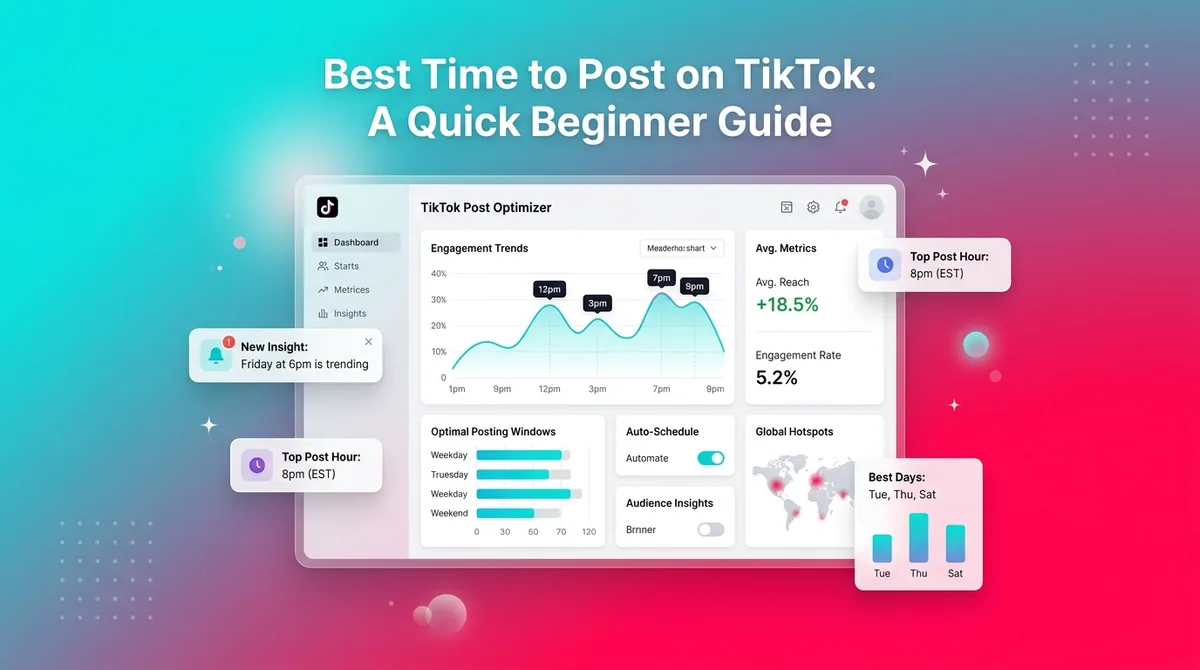
Generally, the best times to post on TikTok are Tuesday at 9 AM, Thursday at 12 PM, and Friday at 5 AM (EST). However, the absolute optimal time depends heavily on your specific audience's location and active hours, which you can easily find inside your TikTok Creator Analytics dashboard.
The Psychology of the Scroll: Why Timing Is Hard to Master
Most creators think a good video will eventually find its audience regardless of when it goes live. In practice, this rarely happens.
You end up with what I call a "Zombie Post." It is alive on your profile grid, but entirely dead on the feed. The platform relies heavily on behavioral habit loops. Human beings check their phones at very predictable times of day. There is the morning coffee scroll. The fifteen-minute lunch break binge. The mindless, hour-long pre-sleep scroll in bed. If your content lands completely outside these ingrained behavioral loops, nobody is there to give it the initial engagement it desperately needs.
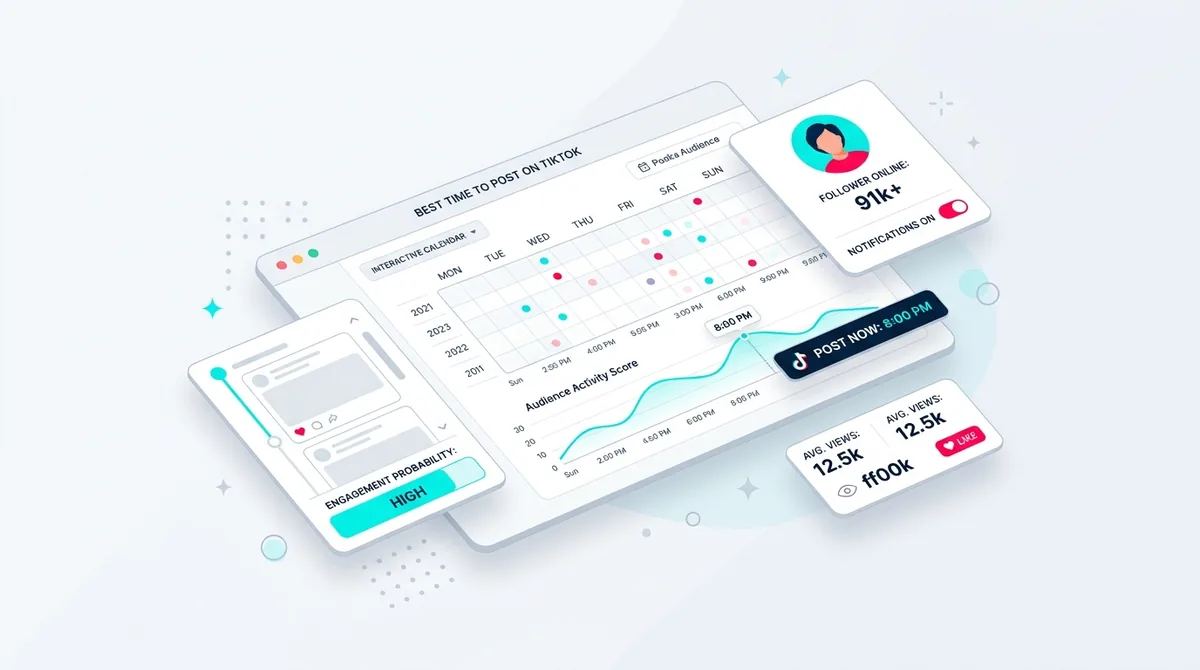
The Algorithm Learning Cycle
The system evaluates your content in small, highly calculated batches.
When a video goes live, it gets pushed to a tiny fraction of your followers and a select sliver of the For You Page. The algorithm measures the engagement velocity strictly in those first two hours. Are people watching the whole thing? Are they hitting the share button? If you publish at 3 AM when your core demographic is in deep sleep, that initial test batch performs terribly. The algorithm registers the low watch time, assumes the video is boring, and immediately stops distribution. The momentum is dead before sunrise.
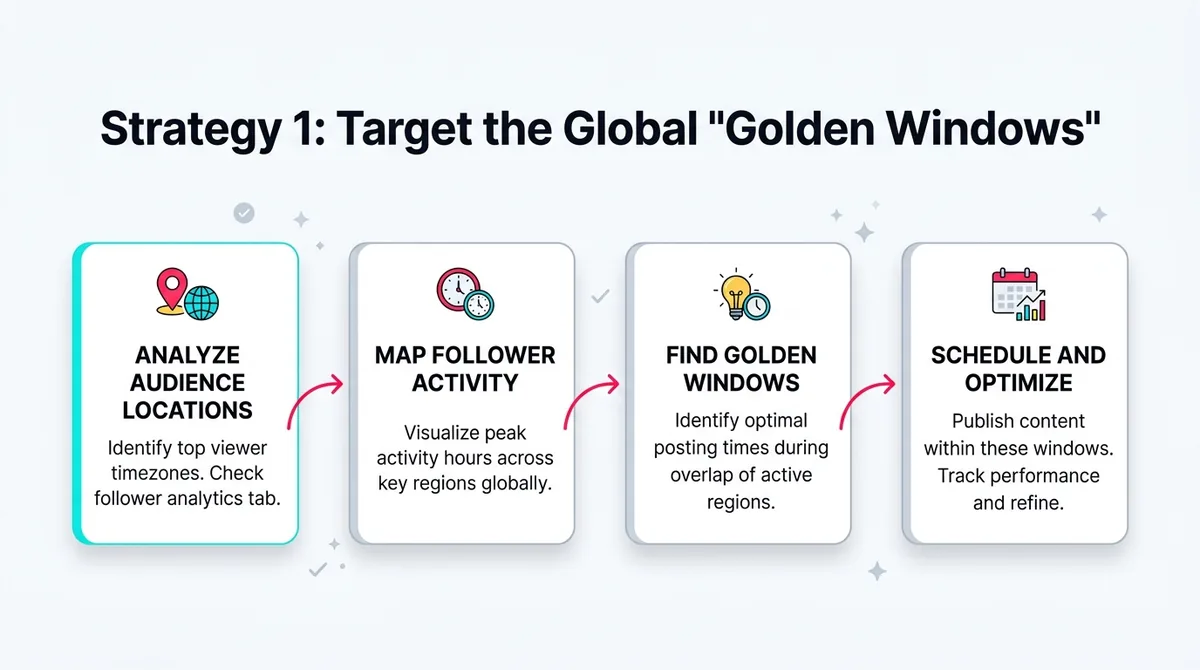
Strategy 1: Target the Global 'Golden Windows'
Sometimes you need a solid baseline before you have enough personal account data to work with. Broad platform data gives us a reliable starting point.
There are universal windows that simply work mechanistically. These windows capture users across multiple time zones simultaneously, maximizing your early engagement velocity. Posting at 9 AM EST means you are catching New Yorkers on their morning commute and Londoners finishing up their workday. These overlapping zones generate massive initial engagement signals that force the algorithm to take notice.
Breaking Down the High-Traffic Days
Tuesdays and Thursdays consistently outperform other days of the week.
Why does this happen? By Tuesday, the chaotic Monday morning email catch-up is finally over. People settle back into their normal distraction routines at their desks. Thursday brings pre-weekend fatigue. Office workers and college students alike are checking out mentally, meaning their passive screen time skyrockets. You want your content waiting for them when they open the app to procrastinate.
Strategy 2: Reverse-Engineer Your Creator Analytics
Global data is a great safety net. Your own analytics are the actual blueprint.
Switch to a Business or Creator account right now and look at your Follower Activity tab. This graph shows you the exact hours your specific tribe is online. Stop guessing what time works best. The data literally tells you when to show up. If your graph spikes at 7 PM every single day, that is your primary target window.
Identifying Your Audience's Time Zone Centers
You need to calculate the time offset.
The platform displays your analytics in UTC (Coordinated Universal Time). If your peak follower activity shows up at 8 PM UTC, and you live in Chicago (CST), you need to subtract five hours. Your actual local posting target is 3 PM. Most creators completely miss this conversion step. They look at the raw chart and post at 8 PM local time, missing their audience window entirely for months on end.
Strategy 3: The 'Time-Zone Split Test' Method
Theory is great, but experimentation always beats theory.
Over a seven-day period, post the exact same visual format at three radically different times. Try 8 AM, 1 PM, and 7 PM. Keep your hook style and video length identical so you are isolating the timing variable. Track the ratio of total reach versus the hour it was published. You will almost always spot a glaring outlier where one specific slot drives double the baseline views.
Analyzing the 'Watch Time' Metric
A high watch time at 2 AM is actually far more valuable than a mediocre watch time at 6 PM.
Late-night scrollers are a captive audience. They are laying in bed, watching full loops without the distraction of a boss walking by or a train arriving. If you spot these weird late-night watch time anomalies in your analytics, lean into them. The algorithm values completion rate above almost every other metric.
Why Most People Still Get Bad Results (5 Common Mistakes)
Even armed with the best data, creators constantly shoot themselves in the foot.
Posting and ghosting. The algorithm loves seeing the creator replying to early comments in the first thirty minutes.
Relying on out-of-date analytics. User habits change drastically during summer break versus the winter holidays.
Constantly shifting the posting time every single day out of panic.
Using a personal account, effectively locking yourself out of the detailed follower metrics you need to succeed.
Completely ignoring how user behavior shifts on the weekends.
Mistake: Treating Weekends Like Weekdays
Saturday behavior is entirely different from a typical Tuesday.
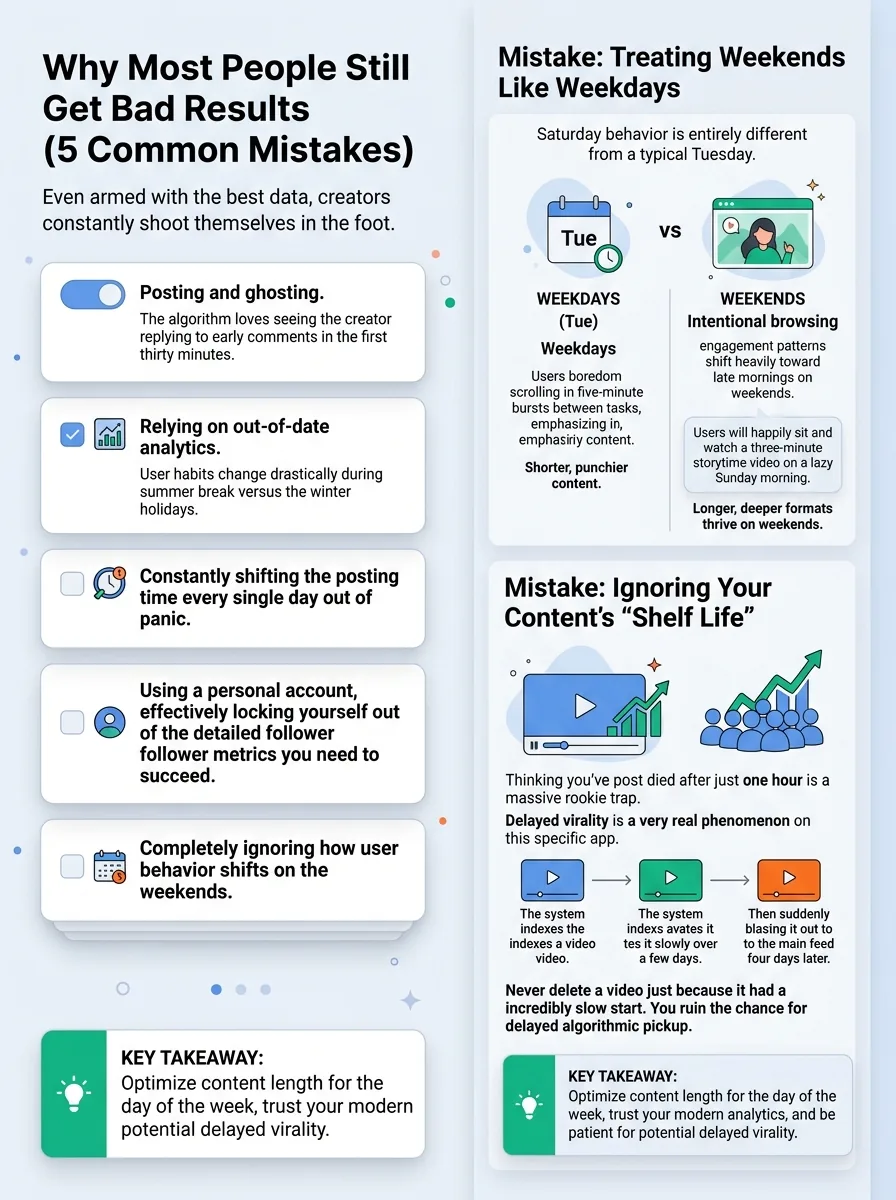
During the week, users are boredom scrolling in five-minute bursts between tasks. On weekends, they engage in much more intentional browsing. According to data from Sprout Social, engagement patterns shift heavily toward late mornings on weekends. Users will happily sit and watch a three-minute storytime video on a lazy Sunday morning. Shorter, punchier content works better on weekdays, while longer, deeper formats thrive on weekends.
Mistake: Ignoring Your Content's 'Shelf Life'
Thinking a post died after just one hour is a massive rookie trap.
Delayed virality is a very real phenomenon on this specific app. The system sometimes indexes a video, tests it slowly over a few days, and then suddenly blasts it out to the main feed four days later. Never delete a video just because it had a incredibly slow start. You ruin the chance for delayed algorithmic pickup.
Real-World Examples: Timing Success vs. Failure
Let's look at what this actually means in practice.
I worked with a fitness creator who was deeply frustrated by stagnant growth. She was posting her morning routine and meal prep videos at 8 PM. We shifted her entire schedule back to 6 AM. Her reach increased by 300 percent in two weeks. Mechanistically, she started catching people exactly when they were waking up, feeling motivated, and planning their own diets for the day. Context matched timing.
Conversely, a B2B SaaS brand tried posting their software tutorials on Sunday nights. They hit the classic Sunday slump. Nobody wants to think about optimizing enterprise software workflows while dreading Monday morning. The videos completely flatlined.
Why Consistency Beats Finding the 'Perfect' Second
Algorithms are simply pattern recognition machines.
They reward predictable, steady signals. If you publish at the exact same time every single day, the system learns to anticipate activity from your account. It actually primes your core audience. The real issue is not finding the perfect magic hour. It is being able to hit that exact hour every single day without fail, even when life gets in the way.
You probably have a life outside of content creation. That is exactly why the ongoing debate over manual posting vs scheduling is one you need to settle quickly. You cannot be tied to your phone, waiting to hit publish at exactly 2 PM during a family dinner or a work meeting. I rely on SocialCal to handle this exact friction point. Their TikTok scheduler lets you batch upload videos straight from your desktop and pushes them live automatically. You get the massive algorithmic benefit of consistency without the daily anxiety of watching the clock.
The 5-Step TikTok Posting Framework
Here is a quick checklist to fix your posting strategy right now.
Switch to a Business Account immediately to unlock your full data suite.
Audit your last seven days of video performance and look for clear velocity trends.
Select three core time slots based directly on your follower activity graph peaks.
Run your videos through a post previewer first to make sure native UI elements do not cover your crucial text hooks.
Schedule your entire week of content in advance so you never miss those core algorithmic windows.
Ready to save 15+ hours every week?
Join other creators who've automated their social media with SocialCal.
Get started freeTikTok Timing FAQ
Does posting too often shadowban you?
No. The algorithm evaluates each video individually. High frequency only hurts your account if your quality drops significantly, causing users to swipe away faster, which signals low value to the system.
Does my location matter if I use a VPN?
Yes. The platform relies heavily on your physical SIM card region, not just your IP address. A basic VPN alone rarely tricks the platform into pushing your content to a completely different country.
Is there an absolute best time for weekends?
Saturday mornings around 9 AM and Sunday evenings around 7 PM tend to perform best for broad, lifestyle-focused content.
Should I post at the exact same time every day?
Yes. Absolute consistency trains the algorithm to expect your content and helps establish a deeply ingrained viewing habit with your core followers.
Conclusion: Start Your 7-Day Experiment
Timing gets you through the door, but consistency keeps the door wide open. You now have the exact data frameworks you need to stop guessing and start hitting the algorithm's absolute sweet spots. Growth on this app is not about getting lucky with one random post. It is about building a behavioral system you can actually stick to long-term. Stop trying to remember to post manually, load your best videos into SocialCal's scheduler, set your newly optimized times, and let the algorithm do the heavy lifting for you.