A creator hits 10 million views, finally gets into payouts, opens the TikTok earnings tab… and sees $200. Their first thought: the math has to be wrong. If you’ve been trying to figure out how much does TikTok pay per view, that “this can’t be right” moment is exactly why you’re here.
Jump to a section:
- How much does TikTok pay per view?
- Why your TikTok payout email looked like a typo
- How much does TikTok pay per view (2026 reality)
- Two TikTok payout programs (and why they pay so differently)
- $20 per million isn’t the whole story (creators earn 5x more elsewhere)
- How to actually qualify (and the gotchas most creators miss)
- Mistakes that kill your TikTok earnings
- TikTok vs YouTube Shorts vs Reels — the real comparison
- From per-view earnings to platform-spread strategy
- Framework: Estimate your TikTok monthly income
- Frequently asked questions
- Why view count is the wrong scoreboard
The twist: they were in the old Creator Fund, not the newer Creativity Program. Those two programs pay wildly different rates, and most articles online mash them together like they’re the same thing. They’re not. At all.
How much does TikTok pay per view?
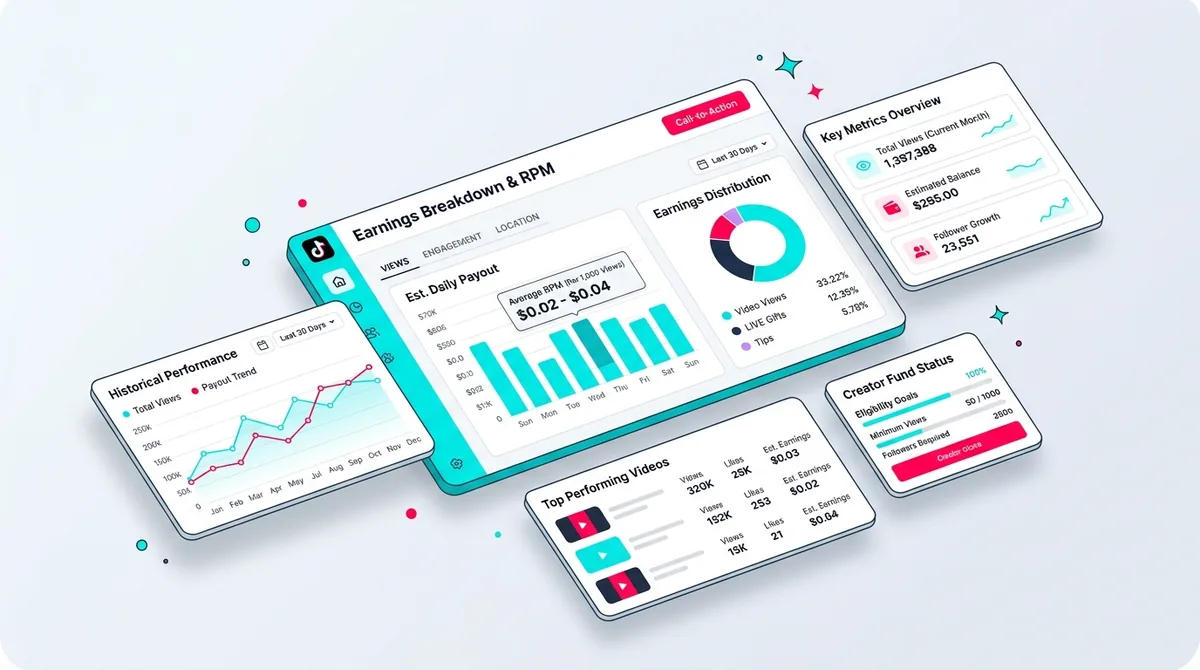
TikTok pays roughly $0.02–$0.04 per 1,000 views (around $20–$40 per 1 million views) through the legacy Creator Fund. Through the newer Creativity Program Beta, creators report around $1–$5 per 1,000 monetized views — roughly $1,000–$5,000 per 1 million views — but only on videos longer than 1 minute and if you’re fully eligible.
Why your TikTok payout email looked like a typo
Let’s start with the shock.
You grind out 3–4 videos a day for a month. One of them hits the For You Page lottery and does 5M views. Two others do 1M each. You finally see the “Your TikTok earnings are ready” email, open the dashboard… and there’s $137.69 sitting there.
I’ve seen that exact reaction from creators: screenshot, panic DM, “Is this per day?? Did it glitch??” Most of the time, nothing glitched. You were just in the wrong program with the wrong expectations.
Here’s the core problem: people Google “how much does TikTok pay per view,” skim one outdated article talking about a mysterious $0.02–$0.04 per 1,000 views, and assume that’s how TikTok always works. But that number is specifically the old Creator Fund, which is basically a fixed pool dividing pocket change between millions of creators.
The newer Creativity Program Beta is a different beast. It’s closer to an ad-revenue model, pays dramatically more per view, and only counts longer videos. So if you’re basing your entire income expectations on the old Creator Fund math, you’re setting yourself up to be disappointed.
Ready to save 15+ hours every week?
Join other creators who've automated their social media with SocialCal.
Get started freeMost creators aren’t “bad” at TikTok. They’re just misreading the scoreboard. They see a view count that feels huge and match it with earnings built on the wrong per-view rates and the wrong monetization rules. That gap is where burnout shows up.
How much does TikTok pay per view (2026 reality)
Let’s get specific, because vague averages are useless when you’re trying to plan actual income.
- Creator Fund: ~$0.02–$0.04 per 1,000 views (so roughly $20–$40 per 1M views)
- Creativity Program Beta: ~$1–$5 per 1,000 monetized views (so roughly $1,000–$5,000 per 1M monetized views)
Notice two key phrases:
- “Per 1,000 views” vs “per 1,000 monetized views” – not every view has an ad on it.
- “1 minute+ videos” – Creativity Program barely counts your 9-second trending-sound meme content.
So if you keep asking “how much does TikTok pay per view” but most of your content is 12-second lip-syncs with commercial music and viewers dropping off in 3 seconds… you’re technically getting views, but you’re starving your monetized view count.
Here’s a simple example to make it concrete:
- Video A: 10M views, 12 seconds, trending commercial song, average watch time 4 seconds → qualifies for Creator Fund only → maybe $200.
- Video B: 2M views, 75 seconds, original audio or commercial-safe track, watch time 60 seconds → qualifies for Creativity Program → might make $2,000–$6,000 depending on RPM.
Fewer views. More money. This is why “per view” is an overrated metric and “per 1,000 monetized views on long-form” is what you should actually care about.
Two TikTok payout programs (and why they pay so differently)
To understand why your friend with fewer views might be earning more, you have to separate the two systems in your head.
Creator Fund — the legacy program
The Creator Fund came first. TikTok announced it in 2020 with a $200M pool that they promised would grow to $1B+ in the US over three years. Sounds generous until you do the math across millions of creators and billions of daily views.
Mechanically, it works like this:
- TikTok sets a fixed budget for the Fund.
- All eligible creators’ views go into one giant bucket.
- The pool gets divided across that bucket based on performance, region, and a few black-box metrics.
Result? As more creators join and more videos go viral, your share of the pie shrinks. You might be crushing it compared to last year, but if the total pool is more crowded, your effective RPM (revenue per 1,000 views) drops.
Current rough eligibility for Creator Fund (in supported countries):
- 18+ years old
- At least 10,000 followers
- At least 100,000 video views in the last 30 days
- Live in eligible regions like the US, UK, France, Germany, Italy, Spain (TikTok sometimes expands this)
Most creators I know who were hyped about the Fund in 2020 are pretty disillusioned now. The payouts just haven’t scaled with the content growth. Which is exactly why TikTok rolled out something new.
Creativity Program Beta — the higher-payout successor
The Creativity Program Beta is TikTok’s answer to “why does this pay so little?” It started rolling out in 2023 and has been expanding countries and features through 2024–2025. It’s much closer to an ad-share model like YouTube, and it rewards exactly the kind of content TikTok wants: longer, more watchable videos.
Mechanism-wise, here’s what changes:
- Payments are based on ad revenue generated, not a fixed pot.
- More advertisers and higher ad spend → higher potential per 1,000 monetized views.
- Payouts scale better with engagement and region (US/UK traffic usually pays more than low-CPM countries).
The catch: TikTok only counts videos longer than 1 minute for this program, and it’s picky about what counts as “original” and “advertiser friendly.”
Typical numbers creators are seeing:
- $1–$5 per 1,000 monetized views (varies by niche, region, season)
- Higher RPMs in monetizable niches (finance, tech, education) and premium countries
The program has its own eligibility rules, similar to or slightly higher than the Creator Fund, and TikTok positions it as a replacement — once you switch, you can’t always go back. TikTok’s own documentation hints that the Fund is being phased out in favor of this model for many markets: see their help center and policy updates at https://www.tiktok.com/creators/creator-portal/en-us/creativity-program/.
So if you’re serious about making money from views, the real question isn’t just “how much does TikTok pay per view?” It’s “how quickly can I get into the Creativity Program and consistently publish 1+ minute videos?”
$20 per million isn’t the whole story (creators earn 5x more elsewhere)
Here’s the thing most non-creators misunderstand: the TikTok payout is usually the smallest slice of a successful creator’s income.
I’ve seen creators with 500K–800K followers making:
- $200–$400/month from Creator Fund or early Creativity Program
- $3,000–$10,000/month from brand deals, affiliate, and TikTok Shop
Realistic scenario for a 500K-follower account in a mid-tier niche (fitness, beauty, productivity):
- Views: 5M/month
- Creator Fund earnings: ~$150/month
- Creativity Program (if 40% are 1+ min and monetized): maybe $2,000–$4,000
- ONE sponsored integration: $3,000–$7,000
This is why serious creators don’t obsess only over “how much does TikTok pay per view.” They obsess over how much they earn per 1,000 views across their whole business.
Where the real money usually comes from:
- TikTok Creator Marketplace / direct brand deals – Brands pay for access to your audience. A 500K-follower creator can charge $2,000–$6,000 per integrated video if they have strong engagement.
- TikTok LIVE gifts – If you stream and build a tight community, gifts can out-earn your Creator Fund on their own.
- TikTok Shop affiliate – 10–30% commission on products you feature. A video that earns $10 from views can earn $300 in affiliate if it sells.
- Off-platform sponsors – YouTube sponsors, newsletter slots, podcast ads, etc. TikTok is the top-of-funnel.
- Paid communities / Patreon / OnlyFans – Converting a tiny fraction of your audience into paying superfans.
Imagine you post a 60-second skincare routine that gets 200K views. The Creativity Program might pay you $200–$400. But if you feature a cleanser on TikTok Shop with a 20% commission and 150 people buy it at $25, that’s $750 in affiliate from the same piece of content.
That’s why creators who rely only on platform payouts constantly feel broke, while creators who build an income stack can look at the same view count and see an actual business.
How to actually qualify (and the gotchas most creators miss)
TikTok’s monetization rules look simple on the surface, but the fine print is what kills your earnings.
Basic eligibility for monetization programs
In 2026, the general pattern (varies a bit by country/program) looks like this:
- Age: You must be 18+.
- Location: You need to live in supported countries (US, UK, France, Germany, Italy, Spain, and a growing list of others).
- Followers: Usually at least 10,000 followers.
- Views: At least 100,000 views in the last 30 days.
- Account status: No recent community guideline strikes, spam behavior, or repeated removals.
The exact thresholds shift as they test new rules, so check TikTok’s official monetization docs periodically: https://support.tiktok.com/en/using-tiktok/creator-portal/getting-started/creator-next-and-eligibility.
The big demonetization gotchas
This is where most creators lose money without realizing it.
- Non-licensed audio: If you use a commercial sound that isn’t cleared for commercial use, especially in trending music, that view count may be non-monetizable.
- Reused or compilation content: TikTok hates “re-upload culture.” Clips from TV, movies, TikToks stitched together, or straight reuploads often earn nothing.
- Borderline content: Anything edgy (violence, risky stunts, certain health claims) can be flagged as “limited ads.” That crushes RPM.
- Low-quality engagement: TikTok wants people to stay on the app. Extremely short watch times and swipe-aways hurt your monetization potential, even if the view count looks good.
The biggest “oh no” moment I see: a 10M-view video with a trending commercial track that made the account blow up… but earned almost nothing because the audio wasn’t cleared for monetization.
If you’re planning monetized content, build a habit of sticking to TikTok’s Commercial Music Library or original audio, especially once you’re in the Creativity Program. For viral idea research, it helps to save ideas locally using a TikTok Downloader and then remake them with your own audio and angle instead of straight reusing the original.
Mistakes that kill your TikTok earnings
Most people don’t fail because TikTok “doesn’t pay.” They fail because their content strategy is incompatible with how TikTok pays.
1. Relying on Creator Fund alone
If your entire plan is “go viral, live off Creator Fund,” you’re planning around poverty-level numbers. Even if you hit 20M views in a month, you’re still probably under $1,000 from the Fund.
What actually works is stacking:
- Switch to Creativity Program as soon as it’s available and you’re ready for 1+ minute content.
- Add brand deals and TikTok Shop affiliate.
- Use TikTok as traffic for higher-paying platforms (YouTube long-form, email list, memberships).
2. Using copyrighted commercial music
Yes, the trending Drake song will get you quick views. It will not get you reliable payouts. TikTok treats a lot of popular commercial tracks as non-commercial use only, which kills monetization.
So you end up with this painful scenario: your “for fun” clip with commercial music is your biggest video, while your carefully scripted monetizable video with safe audio gets half the reach.
The fix: decide upfront which videos are monetizable content. Use either original audio or tracks from the Commercial Music Library there. Save the flashy commercial tracks for brand awareness, not for videos you’re counting on for income.
3. Posting only short-form (under 1 minute)
If 100% of your content is 7–18 seconds long, you’re basically opting out of the Creativity Program’s higher payouts. Short clips are great for growth and testing hooks, but they cap your earnings from views.
A better setup is a mix:
- Short clips (9–20s) → hooks, memes, trends → primarily for growth.
- 1–3 minute videos → explanations, tutorials, stories → primarily for monetization.
Think of your short videos as ads for your long ones. They get people in the door and curious. The longer ones hold attention, show depth, and actually get paid.
4. Ignoring TikTok Shop affiliate
This one hurts to watch.
Creators will casually move $10,000 worth of product in a video and not have a single affiliate tag set up. Meanwhile, someone with 1/10th the views is making $2,000/month just from TikTok Shop because they actually turned their recs into links.
If you talk about specific products at all — skincare, books, camera gear, planners, clothing — you should be testing TikTok Shop or external affiliate links. A 10–30% commission product can absolutely wreck your “how much does TikTok pay per view” math, in a good way.
TikTok vs YouTube Shorts vs Reels — the real comparison
Same vertical video. Same energy. Completely different payout realities.
- TikTok Creator Fund: ~$20–$40 per 1M views.
- TikTok Creativity Program: ~$1,000–$5,000 per 1M monetized views (1+ min videos).
- YouTube Shorts: The old Shorts Fund is gone. As of 2024, Shorts are in the ad revenue share model, where creators get 45% of ad revenue allocated to Shorts. Numbers vary, but a lot of creators report $0.05–$2 per 1,000 views depending on niche and region.
- Instagram Reels: Reels Play Bonus was invite-only and inconsistent; some creators saw $0.01–$0.05 per 1,000 views before it was paused or reshaped in many regions.
So if the same video does:
- 1M views on TikTok (Creativity Program)
- 500K on YouTube Shorts
- 300K on Reels
Your monthly reality might look like:
- TikTok: $1,500 (mid-range RPM)
- YouTube Shorts: $200 (if RPM is around $0.40/1K)
- Reels: $0–$50 (if you’re even in a bonus program)
The content was the same. Distribution and monetization rules weren’t. That’s why smart creators ask:
“How do I get this one video onto every platform that pays anything?”
From per-view earnings to platform-spread strategy
Algorithms reward consistency and volume, not perfection. TikTok’s For You Page, YouTube’s Shorts shelf, Instagram’s Reels tab — they all test your videos with a small batch of viewers, measure early engagement, and decide whether to push harder based on that “engagement velocity.”
That means your real advantage isn’t one magic video. It’s how many decent videos you can get out there consistently across platforms. The more hooks you throw in the water, the more chances some of them take off in at least one feed.
The problem? Actually posting everywhere, every week, with your current energy levels.
The real issue usually isn’t “I don’t know what to post.” It’s “I can’t keep up with editing, exporting, formatting, and re-uploading to TikTok, Reels, Shorts, and Facebook without losing my mind.” That’s where scheduling and cross-posting save your sanity.
Here’s how a lot of full-time creators I know operate:
- Batch film 5–10 vertical videos in one afternoon.
- Edit once, then resize or trim in a tool like a Social Video Resizer if needed.
- Drop them into a scheduler with Multi-Platform Publishing, schedule to TikTok, Reels, Shorts, and Facebook Reels with platform-specific captions.
This way, TikTok pays whatever TikTok pays… but you’re also collecting on YouTube and IG at the same time, with almost no extra effort. A tool like SocialCal’s TikTok Scheduler plus its cross-posting setup turns “Did I remember to upload this everywhere?” into a one-time workflow instead of a daily panic.
Framework: Estimate your TikTok monthly income
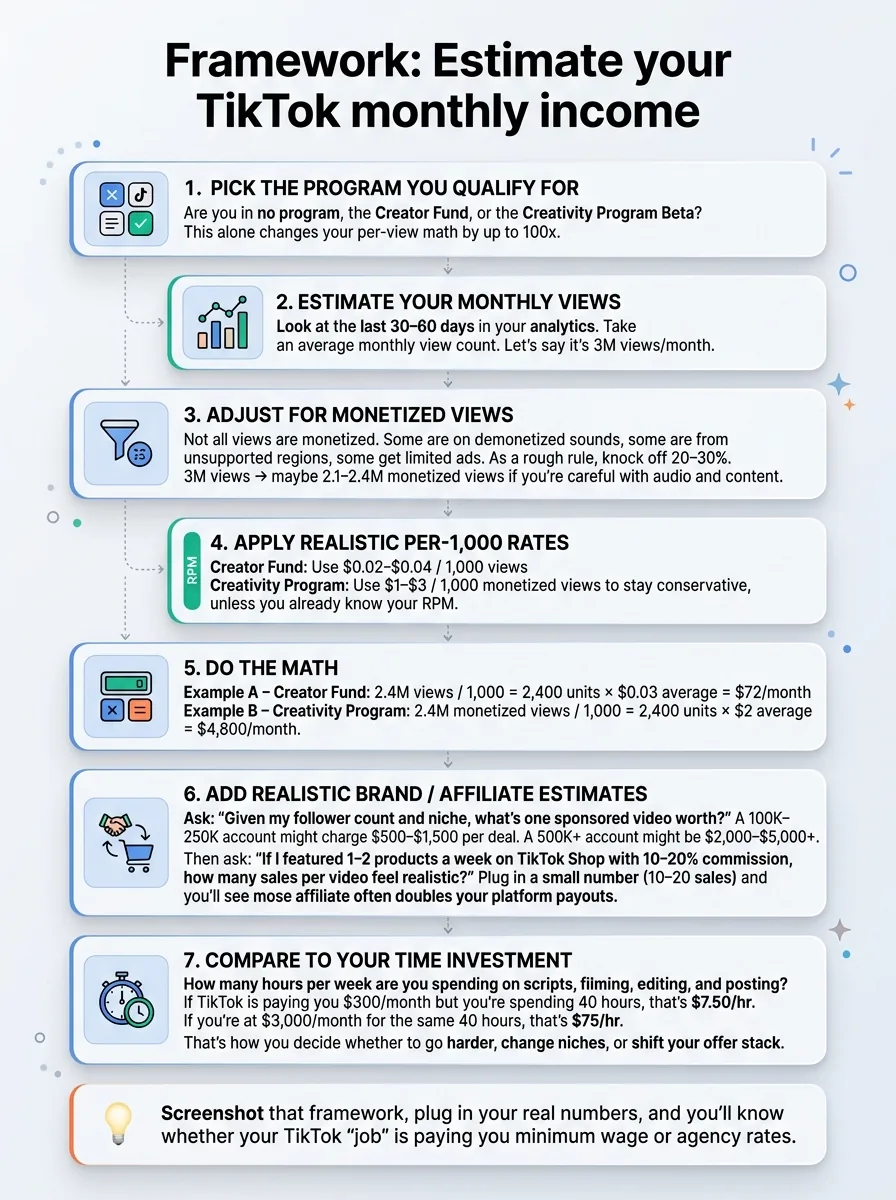
Let’s put numbers on this so you’re not guessing.
- Pick the program you qualify for
Are you in no program, the Creator Fund, or the Creativity Program Beta? This alone changes your per-view math by up to 100x. - Estimate your monthly views
Look at the last 30–60 days in your analytics. Take an average monthly view count. Let’s say it’s 3M views/month. - Adjust for monetized views
Not all views are monetized. Some are on demonetized sounds, some are from unsupported regions, some get limited ads. As a rough rule, knock off 20–30%.
3M views → maybe 2.1–2.4M monetized views if you’re careful with audio and content. - Apply realistic per-1,000 rates
- Creator Fund: Use $0.02–$0.04 / 1,000 views.
- Creativity Program: Use $1–$3 / 1,000 monetized views to stay conservative, unless you already know your RPM.
- Do the math
Example A – Creator Fund:
2.4M views / 1,000 = 2,400 units × $0.03 average = $72/month.
Example B – Creativity Program:
2.4M monetized views / 1,000 = 2,400 units × $2 average = $4,800/month. - Add realistic brand / affiliate estimates
Ask: “Given my follower count and niche, what’s one sponsored video worth?” A 100K–250K account might charge $500–$1,500 per deal. A 500K+ account might be $2,000–$5,000+.
Then ask: “If I featured 1–2 products a week on TikTok Shop with 10–20% commission, how many sales per video feel realistic?” Plug in a small number (10–20 sales) and you’ll see affiliate often doubles your platform payouts. - Compare to your time investment
How many hours per week are you spending on scripts, filming, editing, and posting? If TikTok is paying you $300/month but you’re spending 40 hours, that’s $7.50/hr. If you’re at $3,000/month for the same 40 hours, that’s $75/hr. That’s how you decide whether to go harder, change niches, or shift your offer stack.
Screenshot that framework, plug in your real numbers, and you’ll know whether your TikTok “job” is paying you minimum wage or agency rates.
Ready to save 15+ hours every week?
Join other creators who've automated their social media with SocialCal.
Get started freeFrequently asked questions
How much does TikTok pay for 1 million views?
On the Creator Fund, TikTok pays roughly $20–$40 for 1 million views. On the Creativity Program Beta, creators typically report $1,000–$5,000 per 1 million monetized views on videos longer than 1 minute, depending on niche, region, and watch time.
Is the Creator Fund still active?
In many regions, yes, but it’s slowly being overshadowed by the Creativity Program. TikTok has already started nudging eligible creators to switch over, and in some newer regions, the Fund isn’t even offered — only Creativity-style programs. Always check your Monetization tab to see what’s actually available to you.
Who qualifies for Creativity Program Beta?
Generally, you must be 18+, live in a supported country, have at least 10,000 followers and 100,000+ views in the last 30 days, and consistently follow community guidelines. On top of that, your earnings depend heavily on posting 1+ minute original videos with good watch time and monetizable audio.
Why do my views earn so little?
Usually because of one (or more) of these: you’re still on the Creator Fund, most of your videos are under 1 minute, you’re using non-commercial or copyrighted music, a big chunk of your audience is in low-CPM countries, or your content is getting limited ads due to guidelines. Fixing any of those can move your RPM up.
Does TikTok pay outside the US?
Yes, but payouts and available programs vary by country. Some European and Asian markets have access to the Creativity Program and other monetization features, while others have more limited options. Even where payouts exist, RPMs can be lower if local ad rates are lower, so two creators with the same view count in different regions can earn very different amounts.
Why view count is the wrong scoreboard
If you only chase views, TikTok will gladly give you spikes of attention that pay almost nothing. Viral moments feel good, but they don’t automatically translate into rent money or quit-your-job money.
The real scoreboard is: How much do I earn per 1,000 views across everything? Platform payouts, brand deals, affiliate, products, memberships — combined. Growth isn’t about perfect videos; it’s about showing up often enough, on enough platforms, with a smart monetization setup behind it.
If you use a content calendar like SocialCal’s Content Calendar to actually stick to your posting rhythm — and a cross-poster to push your verticals to TikTok, Reels, Shorts, and beyond — you stop obsessing over one payout email and start building a system that quietly prints content and income every week.