Most creators expect a clean number. Reality: $1 per 1,000 views in one niche, $20+ in another, on the same day. So if you’re trying to figure out how much does YouTube pay for 1000 views in 2026, the annoying but honest answer is this: you’re not paid for views alone. You’re paid for views filtered through niche, country, watch time, ad inventory, and who’s actually watching.
Jump to a section:
- The honest answer (and why it depends on so much more than views)
- How much does YouTube pay for 1,000 views?
- CPM vs RPM — the two numbers creators confuse
- RPM by niche — the 2026 ranges that actually matter
- What actually changes your RPM week-to-week
- Mistakes that tank your real earnings
- Earnings beyond AdSense — where the real income lives
- From RPM tracking to publishing consistency
- Quick framework: Calculate your potential monthly earnings
- Frequently asked questions
- The compound effect of RPM-aware content choices
The honest answer (and why it depends on so much more than views)
Here’s what nobody tells you when you start a channel: “1,000 views” is almost meaningless on its own.
YouTube doesn’t open a cash register every time your view counter ticks up by a thousand. The platform is constantly running an auction between advertisers, then splitting that money based on how valuable your specific audience and watch time are at that moment.
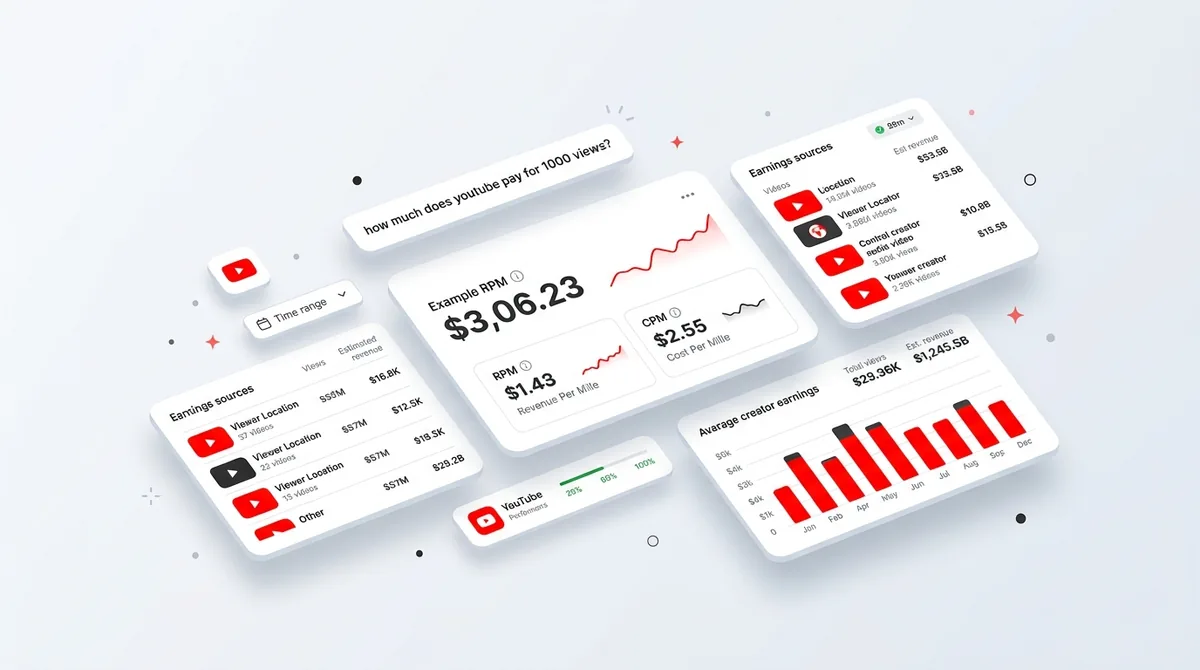
So when you ask “how much does YouTube pay for 1000 views?” what you’re really asking is: what’s my RPM going to be? RPM (revenue per 1,000 views) is a moving target. It’s based on:
Niche – finance vs vlogs is night and day
Audience country – US & UK views are worth several times more than many other regions
Watch time & retention – more watch time = more ad slots
Ad inventory & season – January feels broke; November prints money
Ad suitability – swearing, kids content, and yellow dollar signs all change your earnings
Two channels can both get 100,000 views this month. One gets $150. The other clears $3,000. Same platform. Same number of views. Completely different RPM.
How much does YouTube pay for 1,000 views?
YouTube creators in the Partner Program typically earn $1–7 per 1,000 monetized views from AdSense on average, with niche-driven RPMs ranging from around $0.50 (gaming, broad entertainment) to $20+ (finance, B2B, insurance). YouTube keeps 45% of ad revenue, creators take 55% based on RPM, audience, and watch time.
Notice the wording: “monetized views,” not total views. That difference is where most creator math goes off a cliff.
You’ll see screenshots on Twitter/X or Reddit like, “I got 1M views and only $800, YouTube is broken.” But if half those views had ad blockers, came from regions with low advertiser demand, or were too short to run mid-rolls, that payout can be perfectly normal.
This is why your goal shouldn’t just be “get more views.” It should be RPM × views. That’s the real earnings equation.
CPM vs RPM — the two numbers creators confuse
The fastest way to overestimate your YouTube income is to brag about your CPM.
CPM (cost per 1,000 impressions) is the number advertisers see. It’s how much brands are willing to pay YouTube for 1,000 ad impressions before YouTube takes its cut and before unmonetized views are accounted for.
RPM (revenue per 1,000 views) is the number you should care about. It’s:
RPM = (Your total revenue ÷ total views) × 1,000
That already bakes in:
YouTube’s 45% cut of ad revenue
Views that had no ads served
Shorts vs long-form weighting
YouTube Premium watch-time share
Here’s how creators usually confuse it:
Say your analytics show a $20 CPM on a video. You assume 100,000 views = $2,000.
Then the check comes in and it’s $700. You feel scammed. But:
Your CPM was what advertisers paid
You only got 55% of that after YouTube’s cut
25–40% of your views never showed an ad at all
So your real RPM – what hit your account – might be closer to $7 per 1,000 total views. That’s the number you can actually plan around.
Mechanically, here’s what’s happening behind the scenes:
YouTube runs an auction every time an ad slot is available
Advertisers bid more for certain audiences (high-income countries, business buyers, investors, parents)
YouTube takes its 45% cut from what the advertiser pays
Your share is then spread across all eligible views (including ones with no actual ad served)
This is why comparing CPM screenshots between creators is almost useless. Compare RPM instead. That’s your real earning power per 1,000 views.
Ready to save 15+ hours every week?
Join other creators who've automated their social media with SocialCal.
Get started freeRPM by niche — the 2026 ranges that actually matter
Let’s talk ranges that actually show up in creator dashboards in 2026. These are typical RPM ranges (your cut, not the advertiser’s CPM), based on real channels, public income breakdowns, and what creators are sharing.
High-RPM niches ($10–25+ RPM)
These are the “how is that possible?” screenshots you see.
Personal finance and investing
B2B and SaaS business content
Real estate & mortgages
Insurance & legal content
Crypto & trading (still volatile, but often high)
Why they pay so well:
The audience has serious purchase intent (credit cards, loans, software, high-ticket services)
Advertisers can make thousands per conversion, so they bid aggressively for ad slots
Content is often longer form (10–20 minutes), which means more ad breaks
Seasonality is strong but less “just Christmas” — money topics are year-round
Example: A finance creator with mostly US traffic can see $15–25 RPM on long-form videos. At 200,000 views per month, that’s $3,000–5,000 just from AdSense, before sponsors or affiliates.
Mid-RPM niches ($3–10 RPM)
Tech reviews & gadgets
Education & tutorials
Software how-tos (Notion, Figma, coding)
Fitness & health
Why these sit in the middle:
There is purchase intent (phones, apps, courses, coaching)
But there’s also way more content supply competing for the same advertisers
Viewers skew younger and more global, which pulls the blended RPM down
Example: A tech review channel might average $4–8 RPM. 500,000 views/month could mean $2,000–4,000 from AdSense. Still solid, but you see why sponsorships go crazy in this niche.
Low-RPM niches ($0.50–3 RPM)
Gaming
Music covers & edits
Kids content
Vlogs & lifestyle
Comedy & broad entertainment
Why they’re low:
Huge view volume but low purchase intent (a 13-year-old Minecraft fan isn’t buying enterprise software)
Kids content is heavily restricted because of COPPA rules
Music content often has revenue shared or claimed by labels
Advertisers bid less per impression compared to money or B2B niches
Example: A gaming creator might see $0.80–$2 RPM on long-form. That’s $800–$2,000 for a million views. You need massive scale to make AdSense meaningful here.
This is why you can’t just copy your favorite vlogger and expect their lifestyle and their income. The RPM math is completely different.
What actually changes your RPM week-to-week
RPM isn’t a personality trait. It moves.
If your RPM chart looks like a heart rate monitor, that’s normal. Here’s what’s pushing it up or down under the hood.
1. Audience country mix
YouTube RPM is extremely country-dependent. Advertisers bid more for high-income markets where people have credit cards and spend more online.
US, UK, Canada, Australia often pay 3–5x more than India, Brazil, most of SE Asia
Nordic countries, Germany, and some Western EU markets also pay well
If a video suddenly gets picked up in a lower-CPM region, your RPM for that video can tank even while views skyrocket. Nothing “broke” — your audience just shifted.
Action step: Check your YouTube analytics > Audience > Top geographies. If 70%+ of your views are from low-CPM regions but you’re trying to earn US-level RPM, that’s the mismatch.
2. Watch time and mid-roll opportunities
Longer watch time doesn’t just make the algorithm happy. It gives YouTube more places to serve ads.
Videos under 8 minutes: usually just a pre-roll or skippable ad
Videos 8+ minutes: you can add mid-rolls (and YouTube will auto-place them if you allow)
The algorithm isn’t just checking “Did people click?” It’s measuring how long they stay. Higher average view duration & retention means YouTube can show more ads without viewers bouncing, so the system is literally incentivized to push your video harder.
Action step: Instead of trying to upload 3 short, shallow videos a week, test 1–2 deeper 10–15 minute videos with strong hooks and structured storytelling. You’ll often see RPM jump just from crossing that 8-minute mark.
3. Ad inventory and seasonality
Advertisers don’t spend evenly all year. According to Google’s own reporting and industry data like US digital ad spend seasonality stats, Q4 is consistently the most aggressive period for ad budgets.
Q1 (Jan–Mar): brands slash budgets, RPM feels brutal
Q2–Q3: stabilizes, niche-dependent
Q4 (Oct–Dec): advertisers can spend 30–40% more, especially on retail and finance
If you post the exact same video in January vs November, November usually wins on RPM. Nothing about your content changed; advertisers just have more money to burn, especially on “buying season” topics.
4. Audience demographics
Two channels in the same niche can have very different RPMs just because of who’s actually watching.
Older, higher-income viewers = better RPM (more valuable to advertisers)
Teens and kids = lower RPM and more restrictions
Professionals and founders = B2B advertisers, very high CPM
Your title, thumbnail, and topic choices subtly shape this. “How to start a business in college” pulls a different ad market than “How to scale your agency from 10k to 100k/month.” Same niche, different wallets on the other side.
Mistakes that tank your real earnings
Most creators don’t have a “view problem.” They have an RPM awareness problem.
1. Chasing high view counts in low-RPM niches
Here’s the math almost nobody does.
1,000,000 views in gaming at $0.50–3 RPM = $500–3,000
100,000 views in finance at $10–25 RPM = $1,000–2,500
Same money. 10x fewer views. Which is actually easier to hit consistently?
I’m not saying “abandon gaming if you love it.” I’m saying be honest about how much does YouTube pay for 1000 views in your specific niche so you don’t build a full-time workload around part-time income.
2. Ignoring watch time and audience retention
A lot of creators obsess over click-through rate and forget the rest of the video.
If people bail at the 30-second mark, you don’t just lose algorithm favor. You also lose mid-roll opportunities, end-screen clicks, and the chance for Premium watch-time to stack up.
Mechanically, low retention tells YouTube, “Showing more ads here risks losing the viewer completely,” so the system plays it safer with monetization. That drags RPM down.
Fixable? Totally. Structure your videos like this:
Strong hook that promises a clear outcome
Quick context, then get into value fast
Pattern breaks every 30–60 seconds (visual changes, cuts, B-roll)
Tease payoffs that come later so people stick
3. Optimizing for views, not paying audiences
You can go viral in a country or demographic that barely moves your revenue.
A US or UK viewer can easily be worth 3–5x more in CPM terms than a viewer from a low-CPM region. Same content. Different ad market.
So if all your topics are super broad and global (“10 productivity hacks anyone can use”), you might be unintentionally attracting a huge but low-paying audience. Meanwhile, a more specific angle (“Productivity systems for agency owners”) pulls in fewer viewers but much higher-value ones.
Again, this doesn’t mean ignoring non-US viewers. It just means aligning your expectations with what the ad market actually values.
4. Not factoring in YouTube Premium revenue
A growing chunk of your audience might not see ads at all because they’re on YouTube Premium. But that doesn’t mean those views are “free.”
YouTube takes Premium subscription revenue and shares it with creators based on watch time. So if Premium viewers binge your content, you get a slice of that pool even though no ads ran.
Most creators ignore this line in their revenue breakdown. Don’t. It can be 5–15% of your AdSense on channels with bingeable content.
5. Treating Shorts RPM like long-form RPM
Shorts and long-form are monetized differently. Shorts use a revenue pool model (ad revenue from the Shorts feed is distributed based on views and region), so RPMs there are usually much lower.
If you only look at Shorts payouts, you might think YouTube is stingy. Then you post a 12-minute video and realize 100,000 long-form views can earn what a million Shorts views do.
Earnings beyond AdSense — where the real income lives
Most full-time YouTubers I know do not make most of their money from AdSense.
Once you understand how much does YouTube pay for 1000 views in your niche, you’ll see why: the real leverage is stacking other income streams on top of those views.
Brand deals & sponsors: A 100k-sub niche channel can easily get $1,000–$5,000 per dedicated video in high-intent niches.
Affiliate links: Tool/software channels can quietly pull $2,000–$10,000/month just from affiliate commissions.
Channel memberships & Patreon: Even 300 people paying $5/month is $1,500/month.
Super Chats & live streams: Great for gaming, music, education, and Q&A channels.
Courses, coaching, and digital products: This is where a lot of B2B and education creators make 5–10x their AdSense.
Merch: Works best when your audience is identity-driven (fandoms, memes, subcultures).
Concrete example of a healthy 100K-sub channel in a mid–high RPM niche:
AdSense: 300,000 monthly views × ~$10 RPM ≈ $3,000
Sponsors: 2 videos/month at $2,500 each ≈ $5,000
Affiliates & product sales: ≈ $2,000
Total: $10,000/month, and only 30% of that is ad revenue.
This is why serious creators track RPM to understand “baseline income per view” and then stack better monetization on top of it.
From RPM tracking to publishing consistency
Knowing your RPM is like knowing your hourly rate. It tells you whether your current content strategy can realistically pay your bills.
But here’s the catch: RPM only compounds if you publish consistently. YouTube’s recommendation system is heavily biased toward channels that show up on a predictable rhythm. Predictability lets the algorithm “trust” that if it sends viewers your way, there will be fresh content to keep them on the platform.
Most creators don’t fall off because their idea quality drops. They fall off because their system can’t sustain posting weekly while scripting, filming, editing, and handling life. The real problem isn’t finding the perfect idea; it’s having a setup that lets you hit “upload” every week without burning out.
This is where batching and scheduling quietly carry your channel. I’ve seen creators record 3–4 videos in a weekend, queue them up in a YouTube scheduler, and suddenly their RPM and views stabilize just because the algorithm finally has a rhythm to learn from.
If you’re juggling multiple platforms, a dedicated YouTube Scheduler inside a broader content calendar makes that even easier — you plan once, set titles/descriptions, and let the schedule run while you focus on making the next thing.
Quick framework: Calculate your potential monthly earnings

Let’s turn all this into a simple back-of-the-napkin model you can actually use.
Pick your niche RPM range.
From earlier:
- High: $10–25+ RPM (finance, B2B, real estate)
- Mid: $3–10 RPM (tech, education, fitness)
- Low: $0.50–3 RPM (gaming, vlogs, kids, music)Estimate realistic monthly views.
Not your “one day I’ll go viral” fantasy. Your actual current or near-future number. For example, 50,000 views/month.Rough AdSense earnings formula.
Use:
Earnings ≈ (Monthly views ÷ 1,000) × RPM
Example: 50,000 views in a $5 RPM niche = 50 × $5 = $250/month.Add 30–50% for off-AdSense income at scale.
Once you have sponsors, affiliates, or products, a reasonable target is an extra 30–50% of your AdSense at first, often more later. So that $250 could realistically become $350–400+ down the line.Compare to your time invested.
If you’re spending 20 hours/month to make those videos for $250 total, that’s $12.50/hour. Is that acceptable now as a “building phase”? If not, can you tweak niche, topics, or monetization to raise RPM instead of just chasing more views?
Do this math honestly and suddenly your content decisions get much sharper. Maybe that weekly vlog becomes a monthly thing, and you replace it with two higher-RPM tutorial videos.
Ready to save 15+ hours every week?
Join other creators who've automated their social media with SocialCal.
Get started freeFrequently asked questions
How much does YouTube pay for 1000 views in 2026?
On average, most creators in the YouTube Partner Program earn around $1–7 per 1,000 monetized views via AdSense, with RPM ranging from about $0.50 in broad entertainment niches up to $20+ in high-intent niches like finance and B2B. Your actual number depends on niche, audience country, watch time, and season.
How much do YouTubers with 1M subscribers earn?
Subscriber count doesn’t pay you. Views and RPM do. A 1M-sub channel pulling 500,000 monthly views in a $2 RPM niche might make ~$1,000/month from AdSense, while a 1M-sub finance channel doing 2M monthly views at $15 RPM could make ~$30,000/month. The gap comes from niche, audience, and consistency, not just subs.
Why is my RPM dropping?
Common reasons: your traffic shifted to lower-CPM countries, you had a viral video in a broad audience with low purchase intent, it’s Q1 and ad budgets are down, or your recent videos have weaker watch time so fewer ads are served. Check your geography, content type, and season before assuming something’s “wrong.”
Can I increase my RPM without changing my niche?
Yes. You can target higher-value subtopics (e.g., “YouTube for agencies” instead of just “YouTube tips”), improve retention so more mid-rolls run, make more 8–15 minute videos, and attract a more valuable audience (older, professional, higher-income) with your titles and topics. You don’t have to abandon your niche; you just have to move closer to its money center.
Does YouTube Shorts pay differently?
Yes. Shorts use a separate revenue pool model: ad revenue from the Shorts feed is collected and then distributed to creators based on share of views, region, and other factors. RPMs are usually much lower than long-form, so a million Shorts views might pay what 100k–200k long-form views do.
When does YouTube pay out?
YouTube pays monthly through AdSense once you cross the payment threshold (usually $100). Earnings for a given month are finalized and then paid around the 21st of the following month, assuming your account and tax information are fully set up. You can see the official payout rules at Google’s documentation.
The compound effect of RPM-aware content choices
If you remember one thing from this: don’t just optimize for views. Optimize for RPM × views
Most creators never run the numbers, so they grind in low-RPM niches, post inconsistently, and wonder why it never adds up. The creators who quietly win are the ones who pick topics their audience and advertisers actually pay for, then show up on a schedule the algorithm can trust.
Dial in your RPM, build a simple publishing rhythm, and let tools like a visual Content Calendar or multi-platform scheduler support your consistency so you can spend your energy where it actually pays: making better videos, not fighting your upload schedule.