Stop Creating Content No One Sees: Understanding the TikTok Recommendation System
You just spent three hours scripting, shooting, and editing what you thought was a guaranteed hit.
Jump to a section:
- Stop Creating Content No One Sees: Understanding the TikTok Recommendation System
- What is the TikTok Algorithm?
- Why 'Going Viral' Is the Wrong Metric to Track
- Strategy 1: Mastering the 'Retention First' Framework
- Strategy 2: Signal Layering via TikTok SEO
- Strategy 3: Exploiting the Interest Graph over the Social Graph
- Strategy 4: The 'Initial Batch' Test and High-Value Engagement
- Strategy 5: Audio Synergy and Micro-Trends
- Mistakes: Why Your Reach Is Stalling (And How to Fix It)
- Case Studies: Algorithm Success Stories
- The Consistency Bridge: Why the Algorithm Rewards Habit over Quality
- The TikTok Algorithm Checklist for Every Post
- TikTok Algorithm FAQ
- Conclusion: Mastering the Machine
You hit publish, close the app, and wait for the dopamine hit of watching those numbers climb. Two hours later, you open your phone to a depressing reality: 214 views. Twelve likes. Zero comments. Meanwhile, a poorly lit, seven-second video of someone eating a sandwich is sitting at 2.4 million views.
Sound familiar?
Most creators assume the platform is just a lottery. They think if they post enough random trends, eventually the algorithm will bless them with virality. That is completely backwards.
Getting your content seen is not about luck. It is about understanding the strict, cold logic of a machine learning system designed to do exactly one thing: keep users swiping. Once you stop treating your reach like a slot machine and start treating it like a measurable behavioral puzzle, everything changes.
Ready to save 15+ hours every week?
Join other creators who've automated their social media with SocialCal.
Get started freeLet's strip away the myths and get the tiktok algorithm explained so you can stop guessing and start growing.
What is the TikTok Algorithm?
Having the tiktok algorithm explained simply means understanding it as an advanced recommendation system. It delivers highly personalized content to users based on video interaction data, device settings, and caption metadata. Rather than relying on follower counts, the system ranks individual videos by predicting how likely a specific user is to watch it to completion.
Why 'Going Viral' Is the Wrong Metric to Track
Every creator says they want to go viral. In practice, this is the worst thing that can happen to a new account if the viral video does not match your core niche.
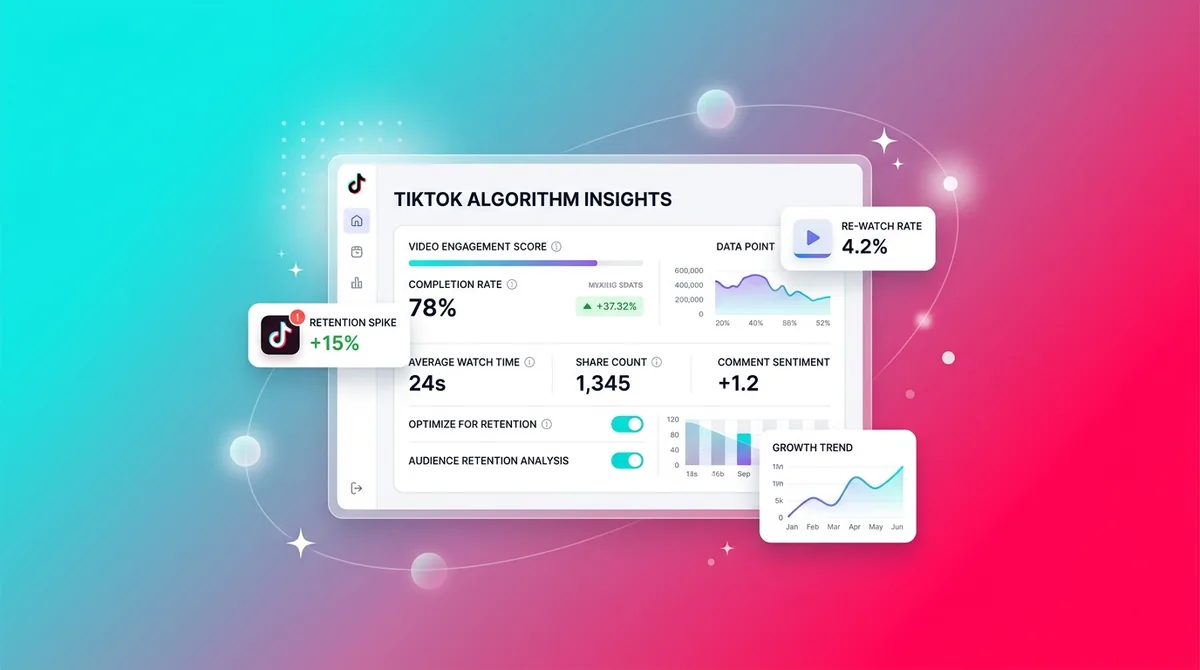
The platform operates on a concept called 'information foraging'. Users are constantly hunting for very specific types of entertainment or education. The recommendation engine's entire job is to categorize your account so it knows exactly which subset of users to feed your content to.
Imagine you are a personal finance creator. One day, you post a video of your golden retriever doing a funny trick, and it hits three million views. You gain 10,000 new followers who love dogs. The next day, you post a highly researched breakdown of Roth IRAs.
The system pushes your finance video to your new dog-loving followers. They immediately swipe away. The system records a massive negative signal—a high swipe-away rate—and immediately kills the reach of your finance video. You have effectively confused the machine.
The system needs consistent data points to categorize you. It needs to know that when you post, there is a specific, reliable audience that will watch your video all the way through.
Strategy 1: Mastering the 'Retention First' Framework
The system operates in stages. When you hit publish, your video is not sent to your entire audience. It undergoes an 'Initial Batch' test.
According to official documentation on how the system recommends videos, your content is initially pushed to a small testing group of a few hundred users. At this stage, the single most critical metric is completion rate.
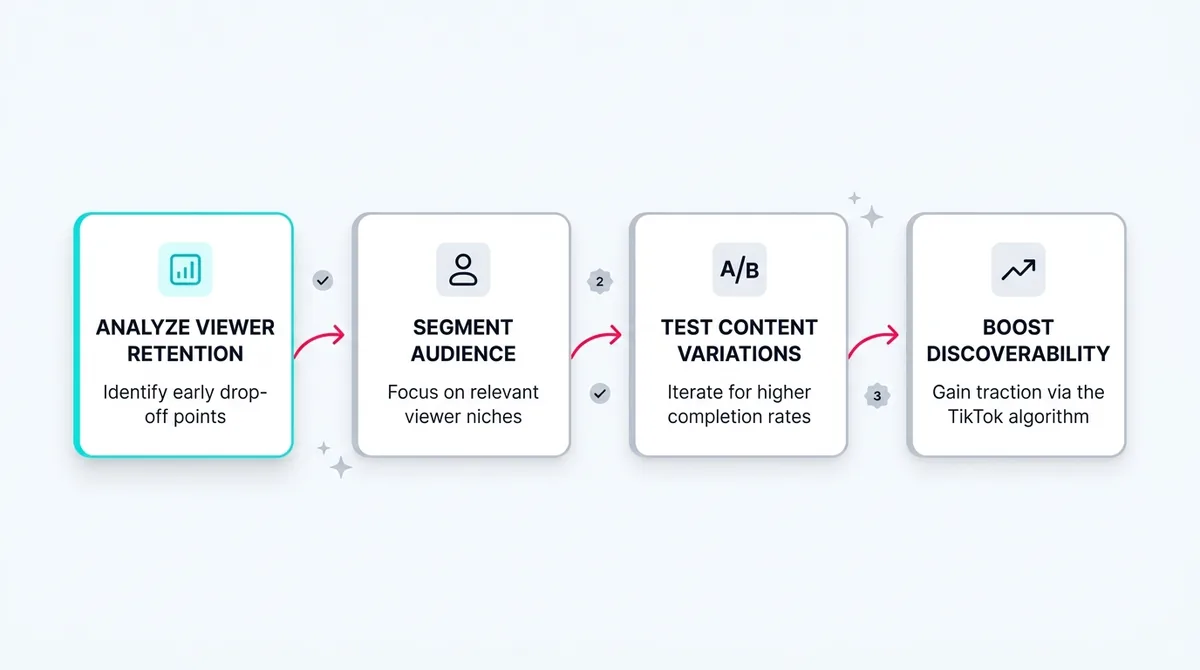
Likes do not matter right now. Comments are irrelevant. The machine only cares about one question: did the user stay until the end?
How to Optimize for Completion Rate and Rewatches
You have to engineer retention into the script itself. You cannot just hope people stick around.
What actually works is tricking the brain's natural instinct for closure. Psychologists call this the Zeigarnik effect—people remember uncompleted tasks better than completed ones. Translated to short-form video, this means you never resolve the core promise of the video until the absolute last second.
If your video is "3 ways to fix your posture", do not spend ten seconds explaining the third way and then five seconds saying goodbye. Deliver the third point rapidly, and cut the video the millisecond you finish the sentence.
Combine this with looped audio. If your script ends with a phrase that naturally flows into your opening hook, a user will often watch the first three seconds of the video a second time before realizing it started over. That pushes your completion rate over 100 percent. If you want to turn these high-retention viewers into long-term followers, building a series strategy for growth is the best way to keep them coming back to your profile for part two.
Strategy 2: Signal Layering via TikTok SEO
Stop thinking of this platform as just a social media app. It is a search engine. A massive portion of the user base now uses the search bar instead of Google to find product reviews, local restaurants, and tutorials.
Recent research from Pew Research shows a massive shift in search behavior, particularly among younger demographics who prefer video answers over text articles.
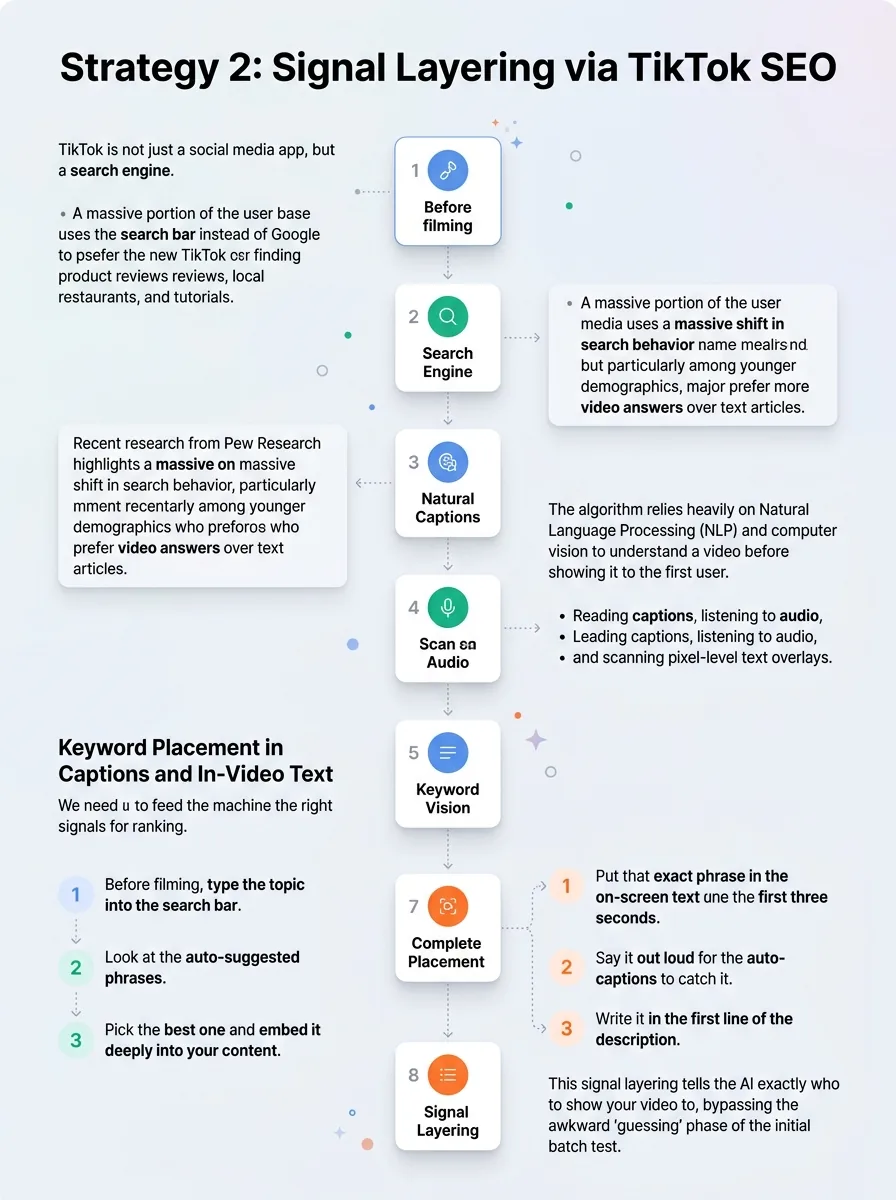
The algorithm relies heavily on Natural Language Processing (NLP) and computer vision to understand what your video is about before it even shows it to the first user. It reads your caption. It listens to your audio. It scans the actual pixels on the screen to read your text overlays.
Keyword Placement in Captions and In-Video Text
If you want the machine to rank your video, you have to feed it the right signals.
Before you film, type your topic into the search bar. Look at the auto-suggested phrases. These are high-intent keywords that people are actively looking for right now. Pick the best one and embed it deeply into your content.
Put that exact phrase in your on-screen text during the first three seconds. Say it out loud so the auto-captions catch it. Write it in the first line of your description. This signal layering tells the AI exactly who to show your video to, bypassing the awkward "guessing" phase of the initial batch test.
Strategy 3: Exploiting the Interest Graph over the Social Graph
Old-school platforms operate on a social graph. They show you what your friends and the people you follow are doing. That is why growing on those older platforms is so notoriously slow for new creators.
The For You Page operates on an interest graph. It prioritizes what you actually like watching, regardless of who made it.
This is a massive advantage for you. You do not need a million followers to reach a million people. You just need to create a video that perfectly satisfies a specific interest cluster.
Defining Your Content Pillar to Feed the AI
Consider a creator I worked with who was stuck at 300 views for months. She was posting general "day in the life" lifestyle content. The problem is that "lifestyle" is not an interest cluster. It is too broad.
We pivoted her entire account to focus solely on aesthetic notion templates for college students. That is a highly specific, hyper-focused interest cluster.
Within two weeks, her baseline reach jumped to 10,000 views per video. She fed the AI a consistent, easily categorizable diet of content, and the AI rewarded her by putting her videos directly in front of the exact people searching for study organization hacks.
Ready to save 15+ hours every week?
Join other creators who've automated their social media with SocialCal.
Get started freeStrategy 4: The 'Initial Batch' Test and High-Value Engagement
Let's talk about what happens after you pass the initial retention test.
If your completion rate is good, the system pushes you to a wider audience. Now, it starts looking at engagement. But not all engagement is created equal. The hierarchy of metrics has shifted dramatically.
Likes are cheap. A user can double-tap a screen in half a second without even processing what they just watched. The algorithm knows this, so likes carry very little weight.
Shares are the new currency. When a user hits the share button, they are signaling to the system that your video is so good, they are willing to attach their own reputation to it by sending it to a friend. More importantly, sharing brings users back into the app or keeps them watching longer. The machine heavily rewards content that drives platform retention.
Saves are a close second. A save indicates that your video has long-term value. Educational content, recipes, and tutorials thrive on saves.
Strategy 5: Audio Synergy and Micro-Trends
Using trending sounds is common advice, but most creators execute it poorly. They slap a trending pop song over a quiet tutorial video and turn the sound down to 1 percent.
That rarely works anymore.
Audio acts as a discovery bridge. Users tap on a sound they find interesting and scroll through the feed of videos using it. If your video matches the vibe, pacing, and visual style of that specific audio cluster, you tap into a pre-existing stream of traffic.
Look for micro-trends. These are sounds with under 10,000 videos that are rapidly gaining momentum in your specific niche. Jumping on a sound that already has four million videos means you will just get buried.
Mistakes: Why Your Reach Is Stalling (And How to Fix It)
Even if you understand the tiktok algorithm explained in theory, small execution errors can completely kill your distribution. The system looks for negative signals just as closely as positive ones.
Mistake 1: Repurposing Content with Foreign Watermarks
The platform aggressively protects its user experience. If its computer vision detects an Instagram Reels watermark, a CapCut logo, or any other competing platform's branding, it will instantly suppress the video's reach.
They want native-looking content. If you absolutely must recycle a video you previously posted elsewhere, run it through a reliable TikTok downloader or generic watermark remover first. Better yet, edit the raw footage outside of the social apps and upload clean files natively to each one.
Mistake 2: Deleting and Re-uploading Low-Performing Videos
We have all been there. A video flops, getting only 45 views in the first hour. The temptation to delete it and try again is strong.
Do not do this. Deleting and rapidly re-uploading identical files triggers automated spam filters. The system assumes you are a bot trying to game the metrics. If you do this multiple times, your account will likely face a temporary shadowban where nothing gets pushed to the For You Page.
If a video flops, let it live. Sometimes videos get picked up by the search engine weeks later.
Mistake 3: Ignoring the First 3 Seconds (The 'Dead Hook')
The human brain decides whether to stay or scroll in roughly 1.5 seconds. If your video starts with you taking a breath, adjusting the camera, or saying "Hey guys, today I want to talk about...", the viewer is already gone.
You need immediate visual or auditory stimulation. Start speaking in the middle of a sentence. Have physical movement on screen. Drop the viewer right into the action.
Mistake 4: Static Visual Pacing
If the camera angle does not change, the text does not move, and there are no zoom cuts for more than five seconds, the viewer's brain gets bored. The algorithm measures this drop-off precisely.
You must introduce pattern interrupts. Zoom in slightly on a crucial point. Pop a relevant image on the screen. Change the text color. You have to constantly re-engage the viewer's visual cortex to maintain that high completion rate.
Case Studies: Algorithm Success Stories
Let's look at how these strategies actually play out for real accounts.
Take an account we'll call Excel Sarah. She was posting screen recordings of spreadsheets with voiceovers. Helpful, but incredibly boring. Her average reach was around 500 views.
She changed exactly two things. First, she optimized her hooks for the Zeigarnik effect. Instead of "How to use VLOOKUP", she opened with, "This hidden spreadsheet trick will save you three hours on Friday." Second, she placed highly searched keywords in big, bold text right in the center of the screen for the first two seconds.
Her next video hit 400,000 views. She gave the machine the metadata it needed to find office workers, and she gave the viewers the psychological hook they needed to stay.
Then there is Marcus, an online fitness coach. He was posting daily vlogs of his workouts. Nobody cared because he didn't have a massive personality yet. He pivoted to highly searchable, three-step form corrections. "Why your lower back hurts during deadlifts." He kept the videos under 15 seconds. His completion rates skyrocketed to 65 percent, and his account grew by 40,000 followers in a month.
The Consistency Bridge: Why the Algorithm Rewards Habit over Quality
Here is the reality check most creators refuse to accept.
You can have the best hooks, the perfect keywords, and the highest production value in the world. But if you post once, disappear for nine days, post three times in a panic, and then vanish again, you will never grow.
The system assigns a hidden 'Trust Score' to your account. It wants to surface reliable creators who consistently provide inventory for the app. When you post at a regular cadence, you train the machine to expect data from your account. This creates 'Algorithm Velocity'. Your baseline reach slowly creeps up because the system knows exactly who your audience is and trusts that you will keep delivering.
The real issue isn't knowing what to post. It is having the discipline to post it consistently without burning out.
If you are trying to manually edit, write captions, and remember to hit publish at the exact right time every single day, you are going to fail. That is why professional creators decouple content creation from content distribution.
You sit down on a Sunday, batch record five videos, and line them up in a tool like the SocialCal TikTok Scheduler. You write your keyword-rich captions, set the times, and walk away. The tool uploads the raw, high-quality video files directly to the platform automatically. You build that essential Trust Score with the algorithm while you are literally sleeping.
The TikTok Algorithm Checklist for Every Post
Before you hit publish on your next video, run it through this exact framework. If you miss even one step, you are leaving views on the table.
The 3-Second Rule: Does the video start with an immediate visual change or a strong verbal statement? Cut any dead air at the beginning.
Keyword Placement: Is your main topic written in on-screen text during the first frame? Did you say it out loud for the auto-captions?
Loop Optimization: Does the last sentence naturally bleed into the first sentence? Is the final cut perfectly tight?
High-Value CTA: Instead of asking for likes, did you give the viewer a concrete reason to save the video for later or share it with a specific type of friend?
Clean Format: Is the video free of external watermarks, shot vertically, and brightly lit?
TikTok Algorithm FAQ
Does the time of day matter when posting?
Yes, but not as much as you think. Posting when your specific audience is online gives you a slight advantage in the 'Initial Batch' test because the users most likely to engage are awake. However, a highly optimized, high-retention video will break through regardless of whether you post it at 2 PM or 2 AM.
How many times should I post per day?
Quality and retention matter more than sheer volume. Posting three terrible videos a day will actually hurt your account by training the algorithm that your content gets swiped away. Aim for one high-quality, highly optimized post per day. Consistency of schedule is vastly more important than high daily frequency.
Does a shadowban actually exist?
Yes. If you repeatedly violate community guidelines, use banned audio, or exhibit bot-like behavior (like bulk deleting and re-uploading videos in a ten-minute window), the platform will restrict your content from appearing on the For You Page. Usually, this lifts after a couple of weeks of normal, rule-abiding behavior.
Will switching to a Business Account hurt my reach?
No. This is a persistent myth. The algorithm evaluates the video itself, not the account type. However, business accounts lose access to commercial mainstream music libraries due to copyright laws, which means you cannot participate in certain audio trends. That limitation is what actually hurts creators, not a secret algorithmic penalty.
Ready to save 15+ hours every week?
Join other creators who've automated their social media with SocialCal.
Get started freeConclusion: Mastering the Machine
The algorithm is not your enemy. It is simply a mirror reflecting human behavior back at you. If your videos are not getting reach, the harsh truth is that they are not holding human attention.
Stop stressing over the mystery of it all. Focus entirely on the mechanics of retention, feed the search engine the keywords it craves, and build a highly specific catalog of content. Growth is not about achieving one perfect viral moment. It is about proving to the machine that you can deliver value day after day, which is exactly why getting your content batched and scheduled with SocialCal is the ultimate competitive advantage.
Master the habit, and the algorithm will follow.