Your Reach Didn't Just "Disappear"—LinkedIn Changed the Rules
You wake up, pour your coffee, and check the post you published yesterday. The one you spent an hour writing. The one you were sure would crush it.
Jump to a section:
- Your Reach Didn't Just "Disappear"—LinkedIn Changed the Rules
- What is the LinkedIn Algorithm? (A 60-Second Explanation)
- The Behavioral Science of the Feed: Why High Reach is Harder to Maintain
- Strategy 1: Optimizing for Dwell Time and Stickiness
- Strategy 2: Winning the 'Golden Hour' Through Velocity
- Strategy 3: Navigating the Interest Graph vs. The Social Graph
- Strategy 4: LinkedIn Algorithm Explained - Managing External Links Without Being Penalized
- Strategy 5: Leveraging Multi-Format Content for Feed Domination
- Why Most Creators Fail: 5 Common Mistakes Killing Your Visibility
- Real-World Case Studies: How Algorithm Shifts Impact Growth
- The Consistency Bridge: Why Perfection is the Enemy of Distribution
- Your LinkedIn Growth Checklist: 7 Steps to Algorithm Recovery
- LinkedIn Algorithm FAQ: What You Need to Know
- Conclusion: Mastering the Algorithm for Sustainable Growth
Nada.
Your views are down 60%. Barely anyone liked it. Your comment section is a ghost town.
Sound familiar?
Most creators assume their content just wasn't good enough, or worse, that their account is somehow shadowbanned. But the reality is usually much simpler, and a lot less personal. You are playing by the rules of a game that doesn't exist anymore.
Ready to save 15+ hours every week?
Join other creators who've automated their social media with SocialCal.
Get started freeLinkedIn fundamentally overhauled its algorithm over the past year. They aggressively shifted away from a "social graph" (showing you content just because you are connected to the author) and moved toward an "interest graph" (showing you content because the AI recognizes you care about the specific topic).
They did this because the feed was getting polluted. Users were complaining about irrelevant viral selfies, copied-and-pasted motivational stories, and engagement bait. The platform wanted to return to its roots as a professional knowledge-sharing network.
If you want your reach back, you need to understand exactly how the machine makes decisions right now. Let's get the linkedin algorithm explained so you can stop guessing and start growing again.
What is the LinkedIn Algorithm? (A 60-Second Explanation)
What is linkedin algorithm explained? The LinkedIn algorithm is a set of AI-driven rules that filters, ranks, and distributes content in a user's feed based on relevance, early engagement velocity, and dwell time. It prioritizes professional knowledge-sharing and penalizes generic engagement bait to keep users on the platform longer.
That is the technical definition. But in practice, you can think of the algorithm as a highly protective bouncer at a club.
The bouncer's only job is to keep the VIPs (the users scrolling the feed) entertained and engaged so they don't leave the club. If you walk up to the bouncer with a generic, boring post, you get turned away. If you bring a highly specific, valuable insight that makes the VIPs stick around, the bouncer gives you a megaphone.
The Behavioral Science of the Feed: Why High Reach is Harder to Maintain
To win on LinkedIn, you have to understand the behavioral science driving the platform's engineering choices.
Algorithms are simply mathematical mirrors of human psychology. LinkedIn engineers track thousands of micro-behaviors to determine what people actually want to see. They look at explicit signals, like likes and comments, but they care far more about implicit signals.
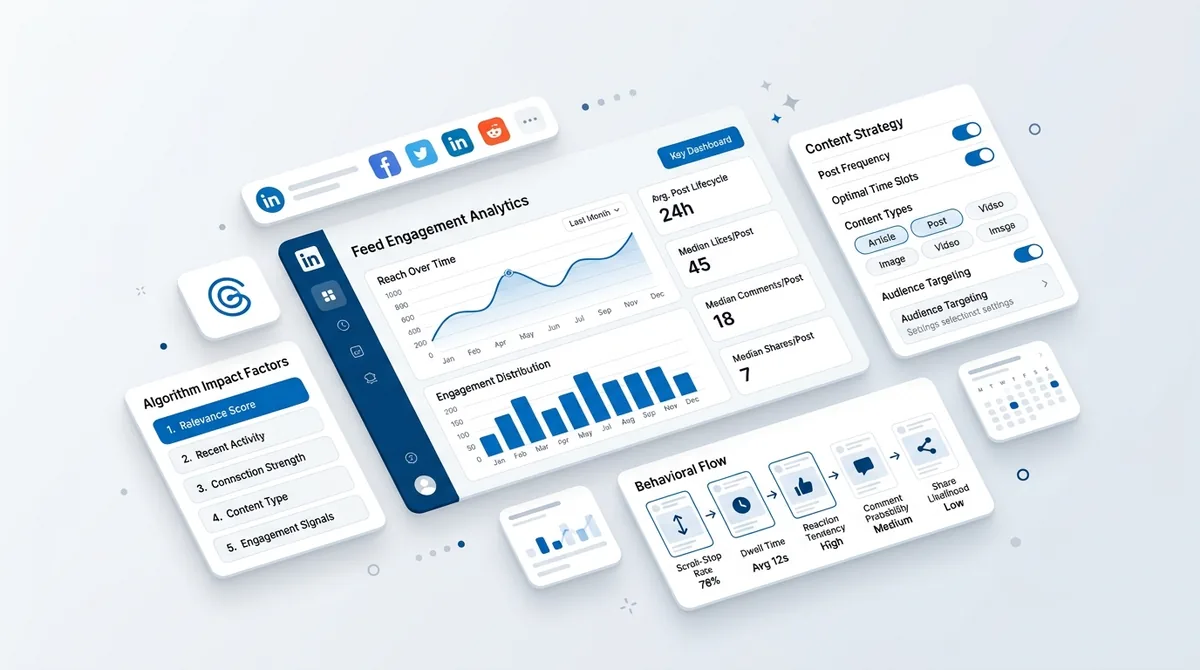
One of the strongest signals is the "I don't want to see this" button. A few years ago, LinkedIn feeds were flooded with "bro-etry" (those excessively spaced out, dramatic stories) and irrelevant polls. Users started aggressively muting creators and hiding posts.
LinkedIn engineers documented this shift, realizing they needed to prioritize "knowledge and advice" over broad virality. They adjusted the feed to reward niche expertise.
This is why high reach is harder to maintain for generalists. If you post about marketing on Monday, personal fitness on Tuesday, and generic leadership on Wednesday, the algorithm cannot categorize your expertise. It doesn't know who your ideal audience is, so it shows your content to no one.
Strategy 1: Optimizing for Dwell Time and Stickiness
Reach isn't about how many people see your post. It is about how long they look at it.
The algorithm measures a metric called "dwell time." This is the exact number of seconds a user spends hovering over your content as they scroll their feed. If an average post gets one second of attention, and yours gets four seconds, the algorithm flags your content as highly engaging.
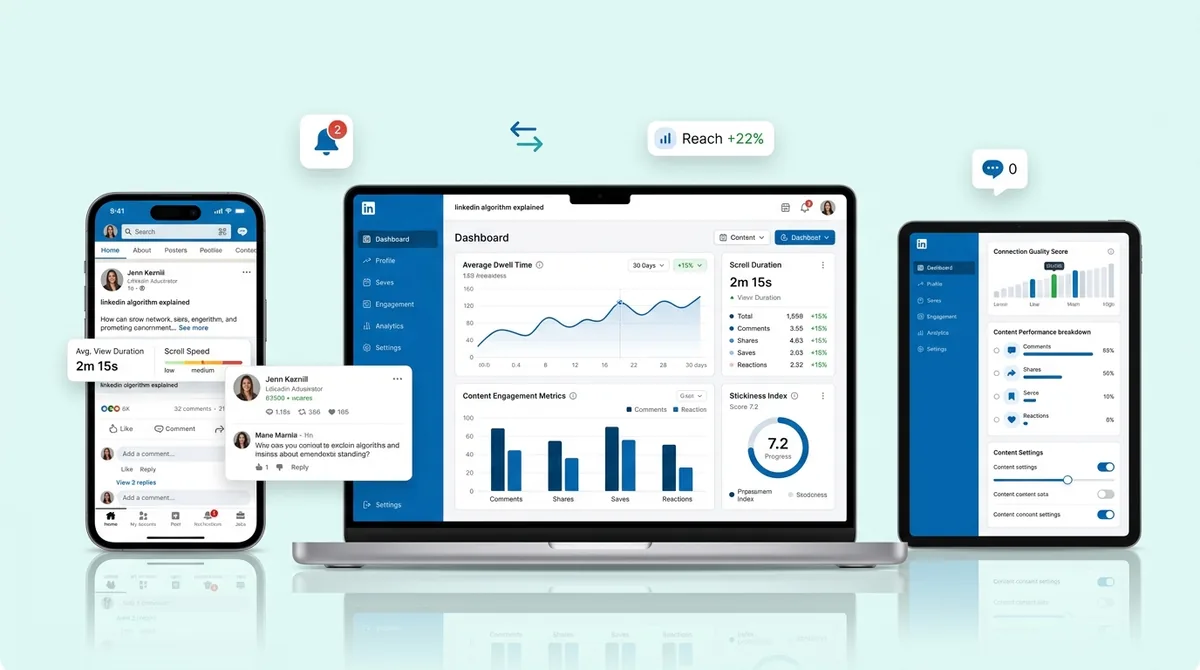
It makes perfect sense from a business perspective. LinkedIn makes money by showing ads. The longer you keep a user staring at the screen, the more ads LinkedIn can serve them. If your content helps LinkedIn make money, they reward you with free distribution.
The 'See More' Hook: Forcing the Click-to-Expand
The easiest way to manipulate dwell time is through the "See More" button.
LinkedIn truncates text posts after the first few lines. If a user clicks "See More" to expand the text, the algorithm registers a massive positive signal. It tells the AI, "This person was interested enough to stop scrolling and request more information."
This happens before they even drop a like or a comment.
Your entire job as a creator is to make those first three lines absolutely irresistible. Most people waste this real estate by saying, "I am so honored and humbled to announce..." By the time the reader gets to the actual point, they have already scrolled past.
Instead, open with a counter-narrative, a stark data point, or a relatable pain point. Force the click.
Strategy 2: Winning the 'Golden Hour' Through Velocity
When you hit publish, your post doesn't immediately go to all your followers. Not even close.
The algorithm tests your content using a staging system. First, it shows your post to a small "seed audience" of your most active followers and connections. It then sets a timer and watches closely.
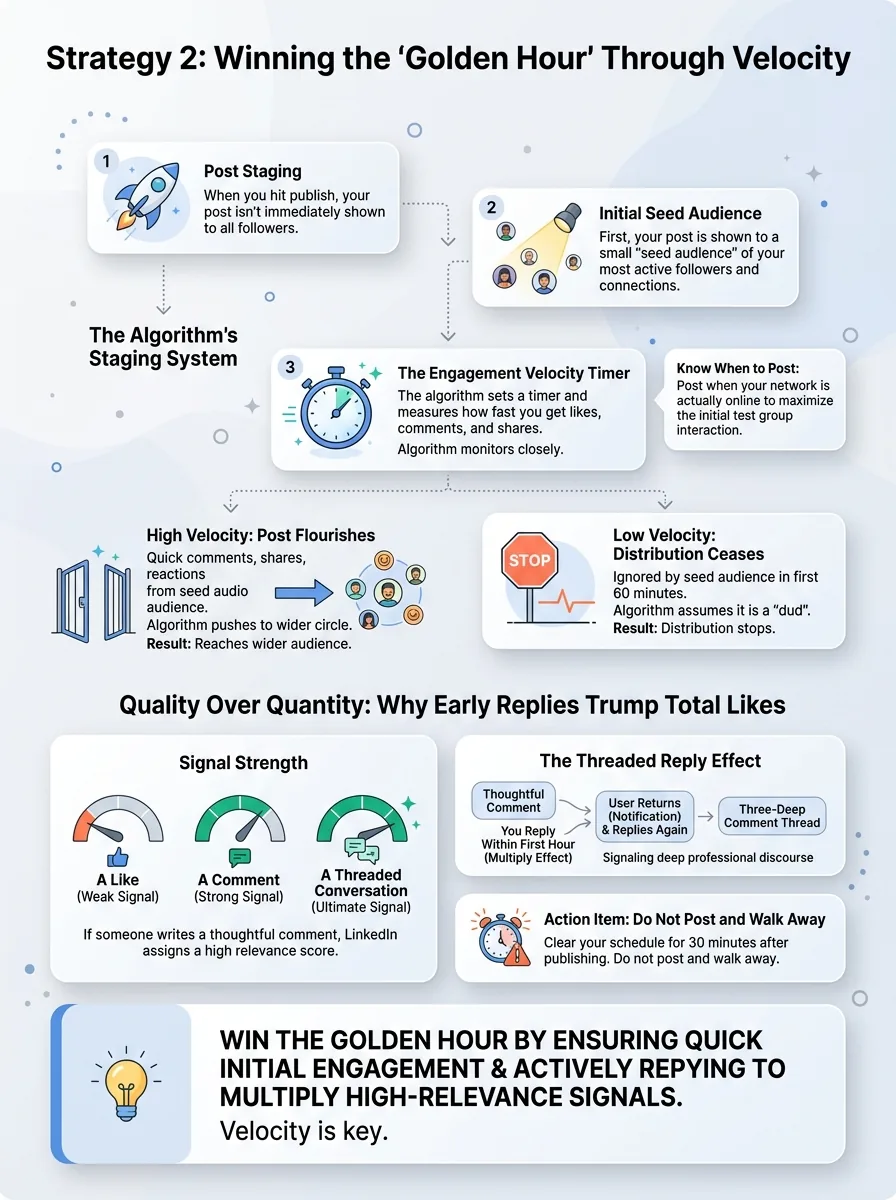
This is where engagement velocity comes in. The algorithm isn't just counting how many likes you get; it is measuring how fast you get them. If your seed audience ignores the post in the first 60 minutes, the algorithm assumes it's a dud and stops distributing it.
If that initial cohort comments, shares, and reacts quickly, the algorithm opens the gate and pushes the post to a wider circle. Knowing the best time to post on LinkedIn gives you a massive advantage here, because publishing when your specific network is actually online ensures that initial test group is awake and ready to interact.
Quality Over Quantity: Why Early Replies Trump Total Likes
A like is a weak signal. A comment is a strong signal. But a threaded conversation is the ultimate signal.
If someone takes the time to write a thoughtful comment, LinkedIn assigns a high relevance score to your post. But you can multiply this effect by replying back within that critical first hour.
When you reply to a comment quickly, you often pull that original user back to the platform via a notification. They might reply again. Now you have a three-deep comment thread, which signals to the algorithm that deep, meaningful professional discourse is happening.
Clear your schedule for the 30 minutes right after you publish. Do not post and walk away.
Strategy 3: Navigating the Interest Graph vs. The Social Graph
For years, LinkedIn operated strictly on a social graph. If Bob liked your post, LinkedIn showed it to Bob's connections.
That is no longer how the feed primarily works. The algorithm has evolved into an interest graph. This changes everything for how you write.
Now, LinkedIn uses Natural Language Processing (NLP) to read your post, extract the core topics, and show it to people who consume content about those topics—regardless of whether they follow Bob, or you, or anyone related to you.
Topic Authority: How LinkedIn's AI Labels Your Expertise
The AI wants to know what box to put you in.
If you consistently write about B2B sales strategies, use terms like "pipeline generation," and have "B2B Sales" in your profile headline, the AI builds a confidence score around your profile. It labels you an authority in B2B sales.
When you publish a new post about sales, the algorithm immediately pushes it into the feeds of users who frequently engage with sales content.
But if you suddenly write a post about baking sourdough bread, your reach will tank. The AI tries to show it to your established "sales" audience, they ignore it because they don't care about bread, and the post dies in the staging phase.
Stay in your lane. The algorithm rewards strict thematic consistency.
Strategy 4: LinkedIn Algorithm Explained - Managing External Links Without Being Penalized
Let's address the elephant in the room. LinkedIn hates it when you link out to a YouTube video, a Substack newsletter, or your company blog.
Every major social network is a walled garden. They want to keep users inside the walls. If you drop an external link in your post, you are actively facilitating platform churn. The algorithm will aggressively throttle your reach as a penalty.
In practice, a post with an external link might get 10% of the impressions a native text post would get.
Creators used to beat this by putting the link in the comments and writing "Link in the first comment!" in the post. LinkedIn caught onto this workaround. While it's still slightly better than putting the link in the main post, the algorithm now actively hides comments containing links, forcing users to hunt for them.
What actually works is native value. Give 90% of the value away directly in the LinkedIn post. Treat the external link as an optional bonus, not the required destination.
Strategy 5: Leveraging Multi-Format Content for Feed Domination
The algorithm doesn't treat all content formats equally. Text, images, video, and documents all have different "weights" in the feed.
Right now, the algorithm heavily favors formats that naturally generate high dwell time and deliver dense knowledge.
The Resurgence of Document Posts (PDF Carousels)
Nothing keeps a user on the screen longer than a multi-slide PDF carousel.
Every time a user swipes to the next slide, it acts as an active engagement signal. If someone swipes through 10 slides, reading the text on each one, they might spend 45 seconds on your post. In algorithmic time, that is an eternity.
Imagine you spend hours writing a dense blog post. You can extract the five main headers, put each one on a simple slide with a couple of bullet points, and upload it as a document. If you don't have a design team on standby, you can use a LinkedIn carousel generator to build these swipeable assets in minutes.
Carousels consistently outperform standard text posts because they visually break up the feed and offer bite-sized, structured learning—exactly what the knowledge graph wants to promote.
Why Most Creators Fail: 5 Common Mistakes Killing Your Visibility
Understanding the linkedin algorithm explained isn't just about knowing what to do. It is largely about knowing what to stop doing. Most creators unknowingly trigger spam filters and reach throttles on a daily basis.
Mistake #1: The 'Post and Ghost' Habit
If you log in, drop a post, and immediately close the app, you are signaling to the AI that you are a broadcaster, not a community member. LinkedIn penalizes accounts that don't consume and interact with other people's content. You have to give engagement to get engagement.
Mistake #2: Irrelevant Tagging and 'Tag-Baiting'
We've all seen it. Someone writes a mediocre post and then tags 25 industry influencers at the bottom hoping for a retweet-style boost. LinkedIn's algorithm is specifically trained to punish this behavior. If you tag 10 people and 8 of them ignore the tag (or untag themselves), your post will be severely throttled. Only tag people who are genuinely involved in the story you are telling.
Mistake #3: Treating LinkedIn Like Twitter
Posting three times a day works on platforms with rapid-fire feeds. On LinkedIn, it cannibalizes your own reach. The algorithm rarely shows more than one post from the same creator in a user's feed per day. If you post a second time within 18 hours, the algorithm will likely kill the momentum of your first post to make room for the new one.
Mistake #4: Ignoring Formatting
Giant walls of text cause users to scroll past immediately. Your formatting dictates your readability, which dictates your dwell time. Use white space. Use short paragraphs. Make the content scannable.
Mistake #5: Engagement Pods
Joining groups where 50 people all agree to like each other's posts is a fast track to irrelevance. The AI is smarter than you think. It recognizes when the exact same group of people comment on your post within 5 minutes of publishing every single time. It flags the behavior as inauthentic and caps your distribution outside of that pod.
Real-World Case Studies: How Algorithm Shifts Impact Growth
Let's look at how this plays out in reality.
Take Sarah, a B2B SaaS founder. For two years, she posted generic startup motivation. "Hustle hard," "Failure is a stepping stone,"—that sort of thing. She had a decent following, but her views tanked when the algorithm shifted to the knowledge graph. She pivoted to posting highly specific tear-downs of customer retention metrics. Her likes dropped by half, but her actual post views went up 400%, and her inbound leads skyrocketed. She aligned with the algorithm's desire for niche expertise.
Then look at Acme Corp, a mid-sized marketing agency. Their company page strategy was just automatically syndicating links to their blog. They averaged 40 views a post. They stopped posting links entirely. Instead, they started having their designers turn the blog posts into native PDF carousels. Within a month, their average post reach hit 5,000 views. They stopped fighting the platform's anti-link bias.
The Consistency Bridge: Why Perfection is the Enemy of Distribution
Here is what nobody tells you about social media algorithms: they crave predictability.
The algorithm builds a profile of your account over time. It wants to know that if it shows your content to 1,000 people on a Tuesday, it can rely on you to provide similar value next Tuesday. This is called the "Algorithm Warm-up."
Accounts that post randomly—three times one week, silent for a month, then twice the next week—frustrate the AI. The algorithm loses confidence in your topical authority and stops trusting your account with broad distribution.
The problem isn't that creators don't know how to write a good post. The problem is they run out of energy to do it consistently. Life gets busy, client work piles up, and the LinkedIn post gets pushed to tomorrow.
You cannot rely on manual effort if you want to win the algorithmic game over a 12-month timeline. The real issue isn't finding the perfect hook. It is being able to show up consistently enough for the AI to categorize you.
This is exactly why using a dedicated LinkedIn scheduler is non-negotiable for serious creators. By batching your content creation on a Sunday and scheduling it out, you feed the algorithm the steady, predictable data set it requires to label you an authority, without the daily anxiety of staring at a blank text box.
Your LinkedIn Growth Checklist: 7 Steps to Algorithm Recovery
If your reach has dropped, stop panicking and start executing this framework.
Audit Your Niche: Pick two core topics. Stop posting about anything else.
Optimize Your Headline: Make sure the exact keywords you write about are in your profile headline so the NLP system can categorize you.
Rewrite Your Hooks: Spend 80% of your editing time on the first three lines to guarantee the "See More" click.
Stop Linking Out: Remove all external links from your main post text.
Start Using Documents: Convert your best text posts into simple, swipeable carousels.
Use the 10-10-10 Rule: Spend 10 minutes leaving thoughtful comments on other creators' posts before you publish, 10 minutes replying to your own comments after you publish, and 10 minutes engaging again later in the day.
Batch and Schedule: Never write a post on the same day you intend to publish it.
Ready to save 15+ hours every week?
Join other creators who've automated their social media with SocialCal.
Get started freeLinkedIn Algorithm FAQ: What You Need to Know
Does editing a post hurt your reach?
It used to severely throttle reach, but LinkedIn has softened this. Fixing a quick typo in the first few minutes won't kill your post. However, making major edits after the post has gained momentum can reset the algorithm's understanding of the text, slowing down distribution.
How often should I post on LinkedIn?
Aim for 3 to 5 times a week. Posting more than once every 18 hours will cannibalize your own reach. The algorithm prefers high-quality, dense value over sheer daily volume.
Do hashtags still work on LinkedIn?
Not really. LinkedIn has quietly deprecated the heavy reliance on hashtags. You don't need a block of 15 tags at the bottom of your post anymore. The NLP system just reads the actual words in your sentences to understand the topic. Use 2 or 3 if you want, but they are no longer a growth hack.
Are company pages penalized by the algorithm?
Company pages naturally have lower organic reach than personal profiles because people prefer connecting with people, not logos. However, company pages that post native, employee-driven content (rather than just press releases and blog links) still get rewarded.
Conclusion: Mastering the Algorithm for Sustainable Growth
The LinkedIn algorithm is not your enemy. It is just a very strict bouncer trying to protect the user experience of its feed. If you understand what it values—niche expertise, high dwell time, and native content—you can work with the machine instead of against it.
Remember that growth isn't about achieving viral perfection on a single post. It is about proving your relevance to the AI over and over again. Focus on writing great hooks, ditching the external links, and feeding the machine on a predictable schedule. If you map out your month using a solid content calendar, the algorithm will eventually reward your consistency with the reach you deserve.