The Instagram Reach Myth: Does Manual Posting Actually Beat Scheduling?
You are out to dinner with friends, but you are not really there. Instead of listening to the conversation, you are hiding your phone under the table, frantically refreshing your feed, waiting for the clock to hit exactly 6:00 PM so you can finally hit 'Publish'.
Jump to a section:
- The Instagram Reach Myth: Does Manual Posting Actually Beat Scheduling?
- Manual Posting vs Scheduling Instagram: Which One Wins for Reach?
- The 'Always-On' Trap: Why Manual Content Management Is Failing You
- Strategy 1: The 'Golden Hour' of Engagement
- Strategy 2: Systematized Distribution for Compound Growth
- Strategy 3: The Hybrid Model for High-Stakes Accounts
- Strategy 4: Technical Parity in the Instagram API
- The Pitfalls: Why Most People Still Get Bad Results (Regardless of Method)
- Case Studies: Manual vs. Scheduled Transformations
- The Consistency Bridge: Why Systems Beat Willpower
- The Instagram Growth Checklist: A Framework for Balance
- Instagram Posting FAQ: Answering Your Burning Questions
- Conclusion: Stop Fighting the Clock and Start Building a System
Sound familiar?
Most creators have been there. We sacrifice our personal lives at the altar of the algorithm because of a persistent rumor: the idea that Instagram actively penalizes third-party scheduling apps.
You have probably heard it from a guru somewhere. They claim that if you want maximum reach, you have to post manually. They tell you the algorithm knows when a robot pushes your content live and throttles your views as a punishment.
Ready to save 15+ hours every week?
Join other creators who've automated their social media with SocialCal.
Get started freeI am going to tell you the truth about the manual posting vs scheduling instagram debate.
It is mostly a myth born out of old hacks and bad habits. The truth about what actually drives reach on this platform is entirely based on human behavior, not the specific button you click to make a post go live. Let's break down exactly what the algorithm cares about, what it ignores, and how you can get your time back without tanking your engagement.
Manual Posting vs Scheduling Instagram: Which One Wins for Reach?
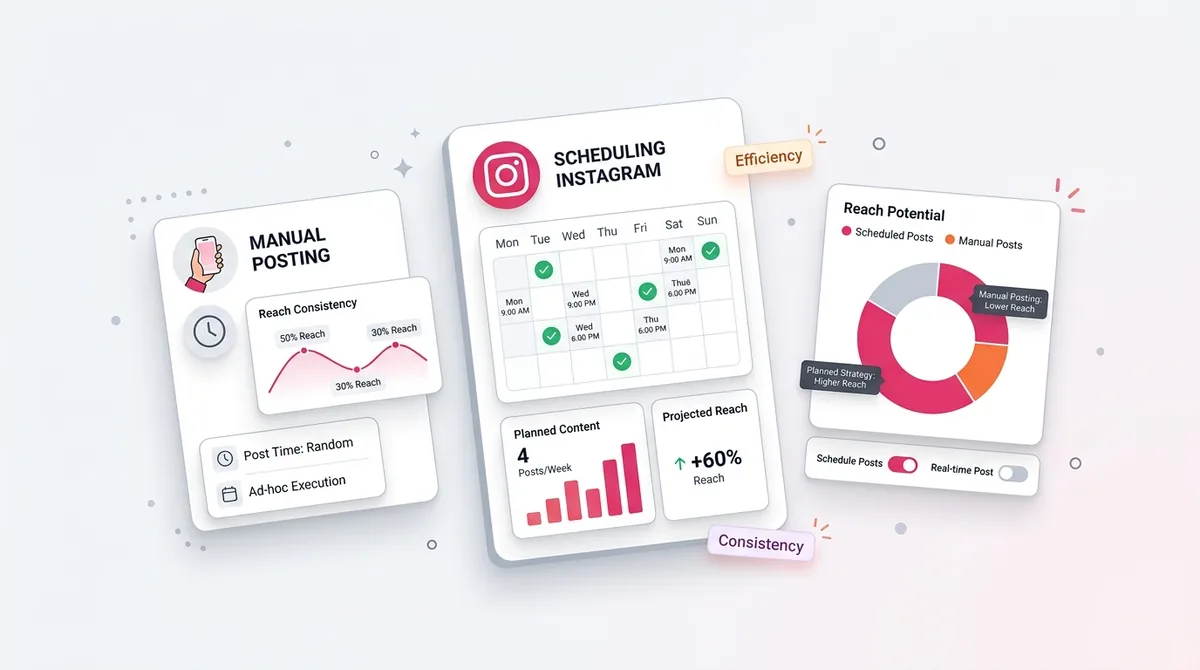
When comparing manual posting vs scheduling instagram, the algorithm treats both methods equally regarding organic reach. Instagram's official API does not penalize scheduled posts. However, scheduling ensures consistent publication—which trains the algorithm to push your content—while manual posting allows for immediate community engagement during the crucial first 30 minutes.
The 'Always-On' Trap: Why Manual Content Management Is Failing You
There is a massive hidden cost to managing your account manually, and it has nothing to do with the software.
It is decision fatigue.
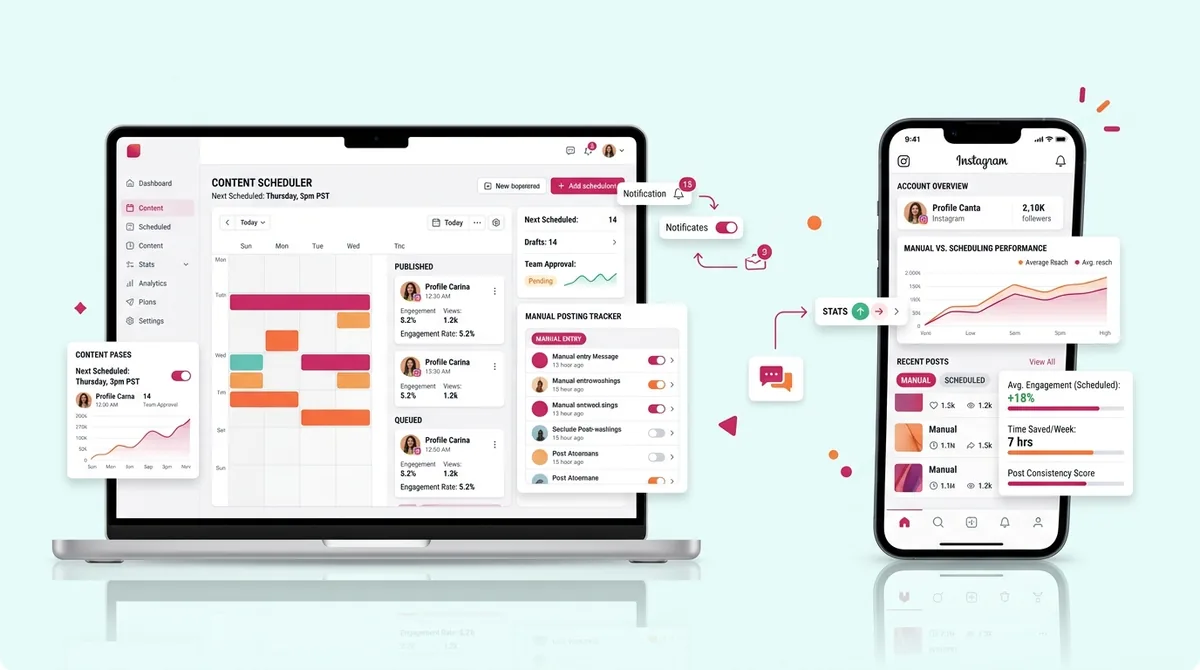
When you rely on manual posting, you are trapped in a constant habit loop. You wake up, realize you need to post today, scramble to find a photo or edit a Reel, agonize over the caption, and then stress about the timing. By the time you actually hit publish, your creative energy is completely drained.
This breaks what we call the Algorithm Learning Cycle. The Instagram algorithm is basically a highly advanced pattern recognition machine. It wants to know when your core audience is most active and receptive to your specific content.
If you post manually, your timing is usually erratic. You post at 9 AM on Tuesday, 4 PM on Wednesday, and maybe 11 PM on Friday because you forgot. The AI cannot identify a pattern. It does not know when to prime your audience's feed, so your initial distribution suffers.
What actually works is training the algorithm to expect your content at specific, reliable intervals.
Strategy 1: The 'Golden Hour' of Engagement
The main argument purists make for manual posting is that you need to be online the second your post goes live. There is some actual truth to this, but people misinterpret the mechanism behind it.
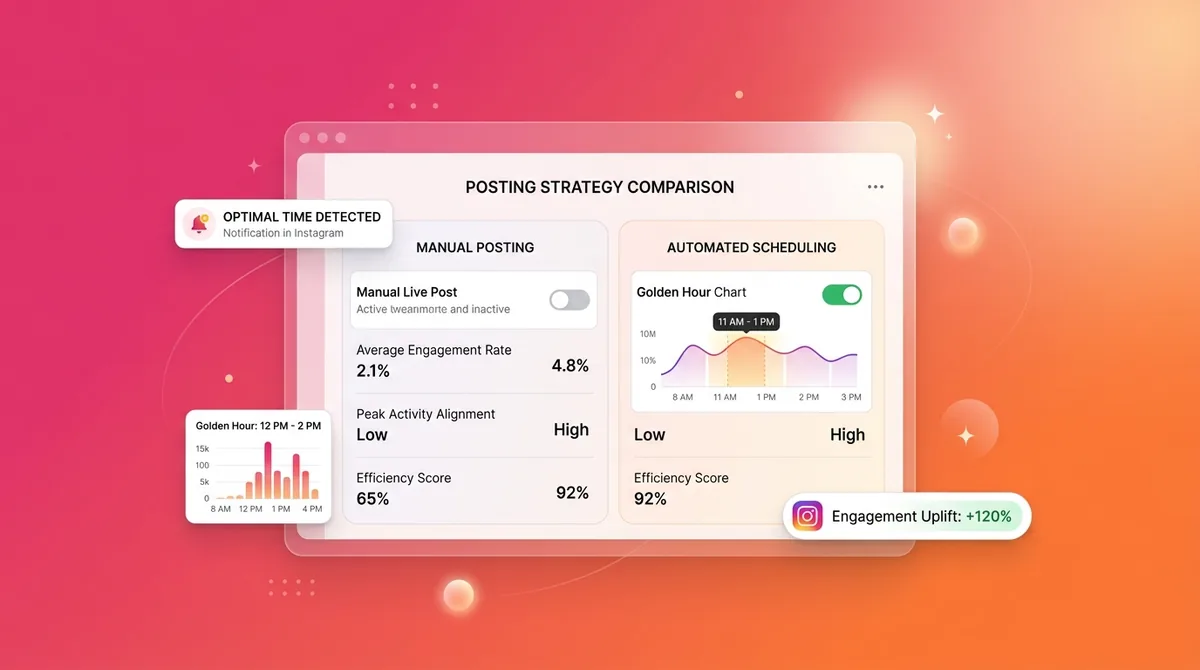
The algorithm measures early engagement velocity. In the first 30 to 60 minutes after a post goes live, Instagram shows it to a small, highly engaged segment of your followers. If those people scroll past it, the post dies. If they like, save, share, or comment, the algorithm says, "This is interesting," and pushes it to a wider audience, and eventually to the Explore page.
The 20-Minute Post-Publish Buffer
This is where manual posting technically has an edge—if you actually use it right. If you publish manually, you are already holding your phone. The tactic here is to stay on the app for exactly 20 minutes after posting.
Reply to every single early comment. Go to the Explore page and leave thoughtful comments on three to five posts in your niche. Watch a few Stories from your most engaged followers. You are signaling to the network that your account is currently an active hub of 'meaningful social interaction.'
But here is the catch: you can do this exact same thing with a scheduled post. You just have to set an alarm to open the app when your scheduled post goes live. The reach comes from your active community management, not the fact that you manually uploaded the photo.
Strategy 2: Systematized Distribution for Compound Growth
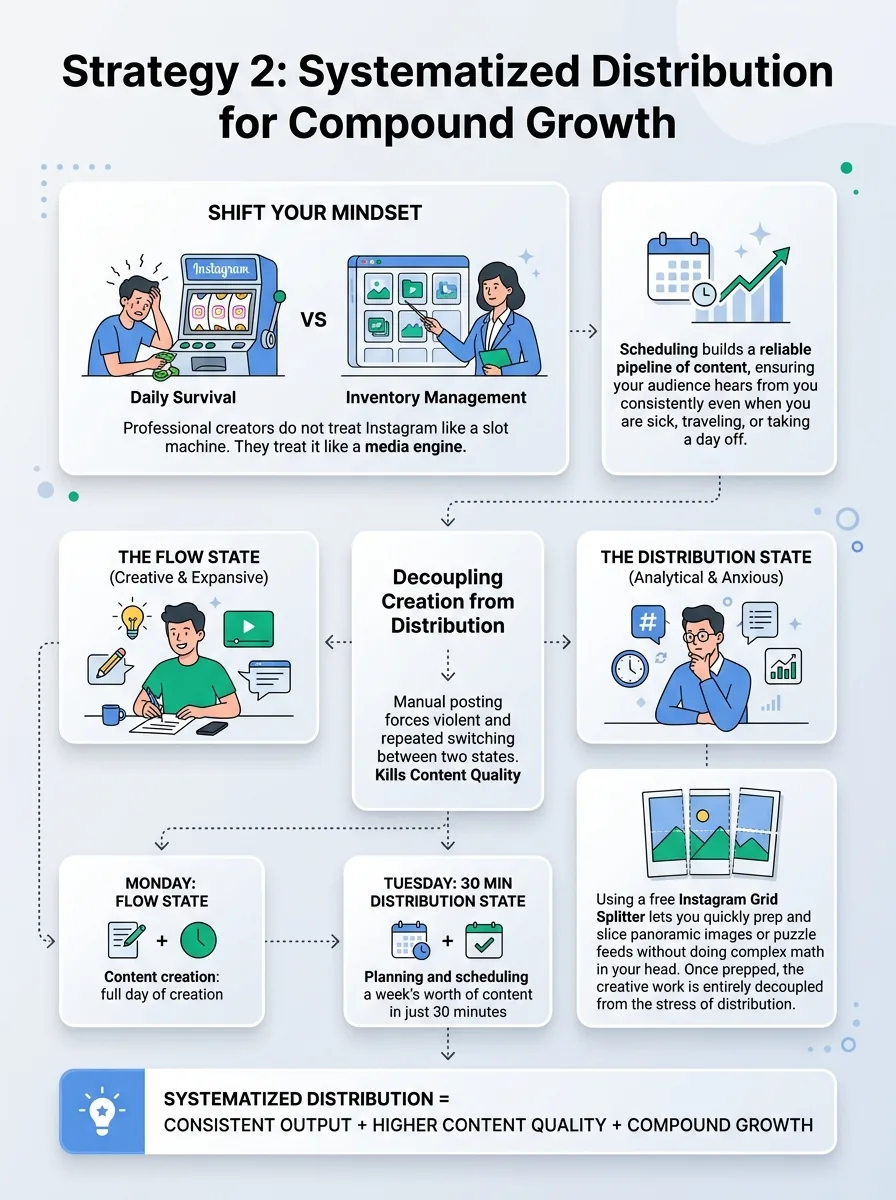
Professional creators do not treat Instagram like a slot machine. They treat it like a media engine.
When you shift your mindset from daily survival to inventory management, everything changes. Scheduling allows you to build a reliable pipeline of content, ensuring your audience hears from you consistently even when you are sick, traveling, or just taking a day off.
Decoupling Creation from Distribution
The human brain is terrible at multitasking. You have two distinct modes as a creator: the Flow State and the Distribution State.
In the Flow State, you are writing captions, editing video, and brainstorming hooks. You are creative and expansive. In the Distribution State, you are thinking about hashtags, formatting, and peak posting times. You are analytical and anxious.
When you post manually, you force your brain to switch between these two states violently and repeatedly. It kills content quality.
Batching and scheduling content removes this emotional friction. You can spend Monday in the Flow State, creating a week's worth of content. Then you spend 30 minutes in the Distribution State, slotting everything into your calendar. Sometimes creators struggle with batching because visualizing the final look is hard, but using a free Instagram Grid Splitter lets you quickly prep and slice panoramic images or puzzle feeds without doing complex math in your head. Once it is prepped, the creative work is entirely decoupled from the stress of distribution.
Strategy 3: The Hybrid Model for High-Stakes Accounts
If you want the absolute best of both worlds, you need to adopt the Hybrid Model. This is what top-tier creators actually do behind the scenes.
They schedule the 'What' and manually handle the 'Where'.
Using Scheduled Posts as Engagement Anchors
In practice, this means your heavy-lifting content—your educational carousels, your high-production Reels, your thought leadership captions—is entirely scheduled. These are your engagement anchors.
Because you are not stressing over posting those, you have free time and mental bandwidth to use Instagram Stories natively and manually.
Imagine you have a scheduled carousel going out at 12:00 PM. At 12:15 PM, you pick up your phone, record a quick, unpolished 15-second Story walking down the street, giving a behind-the-scenes thought related to that carousel, and slap a "New Post" sticker on it.
You get the consistency of a scheduled feed and the raw authenticity of manual Stories. This is the optimal balance.
Strategy 4: Technical Parity in the Instagram API
We need to talk about why the "scheduling kills reach" myth exists in the first place.
Back in 2016, the only way to schedule on Instagram was using unapproved, third-party botting software. These tools required your actual password, logged into your account from a server in another country, and basically screen-scraped the app to post for you.
Instagram absolutely hated this. It was a massive security risk, so they actively shadowbanned accounts using those sketchy tools.
Why Modern Scheduling Tools Don't Get Penalized
Today, the landscape is completely different. Meta developed the Graph API specifically so developers could build approved scheduling tools.
Why? Because Meta knows that consistent creators keep users on their app longer. They want you to schedule your content. According to Meta's official documentation on ranking, the algorithm looks at signals like post popularity, author interaction history, and format preference. Notice what is missing from that list? The method of publication.
As long as you are using an official API partner, the algorithm literally does not care how the post arrived on their servers.
The Pitfalls: Why Most People Still Get Bad Results (Regardless of Method)
If scheduling does not hurt reach, why do so many creators see a drop in engagement when they switch from manual to automated posting?
It is almost always because of user error. Here are the fatal mistakes killing your reach.
Mistake #1: The 'Set It and Forget It' Ghosting Syndrome
This is the most common killer. A creator schedules 10 posts for the week, closes their laptop, and literally doesn't open the Instagram app for five days.
When the post goes live, people comment. But because the creator is ghosting the platform, those comments sit unanswered. The algorithm tracks this. It sees a one-way broadcast instead of a two-way conversation, assumes the creator is unengaged with their own community, and quietly stops pushing their content to the Explore page.
Mistake #2: Over-reliance on Global 'Peak Times' Over Account Data
You Google "best times to post on Instagram" and find an article telling you to post at 11 AM on Wednesdays. You schedule all your content for 11 AM on Wednesdays.
Your reach tanks.
Global peak times are averages across billions of users. They mean nothing for your specific account. If your audience consists of night-shift nurses, posting at 11 AM is a death sentence. You have to dive into your specific audience Insights to see when your actual followers are holding their phones.
Mistake #3: Treating All Platforms Like Identical Twins
Another massive error is cross-posting the exact same file, with the exact same caption and formatting, to every single social network simultaneously.
Creators who master one platform often try to blindly copy-paste their strategy elsewhere, which is why the debate around manual posting vs scheduling TikTok requires completely different considerations than Instagram. A scheduled Instagram Reel needs specific caption formatting, whereas a TikTok might need different on-screen text placements. If you are scheduling, you must customize the post for the platform.
Case Studies: Manual vs. Scheduled Transformations
Let's look at how this plays out in the real world.
Consider Marcus, a B2B consultant. For a year, Marcus posted manually. He averaged two posts a week because his client work always got in the way. His reach hovered around 1,200 accounts per post. The algorithm barely knew he existed because he was completely unpredictable.
He switched to a batch-scheduling workflow. He still spent the exact same total amount of time on Instagram (about 3 hours a week), but he spent it all on Sunday morning. Because the friction was gone, he easily bumped his frequency to five posts a week. Within two months, his average reach jumped by 40%. The tool didn't give him reach; the consistency did.
Now look at a streetwear brand I consulted for. They tried scheduling 100% of their content, including their new product drops. But the streetwear community thrives on hype, sudden drops, and real-time interaction. Their scheduled drops felt corporate and flat. We switched their strategy: evergreen fashion tips were scheduled, but limited-edition drops were posted completely manually with the founders going Live immediately after. Engagement skyrocketed.
The method must match the moment.
The Consistency Bridge: Why Systems Beat Willpower
At the end of the day, the algorithm rewards behavior, not intentions. You can have the best manual posting strategy in the world, but if you get a flat tire on the way home from work and miss your posting window three days in a week, the algorithm assumes you are churning out of the platform.
The real issue isn't finding the perfect publication method. It's being able to execute your strategy consistently, week after week, without burning out.
Willpower is a finite resource. Systems are infinite.
This is where building a proper infrastructure comes in. By using a tool like the Instagram Scheduler inside SocialCal, you bridge the gap between what you want to post and what you actually have the energy to post. You map out your grid, auto-publish your first-comment hashtags to keep your captions clean, and let the system handle the heavy lifting. You remove the manual burden so your brain can actually focus on strategy and community.
Ready to save 15+ hours every week?
Join other creators who've automated their social media with SocialCal.
Get started freeThe Instagram Growth Checklist: A Framework for Balance
Stop guessing. Here is exactly how to structure your workflow this week to maximize both your reach and your sanity.
The 80/20 Content Workflow
Batch Create on Your High-Energy Day: Pick one day a week to shoot, edit, and write all your feed posts and Reels. Do not open the Instagram app during this time.
Schedule the 80%: Load your finished assets into your calendar. Set them for the times your specific audience is online. This handles the bulk of your algorithmic requirements.
Set Community Alarms: Set a phone alarm for 5 minutes after your most important scheduled posts go live. Jump in manually to reply to the first wave of comments to boost initial velocity.
Keep the 20% Native: Use Stories natively every single day. Document your day, ask polls, show your face. This proves to your audience that there is a human behind the automated feed.
Instagram Posting FAQ: Answering Your Burning Questions
Does scheduling affect the quality of images or Reels?
No. If you are using an official API partner, the compression algorithms are exactly the same as if you uploaded it via your phone. Just make sure your original files are exported at Instagram's recommended specs (1080x1920 for Reels, 1080x1350 for portrait images).
Does Instagram prioritize Reels more if they are posted manually?
There is zero data to support this. Reels reach is determined by watch time, average completion rate, and shares. The algorithm does not factor in the scheduling tool when deciding if a Reel is engaging enough to push to the Reels tab.
How many posts per week is optimal for reach?
Quality frequency matters most. Posting 3-5 times a week consistently for six months will yield vastly better reach than posting 14 times in one week and then disappearing for a month. The algorithm craves reliable patterns.
Does using a scheduler flag your account as a bot?
Not if you use modern tools. If you are still wondering does scheduling instagram posts reduce reach because of bot flagging, rest easy. Meta officially endorses tools that use their Graph API. You only risk shadowbans if you use sketchy, unauthorized apps that ask for your direct Instagram password.
Conclusion: Stop Fighting the Clock and Start Building a System
Growth isn't about perfectly timing a manual upload while your dinner gets cold. It's about providing value to a specific audience on a reliable schedule.
The algorithm doesn't care if a robot pushed the button. It only cares if humans want to look at the result.
Stop being an employee to your own Instagram account. Build your strategy, batch your creative work, schedule the heavy lifting with SocialCal, and use your newly reclaimed time to actually talk to the community you are building.