The Burnout Reality: Why You Don’t Need to Post Daily to Win on Instagram
You know the feeling. It is 8:30 PM, you are exhausted from actually running your business, and suddenly you realize you haven't posted anything today. You scramble to find a mediocre photo, slap a generic caption on it, and hit publish just to feed the machine.
Jump to a section:
- The Burnout Reality: Why You Don’t Need to Post Daily to Win on Instagram
- How to Achieve Instagram Growth Without Posting Daily
- The Algorithmic Trap: Why the 'Daily Posting' Myth is Killing Your Reach
- Strategy 1: Creating 'Save-First' Educational Carousels
- Strategy 2: Mastering Instagram SEO for Passive Discovery
- Strategy 3: The 'Reel-to-Story' Bridge for Consistent Visibility
- Strategy 4: Intentional Engagement and the 'Dollar-Eighty' Method
- Strategy 5: Leveraging User-Generated Content (UGC) Loops
- Common Mistakes: Why Most 'Low-Frequency' Strategies Fail
- Real-World Results: Accounts That Grew While Posting 3x Weekly
- The Consistency Bridge: Why Systems Beat Willpower
- The 5-Step Checklist for a Sustainable Instagram Workflow
- Frequently Asked Questions About Instagram Growth Without Posting Daily
- Conclusion: Focus on Impact, Not Noise
Most creators operate this way. They treat the platform like a hungry tamagotchi that will die if not fed every 24 hours.
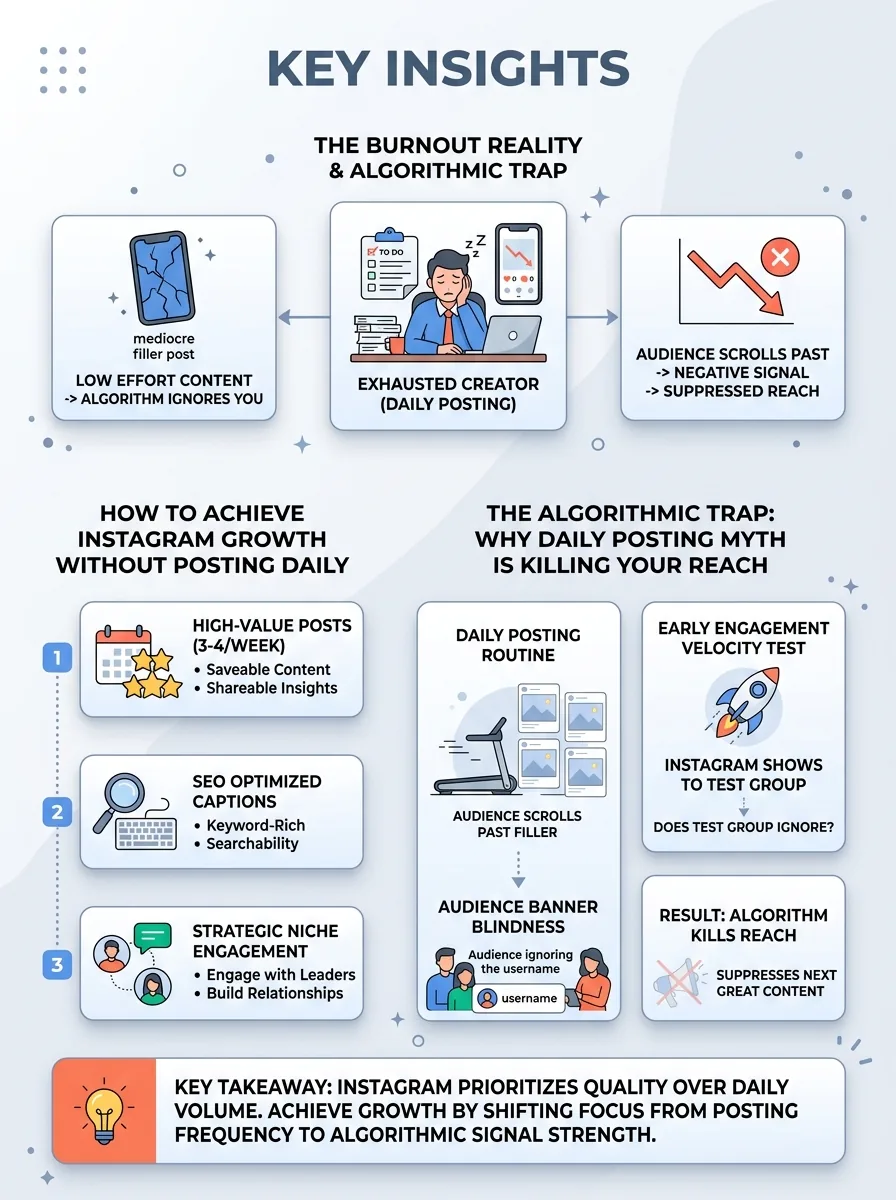
Here is what nobody tells you about that approach. It actively hurts your account. Pumping out low-effort content just to hit a daily quota trains the algorithm to ignore you. Your followers scroll past your mediocre filler posts, which sends a negative signal to Instagram, which then suppresses your next piece of content.
Ready to save 15+ hours every week?
Join other creators who've automated their social media with SocialCal.
Get started freeAchieving true instagram growth without posting daily isn't a pipe dream for giant brands with massive teams. It is a highly strategic, behavioral approach to content creation. By shifting your focus from volume to signal strength, you can actually increase your reach while working less.
This guide breaks down exactly how to step off the daily content treadmill. We are going to look at the mechanisms driving the platform today, and how you can manipulate them to grow a highly engaged audience posting just three times a week.
How to Achieve Instagram Growth Without Posting Daily
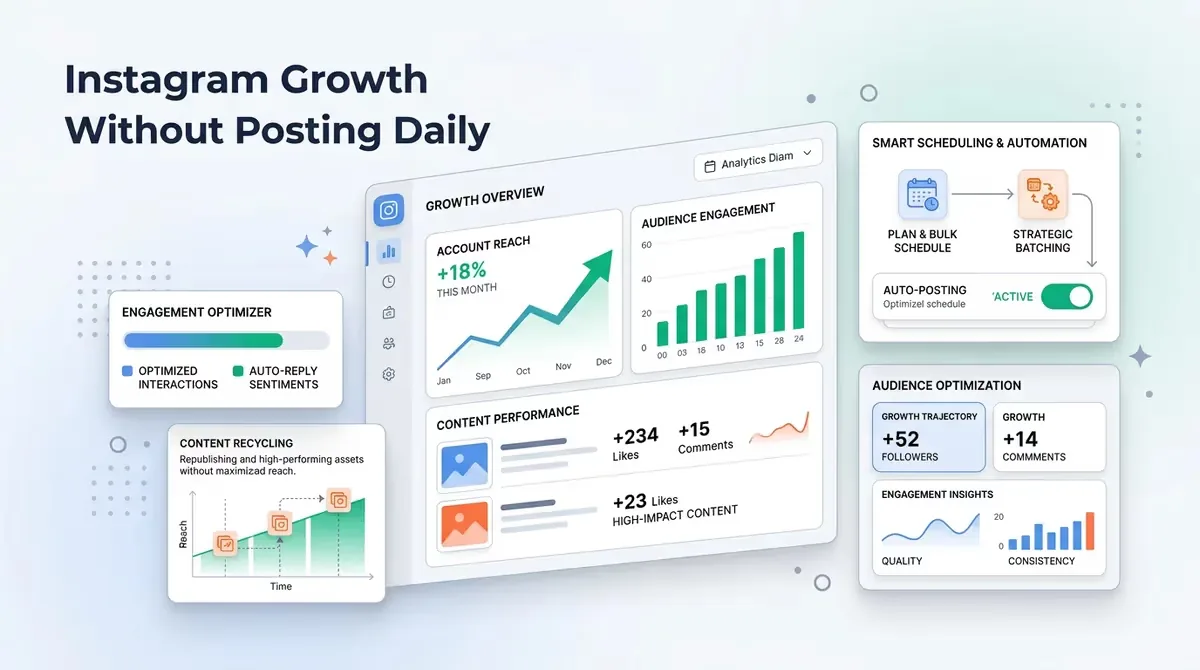
Instagram growth without posting daily relies on optimizing for algorithmic "signal strength" rather than frequency. By publishing 3 to 4 high-value, saveable posts weekly, optimizing your captions for SEO searchability, and engaging strategically with niche leaders, you train the algorithm to prioritize your content's quality over daily volume.
The Algorithmic Trap: Why the 'Daily Posting' Myth is Killing Your Reach
Let's talk about how the algorithm actually works. It does not care about your posting schedule. It cares about user retention.
Instagram makes money by keeping people on the app to show them ads. The algorithm's only job is to predict which posts will keep specific users from closing the app. It measures this through a concept called "Early Engagement Velocity."
The Algorithmic Trap: Why the 'Daily Posting' Myth is Killing Your Reach
When you hit publish, Instagram shows your content to a small fraction of your most active followers. It then watches closely. Do they stop scrolling? Do they read the caption? Do they share it? If this test group ignores your post, the algorithm kills its reach immediately.
This is where daily posting destroys creators. When you post seven times a week, inevitably, three or four of those posts are going to be filler. When your audience gets used to seeing filler from you, they develop "banner blindness" to your username. They scroll past. You fail the early velocity test. By the time you post your one genuinely great piece of content for the week, the algorithm has already categorized your account as low-interest, and it won't even show that great post to your core audience.
The Psychology of Content Satiety and Audience Fatigue
Think about your favorite television show. If they released a new episode every single day, you would eventually fall behind. You would feel overwhelmed. The perceived value of each episode would drop.
The same cognitive load applies to your followers. Scarcity creates anticipation. When you only show up in the feed three times a week, but every single post solves a specific problem or entertains at a high level, your followers begin to associate your profile picture with immediate value. They stop scrolling when they see your name. That behavioral pause is the strongest signal you can send to the algorithm.
Strategy 1: Creating 'Save-First' Educational Carousels
If you are going to post less often, the posts you do publish need to work twice as hard. Enter the educational carousel.
From a mechanical standpoint, carousels are the single most powerful format for non-daily posters. Why? Because Instagram gives them a built-in second chance. If a user scrolls past your carousel in the morning without engaging, Instagram will often re-serve that exact same post to them later in the day, but it will show the second slide instead of the first.

You literally get double the impressions for the same piece of content.
Structuring Your Carousel for Maximum Retention
A carousel only works if people actually swipe. The algorithm tracks "dwell time"—the exact number of seconds a user spends hovering over your post. A user swiping through eight slides signals massive interest.
Here is the exact framework that works right now.
Slide one is your hook. It must agitate a specific pain point. If you struggle with coming up with these opening concepts, running your ideas through a viral hook tester can help you find the phrasing that actually stops the scroll. You want a bold claim or a relatable problem.
Slide two validates the problem. Tell them why their current approach isn't working.
Slides three through eight are the meat. Give them actual, tactical steps. Do not hold back the secret sauce. If they can't implement your advice immediately, they won't save the post.
The final slide is your specific call to action. Tell them exactly what to do next. "Save this for your next content batch" works significantly better than "Thoughts? Let me know below." If you want to use AI to craft converting carousels, you can try the content generator by SocialOrbit.
Strategy 2: Mastering Instagram SEO for Passive Discovery
For years, growth meant hiding thirty hashtags in your first comment and praying for the Explore page. That era is over.
Instagram has transformed into a semantic search engine. This means the AI reads your captions, scans the visual elements of your video, and listens to the audio to categorize your account. When someone searches for "minimalist living room ideas," Instagram doesn't just look for the hashtag. It looks for those exact words woven naturally into highly-engaged content.
If you want to grow without posting daily, your content needs a long shelf life. SEO gives you that passive discovery.
Stop writing two-sentence captions with an emoji. Write mini-blog posts. Use the exact phrases your target audience is typing into the search bar. Describe the problem, outline the solution, and use natural language. This ensures your post continues to gather views from search results weeks after it falls off the main feed.
The only way to know if this is working is by understanding your social media analytics and watching the "reach from search" metric on your individual posts. If that number climbs, your SEO is dialed in.
Strategy 3: The 'Reel-to-Story' Bridge for Consistent Visibility
The most common fear about posting less is that your audience will simply forget about you. This is where you separate your "discoverability" strategy from your "nurture" strategy.
Reels are for top-of-funnel discovery. They are designed to reach non-followers. You only need one or two highly produced, well-scripted Reels a week to keep new traffic flowing to your profile.
Stories are for bottom-of-funnel nurturing. They are for the people who already decided to follow you. The beauty of Stories is that they require zero production value and carry zero algorithmic penalty if they flop.
You bridge the gap by maintaining a daily presence on Stories while only hitting the main grid a few times a week. Show behind-the-scenes work. Share quick thoughts while walking the dog. Post a poll. This maintains the parasocial relationship with your audience and keeps your profile ring active at the top of their app, satisfying their need for connection without burning you out on grid content.
As attention continues to fragment across platforms like Threads and Bluesky, maintaining that low-friction daily touchpoint on Instagram Stories is what keeps your core audience loyal to your visual content when you do finally drop a major post.
Strategy 4: Intentional Engagement and the 'Dollar-Eighty' Method
Here is a secret that large agencies charge thousands of dollars to implement. You can grow your account entirely through the comment sections of other people's posts.
When you aren't spending ten hours a week creating daily content, you have time to actively engage. But I don't mean leaving fire emojis on random accounts.
Find ten creators in your exact niche who have a slightly larger audience than you. Turn on post notifications for their accounts. Whenever they drop a new post, be one of the first people to leave a thoughtful, multi-sentence comment that adds genuine value to their topic.
Because you are early, and because your comment is insightful, other users will like your comment. It will get pinned to the top of the thread. You effectively siphon hundreds of highly-targeted profile visits from their audience over to your page.
If your profile is optimized with those 3-4 high-value posts we talked about earlier, a massive percentage of that traffic will convert into followers.
Strategy 5: Leveraging User-Generated Content (UGC) Loops
The ultimate hack for low-frequency posting is getting your audience to do the posting for you.
Create assets that people inherently want to share. This could be a striking infographic, a controversial but well-reasoned opinion on your industry, or a template they can screenshot.
When someone shares your post to their Story, it acts as a massive algorithmic trust signal. Instagram sees that your content is valuable enough that users are willing to endorse it to their own friends. This forces the algorithm to push your original post even harder on the Explore page.
To build a UGC loop, actively reward the behavior. When someone tags you, reshare it to your own Story. Thank them publicly. This trains your audience that engaging with you results in visibility for them, creating a reciprocal loop of continuous shares.
Common Mistakes: Why Most 'Low-Frequency' Strategies Fail
Many creators hear "post less" and immediately see their metrics tank. That is because they reduce their frequency without increasing their quality, or they break fundamental platform rules. Here is where the strategy usually falls apart.
Mistake: Ghosting Your Stories Between Grid Posts
If you don't post a grid photo for three days, that is fine. If you don't post a Story for three days, you become invisible. The algorithm tracks session times. If your followers haven't interacted with your profile ring in 72 hours, Instagram assumes the relationship is dead. When you finally do post that high-value carousel, it gets buried beneath the accounts they interact with daily.
Mistake: Neglecting Your 'Link in Bio' Conversion Path
High reach is entirely useless if your profile looks like a mess when people actually visit it. If you are only posting three times a week, your bio needs to work overtime. It must clearly state who you are, who you help, and what they get by following you. The link should drive them to a specific, optimized landing page, not a confusing tree of twenty different random links.
Mistake: Being Inconsistent With Your Reduced Schedule
Posting three times a week works. Posting three times one week, vanishing for fourteen days, and then posting five times the next week does not. The algorithm favors predictable patterns. If you are worried that scheduling posts hurts your reach, let that myth die right now. Erratic behavior hurts your reach far more than any automated tool ever could.
Real-World Results: Accounts That Grew While Posting 3x Weekly
Let's look at how this plays out in practice. Consider a graphic design agency that was posting daily tutorials, getting roughly 200 likes per post, but seeing zero follower growth. They were exhausted.
They shifted to posting just three times a week. Every Tuesday, they posted a highly-detailed 10-slide carousel. Every Thursday, they posted a high-energy Reel breaking down a rebrand. Every Saturday, they posted a single-image infographic.
Week one, their overall reach dropped by 15%. This panicked them. But by week three, the algorithm adjusted. Because the dwell time on their carousels was so high, Instagram started pushing them to the Explore page. Their engagement rate per post tripled. Within two months, they saw a 22% month-over-month follower growth, entirely because they stopped diluting their own signal strength with daily filler.
The Consistency Bridge: Why Systems Beat Willpower
The real issue isn't knowing what to post. It's the friction of doing it manually while running your life. When you rely on waking up and feeling "inspired" to post, you will inevitably fail. Willpower depletes.
Algorithms reward behavioral consistency. The easiest way to maintain a sustainable three-day-a-week schedule is to remove the daily decision fatigue entirely. You need a system that builds a bridge between your ideas and your audience without requiring you to open the app every day.
This is why serious creators use tools like the Instagram Scheduler to handle the heavy lifting. You can sit down on a Sunday with a cup of coffee, map out your three high-value posts for the week, upload your carousels, and set them to auto-publish. You can even automate the first comment with your SEO hashtags.
Once the system is handling the distribution, your only job during the week is to show up on Stories and engage in the comments. By relying on a batching and scheduling playbook, you transform social media from a daily source of anxiety into a background engine that simply runs.
The 5-Step Checklist for a Sustainable Instagram Workflow
Ready to step off the daily treadmill? Follow this exact workflow to transition your account.
Audit your last 30 days. Identify the top 20% of your posts that generated the most saves and shares. That is your new baseline for quality.
Define your 3 weekly pillars. Pick three specific formats. (e.g., Tuesday: Educational Carousel. Thursday: Industry Take Reel. Saturday: Personal Story photo).
Batch create your content. Pick one afternoon a month. Write all 12 captions at once. Film all 4 Reels in one session.
Schedule everything. Load your monthly assets into your scheduling tool. Set them and forget them.
Commit 15 minutes a day to engagement. Use the time you saved not creating daily posts to leave thoughtful comments on bigger accounts in your niche.
How to Batch Your Monthly Content in One Afternoon
The secret to batching is separating the ideation from the execution. Do not try to come up with ideas and design them on the same day. Keep a running note on your phone all month. When batch day arrives, you already have your 12 concepts. Open your templates, drop the text in, write the SEO captions, and you are done in three hours.
Frequently Asked Questions About Instagram Growth Without Posting Daily
Does the Instagram algorithm punish you for not posting every day?
No. The algorithm does not have a "punishment" mechanism for low frequency. It simply reacts to user behavior. If you post less often, you have fewer opportunities to trigger algorithmic reach, which is why the quality of the posts you do make must be significantly higher. Quality completely mitigates the lack of frequency.
How many times a week should I post on Instagram for growth?
For most creators and small businesses, posting 3 to 4 times a week on the main grid is the sweet spot. This provides enough data points for the algorithm to understand your account, keeps you relevant to your audience, but leaves enough breathing room to ensure every piece of content is highly polished and valuable.
If I post less, will I lose followers?
You might see a slight dip in the first two weeks as the algorithm recalibrates your reach. However, accounts that switch from high-volume filler to low-volume high-value content almost universally see an increase in overall retention and a higher conversion rate of profile visitors to followers over a 90-day period.
Do Stories count as posting daily?
Yes and no. Stories do not feed the main discovery algorithm (the Explore page or Reel feed). However, they are crucial for maintaining your internal algorithmic ranking with your existing followers. Posting daily Stories ensures your grid posts get shown to your own audience when you do hit publish.
Conclusion: Focus on Impact, Not Noise
Growth isn't about perfectly timing a daily upload to appease a robotic overlord. It is about consistently delivering undeniable value to real human beings. Three phenomenal posts that actually help your audience will always outperform seven mediocre posts that exist just to take up space.
Stop feeding the content machine with filler. Build a reliable system, use a content calendar to manage the distribution, and get your life back while your account grows in the background.