The Scheduling Dilemma: Are You Hurting Your Own Growth?
You are sitting at your desk at 8:55 AM, staring at a Google Doc, waiting to copy and paste your text so you can publish manually at exactly 9:00 AM. Sound familiar?
Jump to a section:
- The Scheduling Dilemma: Are You Hurting Your Own Growth?
- Does Scheduling LinkedIn Posts Reduce Reach? (The Short Answer)
- The Algorithm Anxiety: Why the 'Manual is Better' Myth Persists
- Strategy 1: Mastering Engagement Velocity for Scheduled Content
- Strategy 2: Maintaining the 'Human Signal' via Automation
- The Consistency Bridge: Why Frequency Always Trumps Perfect Timing
- A 5-Step Checklist for Safer LinkedIn Scheduling
- Frequently Asked Questions About LinkedIn Reach
- Conclusion: Reach is a Quality Metric, Not a Delivery Problem
Most creators live in this constant state of algorithm anxiety. You want your life back, but you are terrified of the dreaded "shadowban." You have heard whispers that using automation tools kills your views. You worry that if you don't push the button yourself, the platform will silently punish you and bury your content.
Ready to save 15+ hours every week?
Join other creators who've automated their social media with SocialCal.
Get started freeLook, manual posting is exhausting. It forces you to interrupt your deep work, break your focus, and jump into the social media slot machine just to keep your audience fed. But before you surrender your mornings to manual publishing forever, we need to look at what is actually happening under the hood when a post goes live.
Does Scheduling LinkedIn Posts Reduce Reach? (The Short Answer)
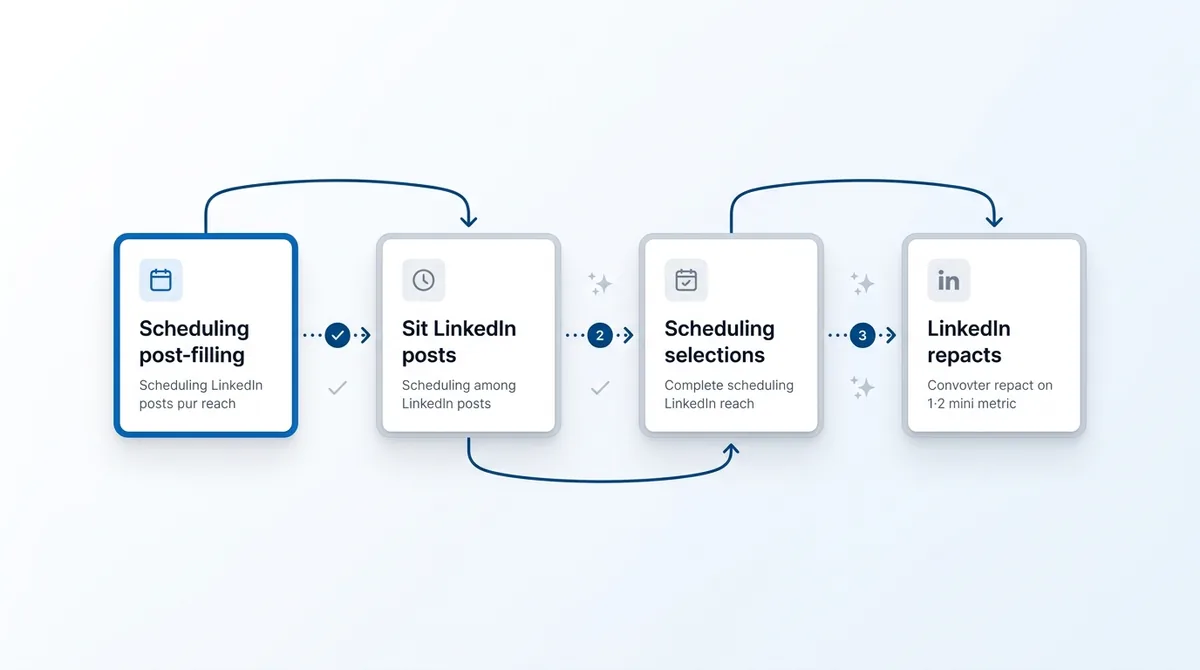
No, does scheduling linkedin posts reduce reach? The short answer is absolutely not. LinkedIn's algorithm does not penalize scheduled posts or third-party tools. Reach is purely dictated by content quality, formatting, and initial engagement velocity, regardless of whether you published manually or used an automation app.
The Algorithm Anxiety: Why the 'Manual is Better' Myth Persists
If scheduling doesn't hurt reach, why do so many creators swear their numbers drop the second they start using a tool?
The answer isn't in the code. It is in your behavior.
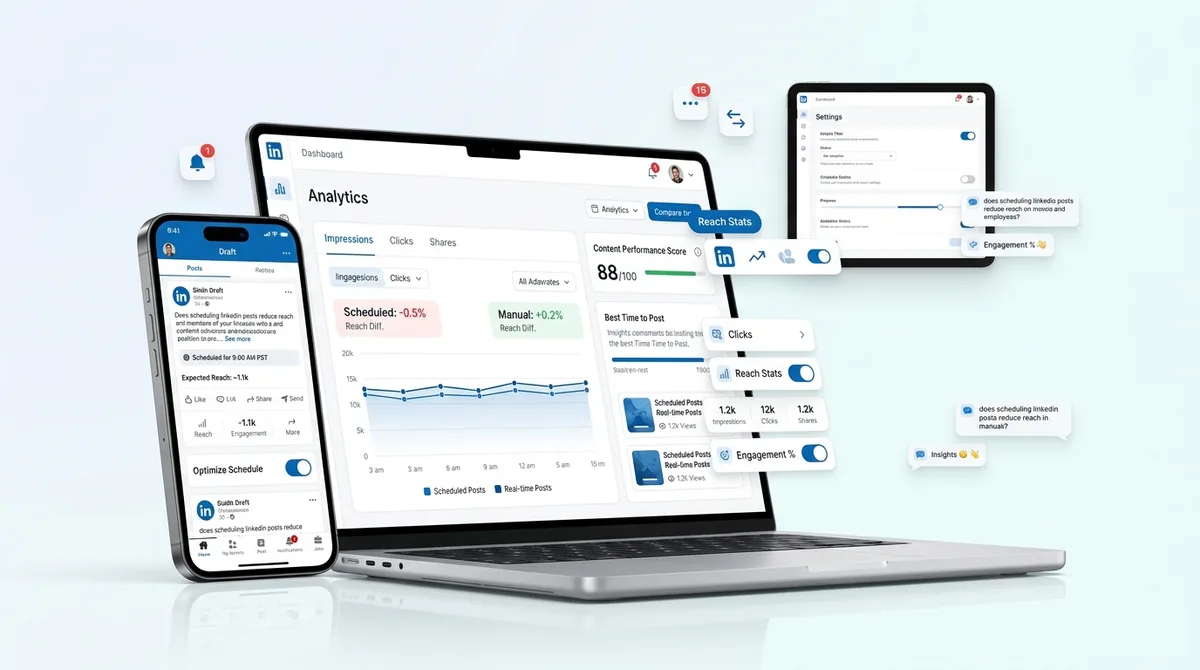
Think about what you do when you post manually. You hit publish, and then you naturally stick around. You wait for that first comment to roll in. You reply immediately. While you wait, you scroll your feed and leave a few thoughtful comments on other creators' posts. You are acting like a highly engaged, active user.
Now think about what happens when you schedule a post for Tuesday at 9 AM. You are likely on a Zoom call, driving, or heads-down in a spreadsheet. The post goes live, but you are entirely absent. This "post and ghost" behavior is what actually tanks your reach. The LinkedIn algorithm explained simply states that the platform rewards conversations, not broadcasts.
Strategy 1: Mastering Engagement Velocity for Scheduled Content
The algorithm measures a metric called engagement velocity. It cares deeply about how fast people interact with your content right after it goes live.
The Critical First 60 Minutes
When your scheduled post hits the feed, LinkedIn doesn't immediately show it to all your followers. It pushes it to a small "tester group" of usually highly active connections. The algorithm watches this group closely.
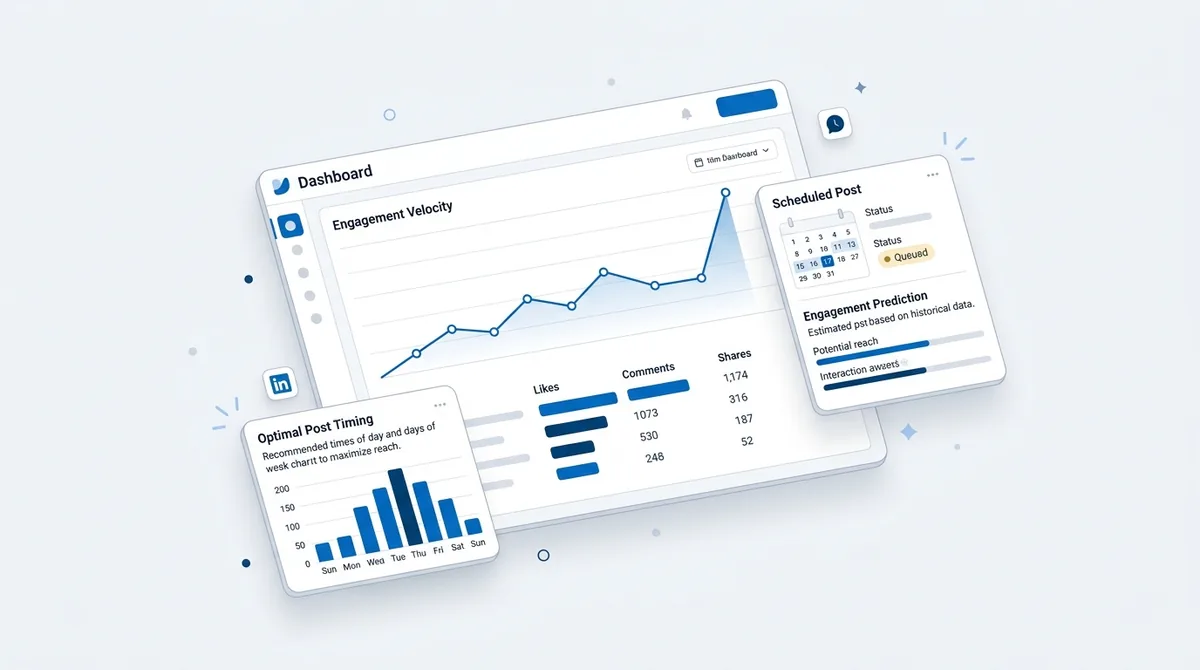
If the tester group scrolls right past it, the algorithm assumes the post is a dud and caps your reach. If they click "See More," dwell on the text, or drop a comment, the algorithm interprets this as a strong positive signal. It then opens the floodgates and pushes your content to a much wider audience. Your job is to make sure you are available to interact with that initial wave of engagement, turning one comment into a three-reply thread.
Native Scheduling vs. Third-Party API Performance
Let's put the technical myth to rest. The text payload sent to LinkedIn's servers via an API is treated identically to text typed directly into the native composer. According to data from official platform sources like the LinkedIn Engineering Blog, feed ranking focuses on relevance and predicted engagement, not the origin of the publish click.
In practice, third-party posts usually fail because creators get lazy. They write a generic caption that looks terrible on mobile, forget to add line breaks, and strip away the formatting that makes native posts so readable. The tool didn't fail them; their formatting did.
Strategy 2: Maintaining the 'Human Signal' via Automation
Social media is supposed to be social. You can automate the delivery of your message, but you cannot automate the relationships that make the message matter.
Avoiding the 'Post and Ghost' Trap
I've seen accounts blow up just by fixing this one bad habit. Setting up a month of content on a Sunday and never logging in again is a recipe for irrelevance.
When you ignore your feed, the algorithm takes notice. It relies on a two-way street of interaction. If you want your scheduled posts to perform like manual posts, you have to build manual engagement time into your daily routine. Ten minutes of authentic commenting on industry peers' posts right around the time your scheduled post goes live will do more for your reach than any viral hook.
Optimizing Post Formatting for Different Devices
The most important part of your post is "the fold"—the point where LinkedIn cuts off your text and adds the "See More" button. A scheduled post with a weak opening line will bomb.
You need to trigger that click. One highly effective way to guarantee dwell time is to stop relying purely on text. If you use a free LinkedIn carousel generator to create swipeable PDF documents, you naturally force users to click through your slides. The algorithm registers every single swipe as an active engagement signal, drastically boosting your post's distribution score before a single person even leaves a comment.
The Consistency Bridge: Why Frequency Always Trumps Perfect Timing
Here is what nobody tells you: the algorithm learns your posting cadence. If you publish three times one week, disappear for a month, and then dump four posts in two days, your reach will be chaotic.
Sporadic posting forces the algorithm to constantly reset its understanding of who actually cares about your content. The real issue isn't finding the perfect manual posting strategy. It is being able to maintain a high-quality standard consistently over months and years. That is why smart creators use a dedicated LinkedIn Scheduler like SocialCal. It builds a consistency bridge, allowing you to decouple the act of creating from the act of publishing.
Overcoming the Content Fatigue Cycle
Writing daily leads to burnout. Some days you are inspired; other days you stare blankly at the screen. Manual posting forces you to publish whatever you can scrape together on those bad days, which leads to massive quality dips.
When you use SocialCal, you write your content during your peak creative hours. You batch your best ideas, schedule them to roll out smoothly, and ensure your audience only sees your highest-quality work.
Planning Strategic Visibility with SocialCal
Consistency requires a visual map. You need to see exactly when your "reach" posts (broad, relatable content) are going out compared to your "conversion" posts (case studies, client wins, direct pitches).
By mapping this out in a calendar, you ensure you never accidentally string together three sales pitches in a row—a surefire way to train your audience to scroll past you. You are engineering a predictable, engaging rhythm that the algorithm learns to trust.
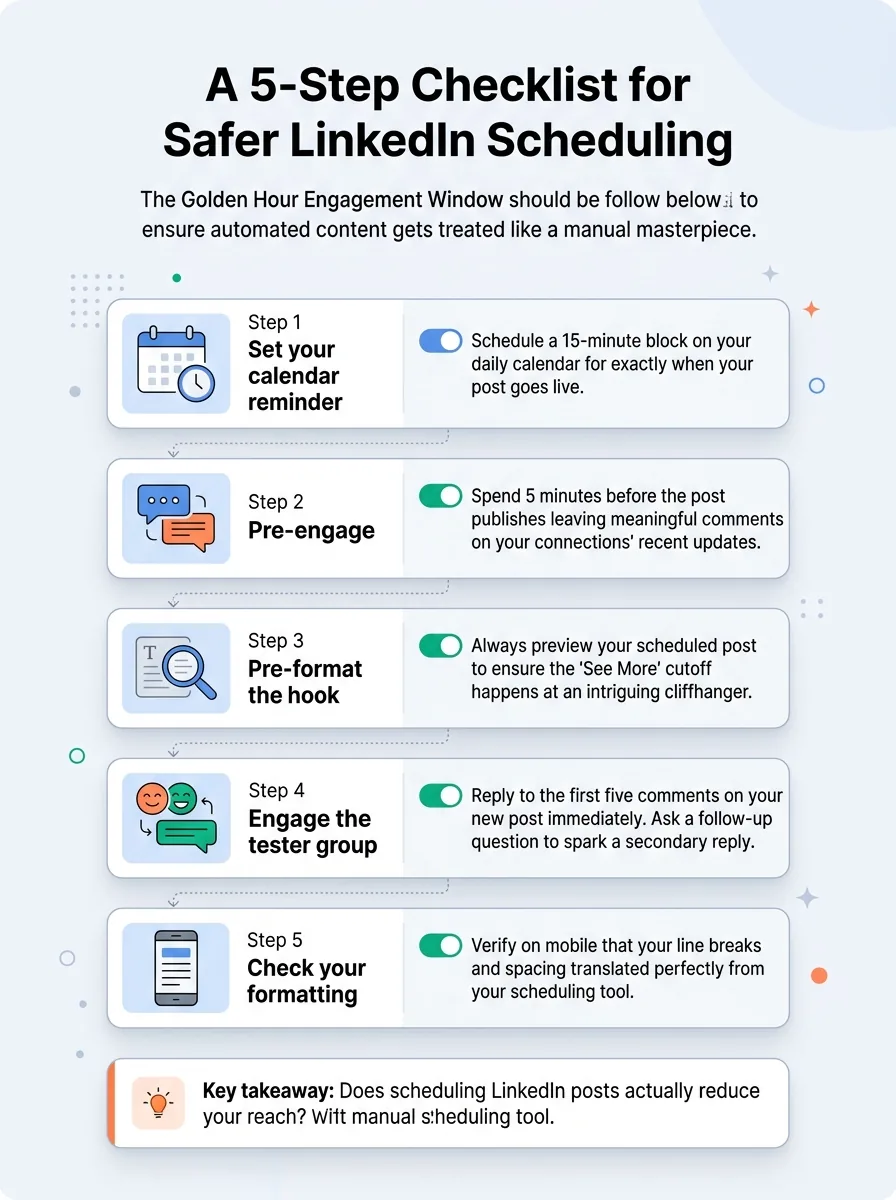
A 5-Step Checklist for Safer LinkedIn Scheduling
Follow this exact framework to ensure your automated content gets treated like a manual masterpiece.
The 'Golden Hour' Engagement Window
Set your calendar reminder: Schedule a 15-minute block on your daily calendar for exactly when your post goes live.
Pre-engage: Spend 5 minutes before the post publishes leaving meaningful comments on your connections' recent updates.
Pre-format the hook: Always preview your scheduled post to ensure the "See More" cutoff happens at an intriguing cliffhanger.
Engage the tester group: Reply to the first five comments on your new post immediately. Ask a follow-up question to spark a secondary reply.
Check your formatting: Verify on mobile that your line breaks and spacing translated perfectly from your scheduling tool.
Frequently Asked Questions About LinkedIn Reach
Does using Buffer or Hootsuite hurt reach?
No. Third-party API tools are officially supported by LinkedIn. Reach drops are usually caused by "post and ghost" user behavior, not the tool itself.
Is LinkedIn native scheduling better than tools?
Both use the exact same distribution network. The only advantage native scheduling has is guaranteeing accurate formatting previews, which a high-quality external tool will also provide.
How many times a week should I post for maximum reach?
Data shows that 3 to 5 times a week is the sweet spot. Posting more than once within an 18-hour window will cause your posts to cannibalize each other's reach.
Does editing a scheduled post kill its performance?
Editing a post within the first hour of publishing temporarily pauses its distribution while the platform scans for policy violations. Try to avoid editing unless absolutely necessary.
Ready to save 15+ hours every week?
Join other creators who've automated their social media with SocialCal.
Get started freeConclusion: Reach is a Quality Metric, Not a Delivery Problem
The algorithm is remarkably simple. It wants to keep users on the platform as long as possible. It cares entirely about what you are saying and how people react to it, not whether a robot hit the publish button for you.
Growth isn't about perfectly timing a manual post. It is about showing up consistently with ideas that make your audience stop scrolling. SocialCal gives you the infrastructure to maintain that consistency without sacrificing your sanity or your mornings. Focus on starting better conversations, schedule the delivery, and make sure you show up to talk back.