The Myth of the 'Daily Grind' on LinkedIn
"Post every day to win." We have all heard the growth gurus say it. But for 90% of creators, it is terrible advice.
Jump to a section:
- The Myth of the 'Daily Grind' on LinkedIn
- What is a LinkedIn personal brand posting schedule?
- Why Creating a Consistent Brand Is Historically Hard
- Strategy 1: The 'Three-Pillar' Content Architecture
- Strategy 2: The 4:1 Batching System
- Strategy 3: Mastering the Engagement Window
- Why Most LinkedIn Brands Stall (Common Mistakes)
- Before and After: From Chaos to System
- The Consistency Bridge: Solving the Execution Gap
- Your 5-Step LinkedIn Scheduling Checklist
- LinkedIn Strategy FAQ
- Conclusion: Building a Brand Without the Burnout
When you try to force a daily linkedin personal brand posting schedule without a system, you inevitably default to creating high-volume, low-value noise. You start posting generic quotes. You share links without context. Your audience tunes you out.
Ready to save 15+ hours every week?
Join other creators who've automated their social media with SocialCal.
Get started freeSuccess on LinkedIn isn't about frequency alone. It is about a sustainable routine that prevents content debt and burnout.
Most creators get this wrong. They think the algorithm rewards pure volume. In practice, the algorithm actually rewards predictable quality and deep engagement. If you are exhausted just trying to hit "publish" at 8 AM, you won't have the energy left to actually talk to the people commenting on your post.
What is a LinkedIn personal brand posting schedule?
A LinkedIn personal brand posting schedule is a strategic roadmap that defines your content frequency, themes, and engagement windows. For most professionals, an effective schedule consists of 3 to 5 high-quality posts per week, balanced across educational, authority-building, and personal narrative pillars to satisfy both the algorithm and human readers.
Why Creating a Consistent Brand Is Historically Hard
Let's talk about why most people fail at this.
The core issue isn't a lack of expertise. It is decision fatigue. Waking up, staring at a blinking cursor, and asking yourself "What should I write about today?" is a guaranteed way to kill your momentum.
Then there is the algorithmic reality.
LinkedIn operates on a machine learning model that needs a predictable data stream from your account. When you post consistently, the algorithm maps your profile to a specific audience graph. It learns that your content appeals to SaaS founders, or junior designers, or real estate agents.
If you post five times in one week, then vanish for a month, that data stream breaks. The algorithm drops your "confidence score" and stops serving your posts to your wider network.
Strategy 1: The 'Three-Pillar' Content Architecture
A schedule shouldn't just dictate when you post. It needs to dictate what category you hit.
If you only post technical tutorials, your audience gets bored. If you only post personal stories, people won't know what you actually sell. You need variety.
The Authority Pillar: Solving Problems
This is where you prove you know your stuff. Schedule deep-dives into your industry expertise.
Share a framework you use to solve a common client problem. Break down a recent industry trend. Authority posts build trust with potential leads, moving them from "passive scroller" to "active buyer."
The Human Pillar: Sharing the 'Why'
Human-centric posts often see three times higher engagement than pure technical content. Why? Because faces and personal stories stop the scroll.
Share a failure you experienced early in your career. Talk about why you started your business. The mechanics of vulnerability work because people connect with people, not corporate resumes.
Strategy 2: The 4:1 Batching System
We are terrible at multitasking.
Behavioral psychology shows that context switching destroys focus. Trying to shift from "CEO mode" to "Creator mode" for 15 minutes every morning creates massive mental friction.
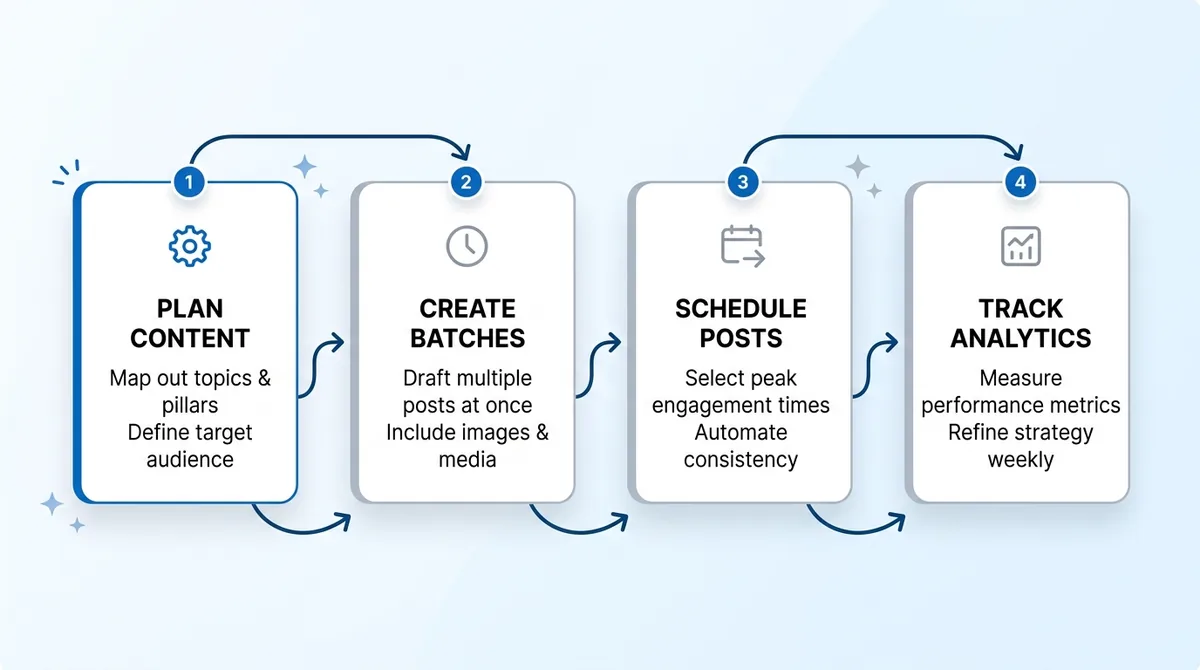
Instead, try the 4:1 Batching System: spend one hour a week writing four posts.
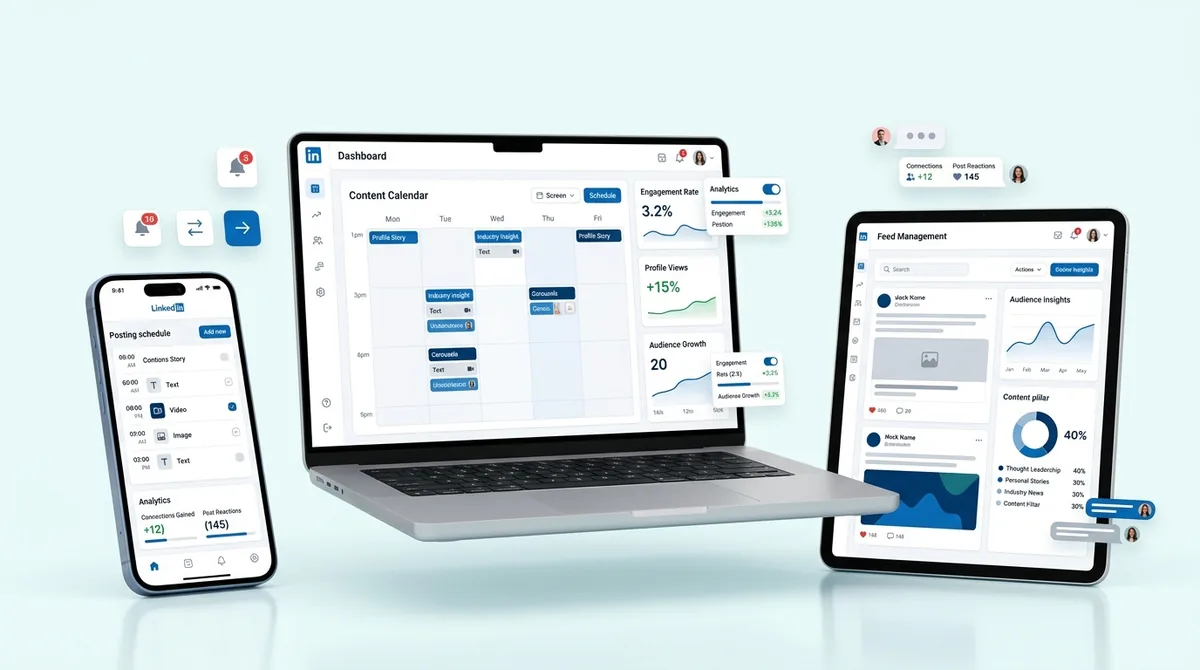
When you stay in writing mode for 60 minutes, your brain enters a flow state. The ideas connect faster. You can drop these drafts directly into a visual Content Calendar to see how your week flows at a glance.
Mapping Your Weekly Calendar
You don't need a complex matrix. A simple Monday-Wednesday-Friday framework is often the best approach when figuring out how often to post to maintain momentum.
Monday: Industry Insight (Authority)
Wednesday: Client Case Study (Authority/Proof)
Friday: Personal Reflection (Human)
That is three solid touchpoints. No weekend scrambling required.
Strategy 3: Mastering the Engagement Window
Posting is only 50% of the job. The other half happens in the "Golden Hour."
The LinkedIn algorithm measures early engagement velocity. The first 30 to 60 minutes after your post goes live dictate whether it gets pushed to a wider audience or dies quietly in the feed.
The '30-30' Rule for Visibility
Here is an actionable habit: Engage for 30 minutes before you post, and stick around for 30 minutes after.
Commenting thoughtfully on other creators' posts right before your own goes live creates a recency bias. Those creators see your comment, click your profile, and see your fresh post. Then, as comments roll in on your content, reply immediately. This signals to the algorithm that your post is sparking an active conversation.
Why Most LinkedIn Brands Stall (Common Mistakes)
Even with a solid linkedin personal brand posting schedule, you can kill your reach by ignoring the platform's unwritten rules. Here are the friction points to avoid.
Mistake 1: The 'Post and Ghost' Mentality
If you drop a post and immediately close the app, you are sabotaging yourself.
Accounts that fail to reply to comments within the first few hours get penalized. LinkedIn wants to keep users on the platform. If you aren't facilitating discussion, they won't distribute your content.
Mistake 2: Relying on External Links
LinkedIn hates it when you send traffic away from LinkedIn. It's a business reality confirmed by years of creator testing and hints from LinkedIn's official marketing blog.
Putting a link in the main body of your post can reduce your organic reach by up to 70%. If you must share a link, write a high-value text post and tell your audience the link is in the comments.
Mistake 3: Over-complicating Visuals
I see creators waste two hours in Canva building complex infographics that nobody reads.
A well-formatted, punchy text post will almost always outperform a messy graphic. If you want to share visual value, use a free LinkedIn Carousel Generator to quickly turn a text framework into a clean PDF slider. Carousels keep users swiping, which increases "dwell time"—a massive positive signal for the algorithm.
Before and After: From Chaos to System
Imagine two creators, Sarah and Mark.
Sarah uses a reactive "post when I feel inspired" approach. Some weeks she posts four times. Other weeks, silence. Her reach fluctuates wildly, and she constantly feels guilty about her inactive profile.
Mark uses a simple 3-post-per-week system. He batches his writing on Sunday mornings. His content alternates predictably between actionable advice and personal stories. Because his data stream is consistent, his impressions grow by 15% month over month. He spends less time on LinkedIn than Sarah, but gets five times the inbound leads.
The Consistency Bridge: Solving the Execution Gap
The real enemy of your personal brand isn't a lack of ideas.
It is the friction of the upload process. Behavioral science tells us that we skip tasks that feel heavy or interrupt our primary workflow. If you have a client emergency at 9 AM, you aren't going to stop and write a LinkedIn post.
The solution is disconnecting the act of writing from the act of publishing.
This is why having a dedicated LinkedIn Scheduler changes everything. It transforms posting from a daily anxiety-inducing chore into an automated background process. You write when you are inspired, you schedule the batch, and SocialCal handles the distribution. Your brand stays alive even when you are stuck in back-to-back meetings.
Your 5-Step LinkedIn Scheduling Checklist
Ready to build a system that actually sticks? Follow these steps.
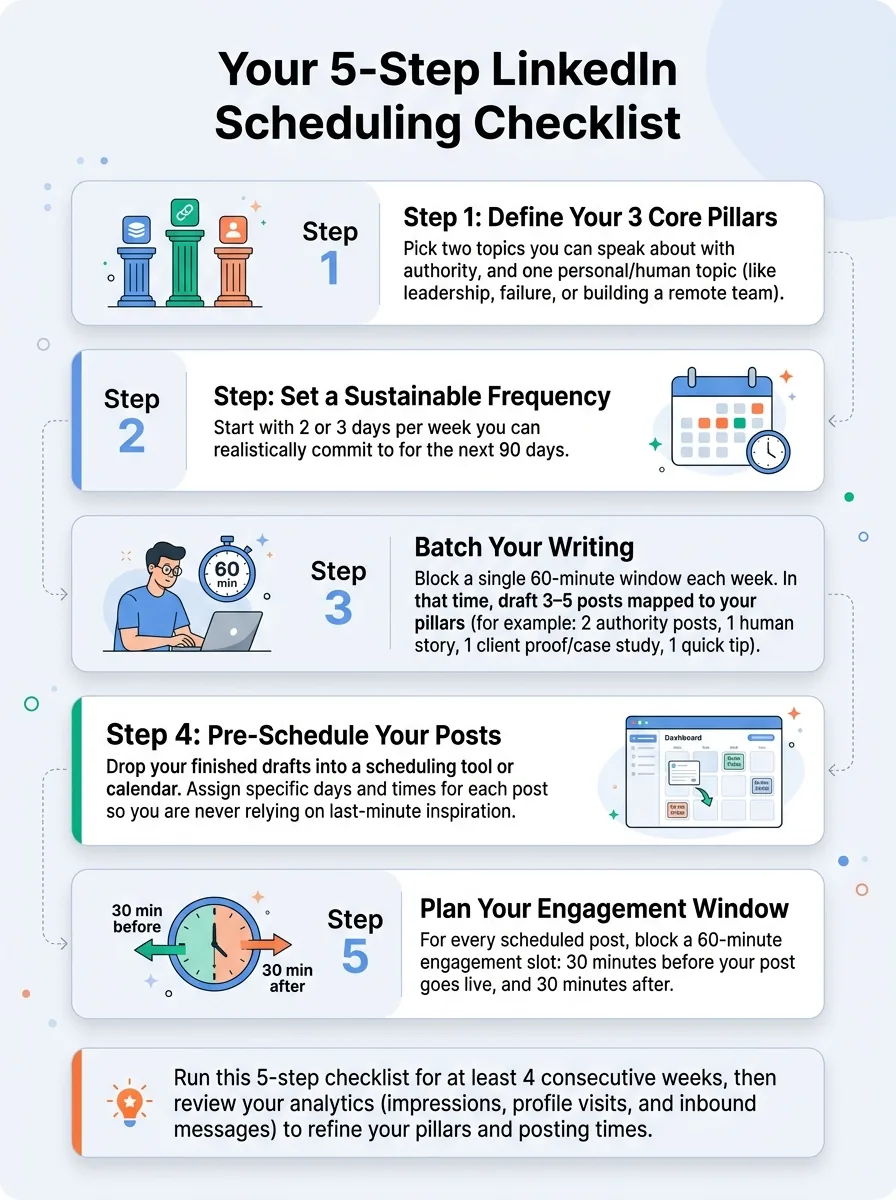
Step 1: Define Your 3 Core Pillars
Pick two topics you can speak about with authority, and one personal/human topic (like leadership, failure, or building a remote team).
Step 2: Set a Sustainable Frequency
Start with 2 or 3 days a week. It is infinitely better to succeed at 2 days a week than to fail at 5.
Step 3: Audit and Automate
Move your rough notes and drafts into a scheduling tool. Remove the "click to publish" anxiety from your daily routine entirely.
LinkedIn Strategy FAQ
What is the best time to post on LinkedIn?
While audiences vary, the general best time to post on LinkedIn is between 8 AM and 11 AM in your target audience's timezone, specifically on Tuesdays, Wednesdays, and Thursdays when professional engagement is highest.
How many times a week should I post for a personal brand?
Three to four times a week is the sweet spot. It provides enough volume to stay top-of-mind without causing creator burnout or overwhelming your audience.
Does scheduling posts hurt reach on LinkedIn?
No. The algorithm evaluates content based on engagement velocity and quality, not the publishing method. If you are wondering does scheduling posts hurt reach, rest assured that the consistency you gain from scheduling far outweighs any mythical algorithmic penalty.
Conclusion: Building a Brand Without the Burnout
A simple system you actually follow will always beat a perfect system you ignore.
Ready to save 15+ hours every week?
Join other creators who've automated their social media with SocialCal.
Get started freeStop trying to emulate the daily grind of full-time influencers. Focus on a realistic linkedin personal brand posting schedule that aligns with your actual workload. Batch your writing, respect the algorithm's need for consistency, and let a tool like SocialCal handle the daily publishing so you can focus on running your actual business.